Continuous Writing · Essay Guide
A Challenge
From ignoring good advice at trials, to watching her name miss the confirmed list, to earning her place back one early morning at a time. A complete guide to writing a CCA-selection FISREC essay.
① What Does This Title Need From Your Story?
“A Challenge” asks for one specific moment – not a list of hard things that have ever happened to you. Two things need to be true of that moment.
Challenge
Something that could plausibly have gone wrong. If success was never really in doubt, it was not a challenge – it was just a task.
The unstated word: Overcome
A challenge title is not satisfied by describing difficulty. Your story has to show the character rising to meet it, not just struggling through it.
The most important element: a choice that makes the challenge harder than it needed to be. The essay only works if some of the pressure comes from the character’s own decisions – not from bad luck alone.
② Match Your Story to Just One Picture Idea
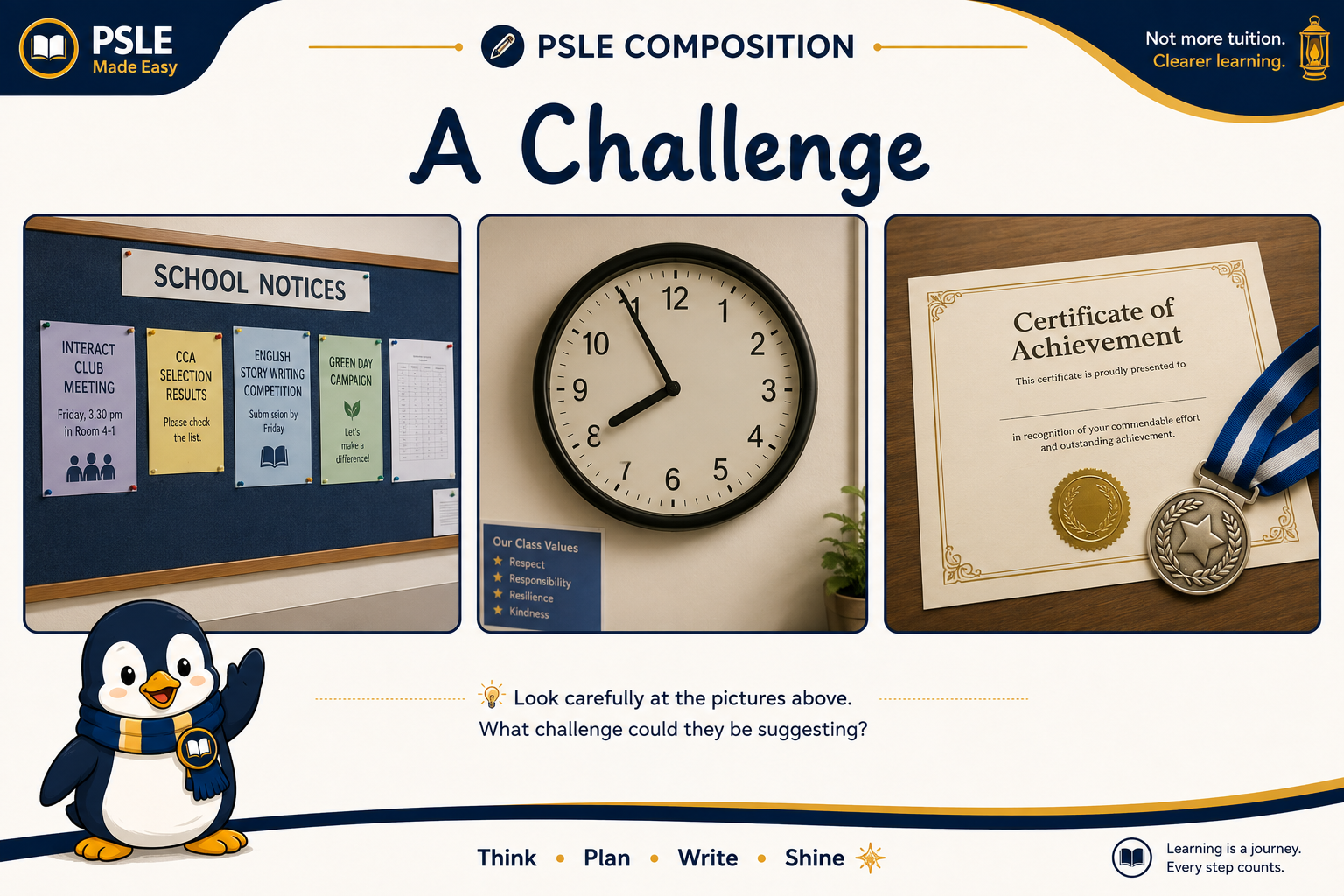
You only need to build your story around one of the picture ideas above – not all three – and the match does not need to be exact. The noticeboard usually works best as the backdrop of an ordinary school week, not as the challenge itself. Here is what each one could loosely mean:
- A noticeboard full of announcements → the ordinary backdrop of school life, or one specific notice that becomes your real challenge
- A clock → any stretch of time spent preparing or practising, not necessarily a deadline counting down
- A certificate and a medal → any form of recognition or proof of achievement, not necessarily first place
This guide picks one notice off the board – CCA Selection Results – and builds the whole challenge around it: a basketball trial gone wrong, and the training that earned a second chance. The clock stands for early practice mornings. The certificate closes the story as an actual award.
③ The Five Elements You Must Include
A strong essay has all five. The more you include, the stronger your story.
| Element | What It Means | Why It Matters |
|---|---|---|
| Wrong choice | During CCA basketball trials, Yves ignores her coach’s advice to work on her weak hand, confident her overall game is strong enough on its own. | Without this, missing the team would just be bad luck – not a choice she made. |
| Failure | Defenders trap her on her weak side in the final trial, and when the confirmed list goes up, her name is on the reserve list instead. | The cost has to come from what she chose to practise – not from the trial itself. |
| Why it matters | This is her third year trying out, and her last chance before leaving for secondary school. | Gives the challenge real stakes, not just one disappointing afternoon. |
| Reflection | Reading her name on the reserve list, she admits the one thing her coach warned her about is exactly what cost her. | Keeps Yves solving her own problem, not being rescued from it. |
| Doing the right thing | She asks Daryl to help drill her weak hand every morning, earns a second look, and is moved up to the confirmed team. | The success has to be earned through the asking-for-help moment – not luck. |
④ The Story in Short Phrases — FISREC Outline ▼
Meet Yves – trying out for the basketball team for the third year running. Meet Daryl – already on the team since Primary Four, and the first person she thinks to ask for help.
Flashback · Present moment
Yves in front of the noticeboard.
The confirmed list is up – her name is not on it.
Under RESERVES, her name sits second from the top.
The whole two weeks of trials flash through her mind, clear from the very beginning…
Introduction · Some weeks earlier
Trials open – Yves’s third year trying out.
Daryl already on the team since Primary Four.
Coach pulls Yves aside on day one: her left hand needs work.
Yves has always trusted her right hand – it has carried her this far.
Situation · Wrong choice
Yves keeps drilling what she is already good at.
Coach warns her again mid-trial – she brushes it off.
Final trial: defenders trap her on her weak side, twice.
The ball slips from her hands in front of the whole group.
Resolution · Failure, then help, then success
At the noticeboard, she stands still, thinking back to the warning.
She messages Daryl – asks for help with her left hand, every morning.
Two weeks of early drills at the court gate before school.
The coach gives reserves a second look – Yves moves up to the team.
Ending · Aftermath
Months later – year-end CCA presentation.
Yves’s name is called: a Certificate of Achievement, Most Improved Player.
Daryl claps the loudest of anyone in the hall.
Conclusion · Return + Lesson
Return: her mother’s voice up the stairs, then the smell of dinner drifting up too.
The certificate sits on her desk, her name printed clearly across it.
Lesson: being picked first had never mattered as much as she once thought – what mattered more was what she did after her name was missing.
⑤ Phrases to Guide Your Writing ▼
These phrases are taken directly from the suggested essay below, arranged in order.
F — Flashback
her name was not among them · her own name sat second from the top · the whole two weeks of trials flashed through her mind, clear from the very beginning…
I — Introduction
Daryl had made the team back in Primary Four and never left it · until now, it had carried her through every game
S — Situation
“that’s still your left hand costing you” · “I’ll be fine,” Yves told him · the ball slipped from her hands in front of the whole group trying out
R — Resolution
she did not move for a while · “can you help me with my left hand? Every morning, if that’s okay.” · until her left hand stopped feeling like a stranger’s · Yves was moved up to the confirmed team
E — Ending
Yves’s name was called for a Certificate of Achievement · Daryl clapped the loudest of anyone in the hall
C — Conclusion (Return + Lesson)
it pulled her back from that trial, now several months behind her · the certificate sat propped on her desk, her name printed clearly across it · what mattered more was what she did after her name was missing
Do not copy. Understand, then write.
⑥ Suggested Essay — Flashback Opening ▼
Written using FISREC. Highlighted phrases are the ones in your phrase bank above. Dialogue appears only at the moments that matter most – the coach’s warning, and the message to Daryl.
F — Flashback
Yves stood in front of the noticeboard. The confirmed team list was pinned above the reserve list. She read the eleven names twice. Her name was not among them. Below, under RESERVES, her own name sat second from the top. The whole two weeks of trials flashed through her mind, clear from the very beginning…
I — Introduction
Basketball trials were back – Yves’s third year trying out. Daryl had made the team back in Primary Four and never left it. On the first day of trials, the coach pulled Yves aside. “Your left hand needs work,” he said. “Defenders will find it if you don’t.” Yves relied on her right hand, and until now, it had carried her through every game.
S — Situation
Over the two weeks, Yves practised the drills she already knew well. She was confident her overall game would carry her through the last trial. Midway through a break on the final day, the coach found her again. “That’s still your left hand costing you,” he said. “I’ll be fine,” Yves told him. During the last trial, defenders forced her onto her left side twice, and both times, the ball slipped from her hands in front of the whole group trying out.
R — Resolution
Standing at the noticeboard, Yves did not move for a while. She thought back to the coach’s warning on the first day of trials, and to her own answer. That evening, she messaged Daryl. “Can you help me with my left hand? Every morning, if that’s okay.” Daryl agreed without hesitating. For two weeks, they met at the court gate before school, running the same drills over and over until her left hand stopped feeling like a stranger’s. When the coach called the reserves back for a second look, Yves was moved up to the confirmed team.
E — Ending
Months later, at the year-end CCA presentation, Yves’s name was called for a Certificate of Achievement, awarded for Most Improved Player. Daryl clapped the loudest of anyone in the hall.
C — Conclusion (Return + Lesson)
Her mother’s voice drifted up the stairs. “Yves, dinner’s ready!” A moment later, the smell of stir-fried noodles reached her room too. It pulled her back from that trial, now several months behind her. The certificate sat propped on her desk, her name printed clearly across it.
She thought about the eleven names on that first list, and about how her own name had been missing from it. Being picked first had never mattered as much as she once thought it did. What mattered more was what she did after her name was missing.
Six Moves That Make This Work
- The flashback is functional, not decorative. A name missing from the list in the opening becomes a certificate with her name on it in the conclusion – the same kind of object, reversed.
- The wrong choice is shown, not told. Yves dismisses the coach’s warning out loud, in her own words, rather than the story simply stating she was overconfident.
- The failure is dramatised, not stated. The ball slipping from her hands twice in front of the whole trial group is shown as it happens, not summarised afterward.
- Asking for help is the turning point, not an afterthought. The message to Daryl is the moment the whole essay pivots on.
- The conclusion returns before it reflects. Her mother’s voice, then the smell of dinner, pull Yves back to the present before the lesson is allowed to land.
- The lesson is a new thought, not a summary. “What mattered more was what she did after her name was missing” is an idea Yves arrives at – not a recap of the trials.
⑦ Suggested Essay — Question-Led Introduction ▼
Four Moves in the Opening Paragraph
- Hook Question – addresses the reader directly, using “you”.
- General Issue – widens out to “many people”, before narrowing to Yves.
- Emotional Anchor – two specific, opposing feelings, looking back.
- Story Starter – one sentence, ending in an ellipsis (…).
Opening — replaces F
Have you ever ignored good advice because you were sure your own way was good enough? Many people brush off a warning that turns out to matter later, especially when they already feel confident in what they know. Looking back, Yves feels both embarrassed that a warning she ignored came true exactly as predicted, and proud of what it took to fix it. This is what happened the year a missing name on a list changed how hard she was willing to work…
I — Introduction
Basketball trials were back – Yves’s third year trying out. Daryl had made the team back in Primary Four and never left it. On the first day of trials, the coach pulled Yves aside. “Your left hand needs work,” he said. “Defenders will find it if you don’t.” Yves relied on her right hand, and until now, it had carried her through every game.
S — Situation
Over the two weeks, Yves practised the drills she already knew well. She was confident her overall game would carry her through the last trial. Midway through a break on the final day, the coach found her again. “That’s still your left hand costing you,” he said. “I’ll be fine,” Yves told him. During the last trial, defenders forced her onto her left side twice, and both times, the ball slipped from her hands in front of the whole group trying out.
R — Resolution
Standing at the noticeboard, Yves did not move for a while. She thought back to the coach’s warning on the first day of trials, and to her own answer. That evening, she messaged Daryl. “Can you help me with my left hand? Every morning, if that’s okay.” Daryl agreed without hesitating. For two weeks, they met at the court gate before school, running the same drills over and over until her left hand stopped feeling like a stranger’s. When the coach called the reserves back for a second look, Yves was moved up to the confirmed team.
E — Ending
Months later, at the year-end CCA presentation, Yves’s name was called for a Certificate of Achievement, awarded for Most Improved Player. Daryl clapped the loudest of anyone in the hall.
C — Conclusion (Return + Lesson)
Her mother’s voice drifted up the stairs. “Yves, dinner’s ready!” A moment later, the smell of stir-fried noodles reached her room too. It pulled her back from that trial, now several months behind her. The certificate sat propped on her desk, her name printed clearly across it.
She thought about the eleven names on that first list, and about how her own name had been missing from it. Being picked first had never mattered as much as she once thought it did. What mattered more was what she did after her name was missing.
What’s Different From the Flashback Version
- The opening replaces the in-scene flashback with a direct address to the reader – no noticeboard, no lists, just the question itself.
- The general issue sentence widens the story before narrowing back into Yves’s specific trial.
- The emotional anchor names two feelings at once – embarrassment and pride – rather than one tidy takeaway.
- The story starter’s ellipsis creates the same forward pull the flashback image did, without needing a physical scene to do it.
“A challenge is rarely lost the moment your name is missing from a list. It is lost only if that is where the story ends.”