P
PSLE Made Easy
Clearer Systems. Better Revision. More Purposeful Practice.
PAPER 1 • PICTURE COMPOSITION • P4

A Kind Deed

From three pictures to one clear story

Follow the pictures in order, develop each important moment and show clearly why the boy’s action was kind.
The idea in one line

Find the wallet → make the right choice → return it safely → show the owner’s gratitude.

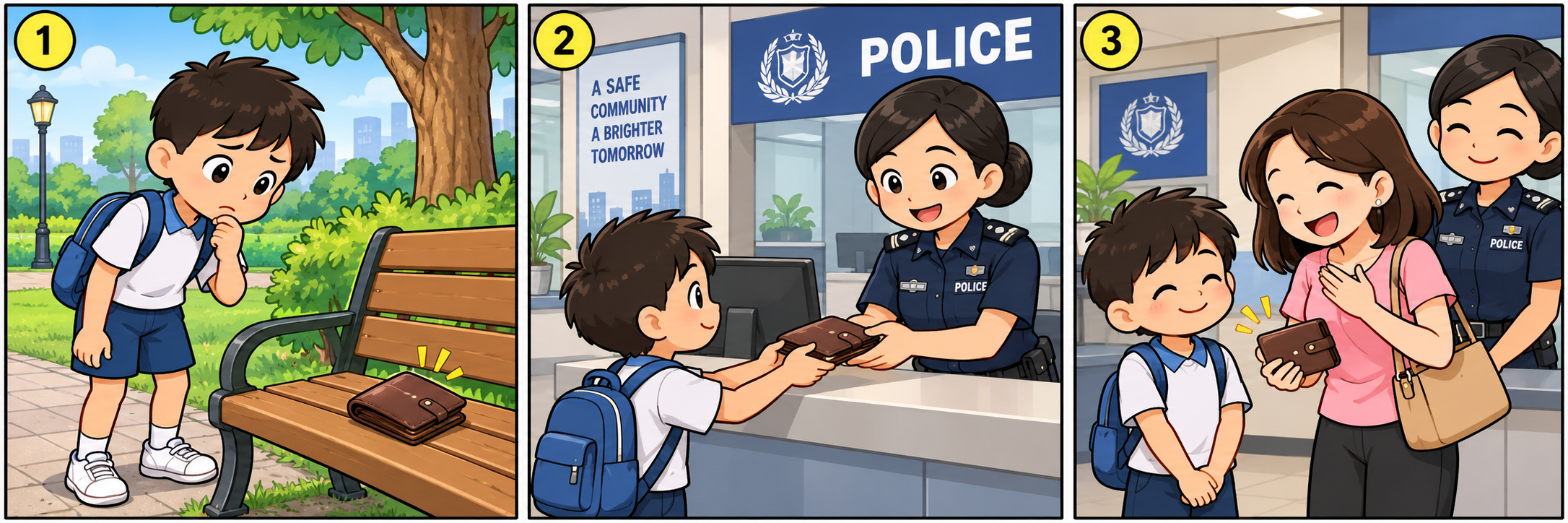
For a linear picture composition, the pictures already give you the main sequence. Your job is not to invent a completely different story. Your job is to connect the pictures smoothly and develop what happens between them.

For this story, the title is A Kind Deed. The kind deed must stay central: the boy finds a wallet, chooses not to keep it and makes sure it is returned to its owner.

Parent Note

At P4 level, clarity matters more than difficult vocabulary. Encourage your child to build each picture into a complete scene: what happened, what the character thought or felt, what the character did, and what happened next.

Student Note

“Do not rush from Picture 1 to Picture 2. Slow down at the important moments and let the reader see your character making the right choice.”

1. Read the Three Pictures as One Story

Picture 1 — The problem begins

A boy notices a wallet left on a park bench. Nobody seems to be nearby. He must decide what to do.

Picture 2 — He acts

The boy takes the wallet to a police post and hands it to a policewoman.

Picture 3 — The problem is solved

The owner gets her wallet back and thanks the boy. His kind and honest choice has helped her.

2. Plan It in Three Clear Parts

Story Flow

Find → Think → Decide → Hand in → Reunite → Reflect

Beginning

  • Where was the boy?
  • How did he notice the wallet?
  • Was anyone nearby?

Middle

  • What did he think about?
  • Why did he decide to go to the police?
  • What did he tell the policewoman?

Ending

  • How did the owner react?
  • How did the boy respond?
  • What did he learn from the experience?
3. Useful P4 Language

Use clear vocabulary that helps the reader picture the action. You do not need difficult words in every sentence.

Purpose Useful language
Noticingsomething caught his eye · he stopped in his tracks · he noticed a wallet
Thinkinghe wondered what to do · he knew the owner would be worried · he made up his mind
Worryworried-looking · anxiously · breathing heavily
Reliefher face lit up · sighed with relief · smiled gratefully
Reflectionfelt warm inside · realised that · was glad that

PME Penguin Reminder

“The pictures give you the events. Your writing must give the events thoughts, feelings, dialogue and clear connections.”

4. Model Essay — A Kind Deed

This is not a script to memorise. It shows how a simple P4 story can be fully developed while still following the three pictures closely.

A Kind Deed

It was a bright Saturday afternoon. Ben was walking home from the library when he decided to take a shortcut through the neighbourhood park. As he passed a wooden bench, something brown caught his eye.

Ben stopped. A wallet was lying on the bench.

He looked around, but there was no one nearby. For a moment, he wondered what he should do. He picked up the wallet and opened it carefully. Inside were several notes, some cards and an identification card. Ben quickly closed it again. He knew that the owner would be worried.

“What if I lost my wallet?” he thought.

Ben decided that the safest thing to do was to hand it to the police. He walked to the nearby police post and approached the counter. A policewoman smiled at him.

“Good afternoon. How can I help you?” she asked.

“I found this wallet on a bench in the park,” Ben explained as he handed it to her. “I waited for a while, but no one came back for it.”

The policewoman thanked Ben and took down a few details. She told him that he had done the right thing. Ben felt relieved. He was glad that the wallet was now in safe hands.

Just as Ben was about to leave, a worried-looking lady hurried into the police post. She was breathing heavily and kept searching through her handbag.

“I think I lost my wallet in the park,” she said anxiously.

The policewoman checked the details and showed her the wallet. The lady’s face immediately lit up.

“Yes! That’s mine!” she exclaimed.

When she learnt that Ben had found it, she turned to him with a grateful smile.

“Thank you so much,” she said. “There are important cards inside. I was so worried.”

Ben smiled shyly. “You’re welcome. I’m just glad you got it back.”

The lady thanked him again before leaving. As Ben walked home, he felt warm inside. He had not done anything difficult, but his small act of honesty had helped someone greatly. Ben realised that a kind deed could be as simple as choosing to do the right thing.

Model length: about 355 words

5. Look Closer — Why the Model Works

It follows all three pictures.

The story does not wander away from the given sequence. Each picture becomes an important stage of the plot.

The boy makes a clear choice.

His thought — “What if I lost my wallet?” — shows why he decides to hand it to the police.

Dialogue moves the story forward.

The characters speak at important moments instead of having long conversations that do not add to the story.

The ending returns to the title.

The final reflection explains why returning the wallet was a kind deed without sounding like a long lecture.

6. Common Mistakes

✗ Rushes the pictures

Ben found a wallet. He went to the police station. The owner thanked him.

✓ Develops the important moments

Show Ben noticing the wallet, thinking about the owner, deciding what to do and explaining the situation to the policewoman.

✗ Adds an unnecessary villain

A thief suddenly appears and chases Ben through the park.

✓ Keeps the conflict simple

The real problem is already enough: Ben has found something valuable that belongs to someone else.

7. Try It Yourself

Before writing, answer these six questions in short notes:

  1. Why was the boy in the park?
  2. How did he notice the wallet?
  3. What made him decide to hand it to the police?
  4. What did he say at the counter?
  5. How did the owner show her relief and gratitude?
  6. What did the boy realise at the end?
8. Final Checklist
  • Did I use all three pictures in the correct order?
  • Is the kind deed clearly the main event?
  • Did I show what the boy thought before he acted?
  • Did I develop the police-station scene instead of rushing it?
  • Did I show the owner’s relief and gratitude?
  • Did I check my tenses, punctuation, spelling and paragraphing?

Remember

“The pictures give you the path. Your details make it a story.”

PSLE Made Easy · Not more tuition. Clearer learning.