Continuous Writing · Essay Guide
An Unexpected Apology
From a public accusation to a quiet apology no one saw coming. A complete guide to writing an unexpected-apology FISREC essay.
What Does This Title Need From Your Story?
“Unexpected” is not a word you can define your way into a story. It is a condition your plot has to satisfy. Before you write a single word, decide which of these three levers your apology will pull.
WHO apologises
Not the obvious person. The strongest version is someone the reader assumes will stay angry — or has no reason to say sorry at all.
WHY they apologise
Not for the exact wrong the accusation named. A smaller mistake is hiding underneath the big one — often silence, not the crime itself.
WHEN it happens
Right when the reader — and the character — expects anger, silence, or nothing at all.
This guide uses two levers: WHO — the wrongly accused friend apologises first. WHY — not for a theft he never committed, but for staying quiet instead of explaining sooner. Two levers are enough. You do not need all three.
Match Your Story to Just One Picture Idea
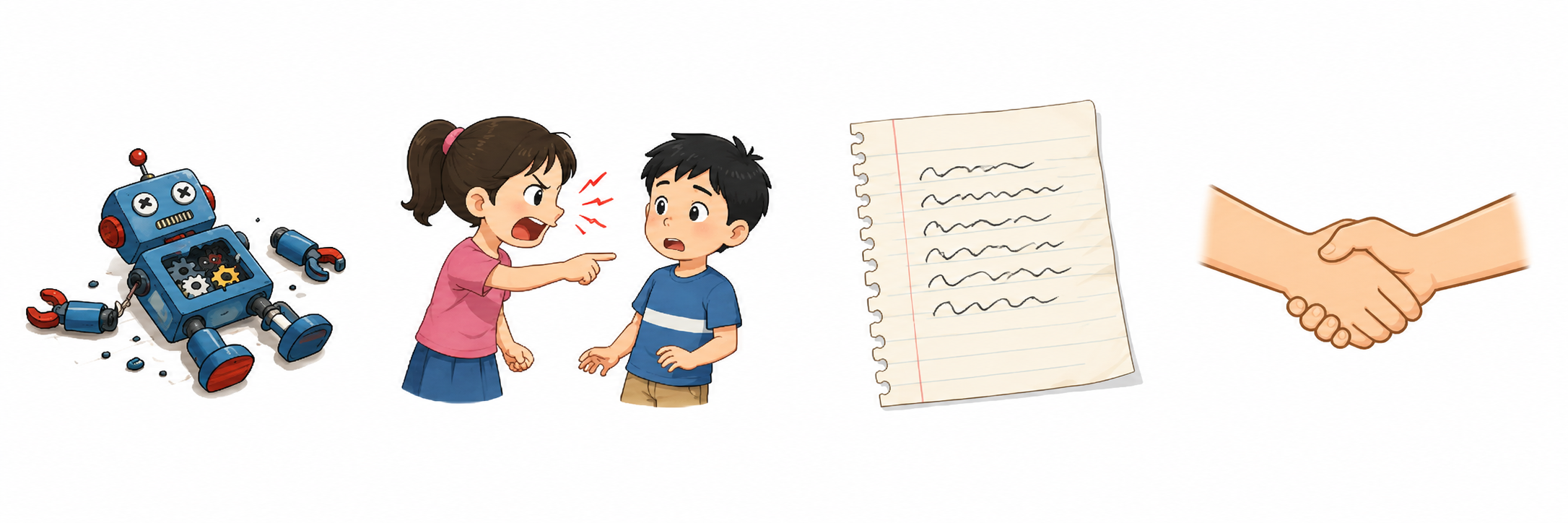
You only need to build your story around one of the picture ideas above — not all of them — and the match does not need to be exact. Here is what each one could loosely mean:
- A broken toy → any broken or lost item
- A girl yelling at a boy → any argument, or someone upset with another
- A handshake → any reconciliation, in whatever form it takes
- A written note → reflection, a note, or a letter
This guide uses the broken item loosely (a bracelet’s faulty clasp), the argument loosely (a public accusation, not literal shouting), and closes with an actual handshake. The written note becomes Yves’s private reflection rather than a physical note.
The Five Elements You Must Include
A strong essay has all five. The more you include, the stronger your story.
| Element | What It Means | Why It Matters |
|---|---|---|
| Wrong choice | Yves accuses Daryl publicly, based on assumption, without asking first. | Without this, there is no fall to redeem. |
| Failure | Classmates whisper and stare. Daryl goes red and says nothing in his own defence. | The cost has to be visible and public, not just private embarrassment. |
| Why it matters | The bracelet was a gift from her grandmother, before she moved overseas. | Gives the accusation real weight, not pettiness. |
| Reflection | Doubt creeps in before Daryl even speaks — a small memory that does not fit the story she told herself. | Keeps Yves active in her own change, not just shamed into it. |
| Doing the right thing | Once Daryl explains and apologises first, Yves owns her mistake out loud, unprompted. | The apology has to be hers, earned, not a copy of his. |
④ The Story in Short Phrases — FISREC Outline ▼
Meet Yves. She is quick to trust — and just as quick to judge when that trust feels broken. Meet Daryl — steady, a little quiet, the kind of friend who fixes things instead of announcing them.
back
Present moment
Yves stands in front of the class.
The small velvet pouch, empty, in her open palm.
The classroom goes completely silent.
The words are already out — she cannot take them back.
Characters, setting — some years earlier
The bracelet — a gift from her grandmother, before the move to Perth.
The clasp does not close properly; Yves has been meaning to get it fixed.
Yves and Daryl — friends since Primary Three, a trust that never needed explaining.
ation
Wrong choice
Bracelet gone from her bag during library period.
She remembers Daryl's fingers closing around something small that morning — she never turned to look.
She does not stop to ask, does not wait.
In front of the whole class: “You went through my bag, didn’t you?”
ution
Failure, then reflection + apology
Classmates whisper. Daryl's ears turn red. He says nothing in his own defence.
Daryl finally speaks — pulls the bracelet from his pocket, clasp still loose.
Yves is no longer sure she is right — she remembers his hand at her wrist, not her bag.
Daryl apologises first — not for taking it, for staying quiet instead of explaining.
Yves apologises back — for accusing first and never asking.
ing
Aftermath
Neither knows what to say.
Daryl holds out his hand.
Yves shakes it — embarrassed and relieved at the same time.
clusion
Conclusion (Return + Lesson)
Return: her mother's voice up the stairs, then the smell of dinner drifting up.
The pouch sits on her desk, bracelet safe inside, clasp freshly mended.
Lesson: the empty pouch had once felt like proof — now it is just a memory.
An apology means far more before you are proven wrong than after. Hers came after.
⑤ Phrases to Guide Your Writing ▼
These phrases are taken directly from the suggested essay below, in the order they appear.
the small velvet pouch was empty in her open palm · the words were already out · she could not take them back · the whole morning flashed through her mind, clear from the very beginning…
the clasp did not close properly, and Yves had been meaning to get it fixed · they trusted each other so much that they never had to explain it
his fingers had closed around something small · she did not stop to ask, she did not wait · “You went through my bag, didn’t you?”
Daryl's ears turned red · he stood there and said nothing at all · Yves was no longer sure she was right · she had not expected an apology like this · Daryl had done nothing wrong, yet he was the one saying sorry
he held out his hand before she could find the right words · she felt embarrassed and relieved at the same time
that morning, the empty pouch had felt like proof · now it was just the memory of a question she had never asked · it seemed the wrong way round · an apology means far more before you are proven wrong than after
These phrases belong to the suggested essay. Understand why each one works, then write your own version. Do not copy. Understand, then write.
⑥ Suggested Essay — Flashback Opening ▼
Written using FISREC. Highlighted phrases are the ones in your phrase bank above.
Dialogue appears only at the most important moments — the accusation, and the two apologies.
F — Flashback
Yves stood in front of the class. The small velvet pouch was empty in her open palm. The classroom went completely silent. Everyone had heard what she said, and no one said a word. Daryl's face changed the moment she said it. She would remember that look for a long time. The words were already out. She could not take them back. The whole morning flashed through her mind, clear from the very beginning…
I — Introduction
The bracelet was a gift from her grandmother. She had given it to Yves three years ago, the week before she moved to Perth. It was thin and gold-plated. The clasp did not close properly, and Yves had been meaning to get it fixed. She and Daryl had been friends since Primary Three. They trusted each other so much that they never had to explain it. Yves would leave her bag open on her desk and not think twice about who was nearby.
S — Situation
During library period, Yves reached into her bag for the pouch. It was flat and empty. Her stomach dropped. She thought back to something she had hardly noticed at the time. That morning, Daryl had reached towards her as she stood up from her desk. His fingers had closed around something small. She had not turned around to see what it was. She did not stop to ask. She did not wait. The librarian had not looked up yet. In front of the whole class, she said it louder than she meant to, “You went through my bag, didn’t you?”
R — Resolution
For a moment, nobody moved. Then a few classmates began to whisper. They turned to look at Daryl. Some stared at him without looking away. Daryl's ears turned red. He did not argue back. He did not look up. He stood there and said nothing at all.
After a long silence, Daryl finally moved. He reached into his pocket and took out the bracelet. Its clasp was still hanging loose. “It caught on your sleeve when you stood up,” he said quietly. “I saw it slipping off and grabbed it before it hit the floor. I was going to give it back after class and explain.” Yves was no longer sure she was right. She remembered the same moment again, more clearly this time. His hand had closed around her wrist, not her bag, before she walked away. Daryl looked at the pouch, not at her. “I should have said something the instant it happened,” he said. “I'm sorry I stayed quiet instead of telling you the truth. I should have spoken up.” She had not expected an apology like this. Daryl had done nothing wrong, yet he was the one saying sorry.
Yves stood there for a moment. She had not expected his words to affect her so much. “No,” she said at last, quieter than before. “I'm sorry. I accused you in front of everyone before I even thought to ask.” She had accused him first, and never asked.
E — Ending
Neither of them quite knew what to say after that. He held out his hand before she could find the right words. It was a small, slightly awkward gesture. Yves shook it. She felt embarrassed and relieved at the same time.
C — Conclusion (Return + Lesson)
That evening, her mother called up the stairs, “Yves, dinner!” A moment later, the smell of dinner drifted up too. It pulled her back from the memory. The small pouch sat on her desk. The bracelet was safe inside it now. Its clasp had been mended by her mother earlier that evening. That morning, the empty pouch had felt like proof. Now it was just the memory of a question she had never asked.
But the sight unsettled her more than it should have. She thought about how easily the accusation had left her mouth that morning. She thought about how much longer it had taken Daryl to say sorry. Now that she could see it clearly, it seemed the wrong way round. An apology means far more before you are proven wrong than after. Hers had come after.
Six Moves That Make This Work
1. The flashback is functional, not decorative. The empty pouch in the opening is the same pouch that appears, full, in the conclusion.
2. The wrong choice is shown, not told. Yves does not ask, does not wait, and accuses in one unbroken moment.
3. The failure is dramatised, not just stated. Classmates whisper. Daryl goes red and says nothing in his own defence — a public, visible cost, not private embarrassment.
4. The reveal is planted, not sudden. Daryl's fingers “closing around something small” in S is ambiguous enough to read as guilt — until R shows the reader what it actually was.
5. The conclusion returns before it reflects. Mum's voice, then the smell of dinner, pull Yves back to the present before the lesson is allowed to land.
6. The lesson is a new thought, not a summary. “An apology means far more before you are proven wrong than after” is an idea Yves arrives at — not a recap of what happened.
⑦ Suggested Essay — Question-Led Introduction ▼
Four Moves in the Opening Paragraph
1. Hook Question — addresses the reader directly, using “you”.
2. General Issue — widens out to “many people”, before narrowing to Yves.
3. Emotional Anchor — two specific, opposing feelings, looking back.
4. Story Starter — one sentence, ending in an ellipsis (…).
Opening — replaces F
Have you ever been so sure you were right that you never stopped to ask if you might be wrong? Many people mistake speed for certainty — deciding who is at fault before they have actually checked. Looking back, Yves feels both ashamed of how quickly she turned on a friend, and unsettled by how easily she could have been wrong about someone else too. This is what happened the day her certainty turned out to be nothing more than a guess…
I — Introduction
The bracelet was a gift from her grandmother. She had given it to Yves three years ago, the week before she moved to Perth. It was thin and gold-plated. The clasp did not close properly, and Yves had been meaning to get it fixed. She and Daryl had been friends since Primary Three. They trusted each other so much that they never had to explain it. Yves would leave her bag open on her desk and not think twice about who was nearby.
S — Situation
During library period, Yves reached into her bag for the pouch. It was flat and empty. Her stomach dropped. She thought back to something she had hardly noticed at the time. That morning, Daryl had reached towards her as she stood up from her desk. His fingers had closed around something small. She had not turned around to see what it was. She did not stop to ask. She did not wait. The librarian had not looked up yet. In front of the whole class, she said it louder than she meant to, “You went through my bag, didn’t you?”
R — Resolution
For a moment, nobody moved. Then a few classmates began to whisper. They turned to look at Daryl. Some stared at him without looking away. Daryl's ears turned red. He did not argue back. He did not look up. He stood there and said nothing at all.
After a long silence, Daryl finally moved. He reached into his pocket and took out the bracelet. Its clasp was still hanging loose. “It caught on your sleeve when you stood up,” he said quietly. “I saw it slipping off and grabbed it before it hit the floor. I was going to give it back after class and explain.” Yves was no longer sure she was right. She remembered the same moment again, more clearly this time. His hand had closed around her wrist, not her bag, before she walked away. Daryl looked at the pouch, not at her. “I should have said something the instant it happened,” he said. “I'm sorry I stayed quiet instead of telling you the truth. I should have spoken up.” She had not expected an apology like this. Daryl had done nothing wrong, yet he was the one saying sorry.
Yves stood there for a moment. She had not expected his words to affect her so much. “No,” she said at last, quieter than before. “I'm sorry. I accused you in front of everyone before I even thought to ask.” She had accused him first, and never asked.
E — Ending
Neither of them quite knew what to say after that. He held out his hand before she could find the right words. It was a small, slightly awkward gesture. Yves shook it. She felt embarrassed and relieved at the same time.
C — Conclusion (Return + Lesson)
That evening, her mother called up the stairs, “Yves, dinner!” A moment later, the smell of dinner drifted up too. It pulled her back from the memory. The small pouch sat on her desk. The bracelet was safe inside it now. Its clasp had been mended by her mother earlier that evening. That morning, the empty pouch had felt like proof. Now it was just the memory of a question she had never asked.
But the sight unsettled her more than it should have. She thought about how easily the accusation had left her mouth that morning. She thought about how much longer it had taken Daryl to say sorry. Now that she could see it clearly, it seemed the wrong way round. An apology means far more before you are proven wrong than after. Hers had come after.
What’s Different From the Flashback Version
1. The opening replaces the in-scene flashback with a direct address to the reader — no scene-setting image, just the question itself.
2. The general issue sentence widens the story before narrowing back into Yves’s specific version of it.
3. The emotional anchor names two feelings at once — shame and unease — rather than one tidy takeaway.
4. The story starter’s ellipsis creates the same forward pull the flashback image did, without needing a physical scene to do it.
“The best unexpected apology is not a surprise for the reader alone. It has to be a surprise your character earns the right to give.”
Back to Essay Guides | Home | Sitemap
PSLE Made Easy · John C. · Not more tuition. Clearer learning.