 PSLE Oral Scenario
Celebrating Hari Raya Together
Theme: Racial Harmony & Cultural Understanding · Values: Respect, Friendship, Inclusiveness
Parent Note
Students often know the right words to use for racial harmony — respect, understanding, friendship — but strong oral responses need more than a list of values. Encourage your child to notice how people are actually treating one another in the picture and what that reveals about their relationship.
For the personal question, ask your child to recall one real festival they celebrated. The festival can be their own or one they experienced with others. What matters is the specific experience, what they noticed, and what they learnt from it.
Student Note
“Do not just say that everyone looks happy. Look at how they are greeting, talking, sharing food and welcoming one another. Then explain what those actions show about their relationship.”
① Read the Picture First ▼
Before answering, spend a few seconds reading the relationships in the picture. Do not stop at “people are celebrating Hari Raya”. Look at who is welcoming whom, who is talking together, and how comfortable the guests appear.
What you can see
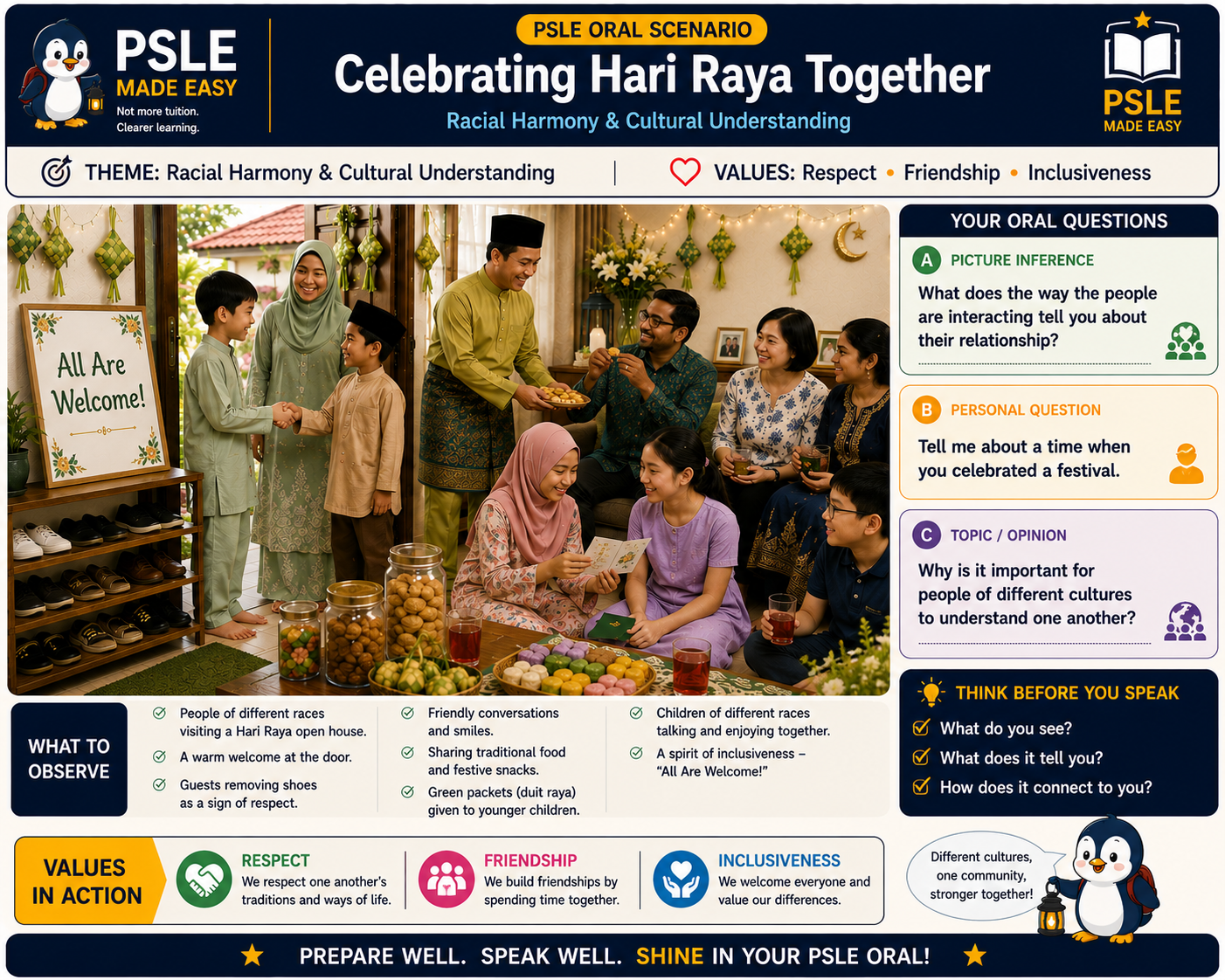
A Malay family is hosting a Hari Raya gathering at home. Guests from different backgrounds are being welcomed at the door, offered festive food and included in conversations.
Some of the children are talking closely with one another, while the adults are also chatting comfortably. The guests have removed their shoes before entering, which shows respect for the home.
A sign saying “All Are Welcome!” reinforces the welcoming mood, while traditional decorations, festive snacks and green packets show that the visitors are being included in the celebration rather than simply observing it from a distance.
What to notice for Q(a): This is a Relationship-type question. Name the people involved, describe how they are interacting, then explain what that interaction suggests about the relationship between hosts and guests.
② Q(a) — Relationship Type ▼
The Question
“What does the way the people are interacting tell you about their relationship?”
A strong answer does not just say that the people are friendly. Show the relationship through visible actions, then explain what those actions suggest about trust, comfort, respect or closeness.
Picture evidence you can use
- The hosts are greeting the guests warmly at the door — this suggests the visitors are genuinely welcomed, not merely invited out of politeness.
- The children from different backgrounds are talking comfortably together — this suggests familiarity and friendship rather than awkwardness.
- The family is sharing festive food with the guests — this shows generosity and a willingness to include others in an important family celebration.
- The guests have removed their shoes before entering — this shows that respect works both ways: the hosts welcome the guests, and the guests respect the household.
What a weak answer sounds like
“I think they have a good relationship because they are all smiling and celebrating together.”
The idea is relevant, but it relies on one general observation and does not explain the interaction between the people.
What a stronger answer sounds like
“I think the hosts and guests have a warm and respectful relationship. The family is welcoming the visitors at the door and sharing festive food with them, while the children from different backgrounds are talking comfortably together. The guests have also removed their shoes before entering, which shows that they respect the family’s home and customs. This makes the gathering feel more like friends and neighbours celebrating together than people who are simply visiting out of obligation. I think that kind of comfort only develops when people are willing to understand and respect one another.”
Why this works: It names both sides of the relationship, uses several visible interactions as evidence, and connects those interactions to respect and cultural understanding.
Going Beyond — add this
“I also think the relationship is strong because the guests are not just watching the celebration — they are being included in it. That can make people feel that another culture is something they can appreciate and share, rather than something unfamiliar to them.”
③ Q(b) — Personal Question ▼
The Question
“Tell me about a time when you celebrated a festival.”
Choose one real festival experience. The strongest answers are specific: where you were, who you were with, what happened, and what you learnt or appreciated from the experience.
Experiences you could draw on
- Celebrating Hari Raya, Chinese New Year, Deepavali or another festival with family.
- Visiting a friend or neighbour during a festive open house.
- Taking part in a school celebration or cultural activity.
- Trying traditional food, learning a custom or joining a festive activity for the first time.
- Helping to prepare the home, food or decorations for a festival.
What a weak answer sounds like
“I celebrated Chinese New Year with my family. We ate food and visited relatives. It was fun.”
The experience is real, but it is too general. Almost any student could give the same answer.
What a stronger answer sounds like
“Last year, I celebrated Chinese New Year at my grandmother’s home with my extended family. What I remember most was helping her prepare the table before everyone arrived. I used to think the celebration was mainly about food and receiving red packets, but while helping her, I realised how much work went into bringing the whole family together. Later, my younger cousins and I served tea to the older relatives, and my grandmother explained why showing respect to elders is an important part of the celebration. That made the festival feel more meaningful to me than it had before.”
Why this works: It is specific, includes a real moment, and shows a change in understanding rather than simply describing what happened.
Going Beyond — add this
“That experience made me realise that festivals are not only about enjoying traditions. They are also one of the ways families pass their values and memories from one generation to the next.”
④ Q(c) — Broader Opinion ▼
The Question
“Why is it important for people of different cultures to understand one another?”
Avoid stopping at “so everyone can live peacefully”. Explain how understanding another culture changes the way people behave towards one another and why that matters in a diverse society.
What a weak answer sounds like
“It is important because people from different cultures should respect one another and live in harmony.”
The values are correct, but the answer does not explain how understanding leads to respect or harmony.
What a stronger answer sounds like
“I think it is important because people are less likely to judge something when they understand why it matters to someone else. A custom may seem strange if we only see it from the outside, but once someone explains the meaning behind it, we are more likely to respect it. In Singapore, people from different cultures live, study and work closely together, so misunderstandings can affect everyday relationships. Celebrations like the one in this picture can help because people are learning through real interaction, not just from a textbook. When people understand one another better, differences become less threatening and more interesting.”
Why this works: It explains cause and effect, connects the idea to Singapore’s multicultural setting, and goes beyond the festival itself.
Going Beyond — add this
“I also think understanding another culture does not mean we have to practise every tradition ourselves. It simply means we know enough to treat that tradition — and the people who value it — with respect.”
⑤ Going Beyond Yourself — for This Topic ▼
Racial harmony can easily become a topic where everyone gives the same “correct” answer. The way to make your response stronger is to show what cultural understanding actually changes in the way people think or behave.
After giving your answer, ask yourself: What does this mean beyond this one celebration?
How my thinking has changed
Ask: “What did I used to assume about another festival or custom?”
“I used to think learning about another festival was mostly about remembering the food and decorations. Now I realise that understanding why people celebrate it tells me much more about what they value.”
Seeing the other person’s point of view
Ask: “How might it feel when others take a genuine interest in something important to you?”
“If someone asked me respectfully about a tradition that mattered to my family, I would probably feel that they were interested in understanding me, not just being polite.”
What this makes me want to do
Ask: “How can I become more open to people who are different from me?”
“It makes me want to ask more questions when I do not understand a custom instead of making assumptions about it.”
⑥ Values to Anchor Your Answers To ▼
Respect, Friendship and Inclusiveness each give your answer a different direction beyond simply saying that racial harmony is important.
🤝 Respect
Respect means being willing to understand that another person’s customs and traditions may be different from yours but still deeply meaningful to them.
Anchor line: “You do not need to share someone’s tradition to treat it with respect.”
🧑🤝🧑 Friendship
Friendship grows when people are curious about one another, spend time together and are comfortable enough to ask and explain.
Anchor line: “Understanding grows when people stop observing one another from a distance and start sharing experiences.”
🌏 Inclusiveness
Inclusiveness means making people feel welcome even when they come from a different background or may not know every custom.
Anchor line: “A welcoming community does not expect everyone to be the same before they can belong.”
“Do not just say that people should respect different cultures. Show what respect looks like, explain why understanding matters, and connect it to a real experience of your own.”