Community Food Donation Drive
Theme: Helping Others & Community · Values: Kindness, Empathy, Responsibility, Community Spirit
Parent Note
Volunteering is a topic that tempts children into saying what sounds virtuous — "helping others makes me happy" — without any real substance behind it. What earns marks is a child who can describe an actual volunteering moment, including the parts that weren't entirely comfortable.
Ask your child to recall a specific instance of volunteering or helping someone — a school CIP activity, helping a neighbour, or a family gesture — rather than a general statement about kindness.
Student Note
“The examiner has heard 'helping others makes me happy' a hundred times today. What they have not heard is what actually happened when you volunteered — who you helped, what was hard about it, and why you kept going.”
① Read the Picture First ▼
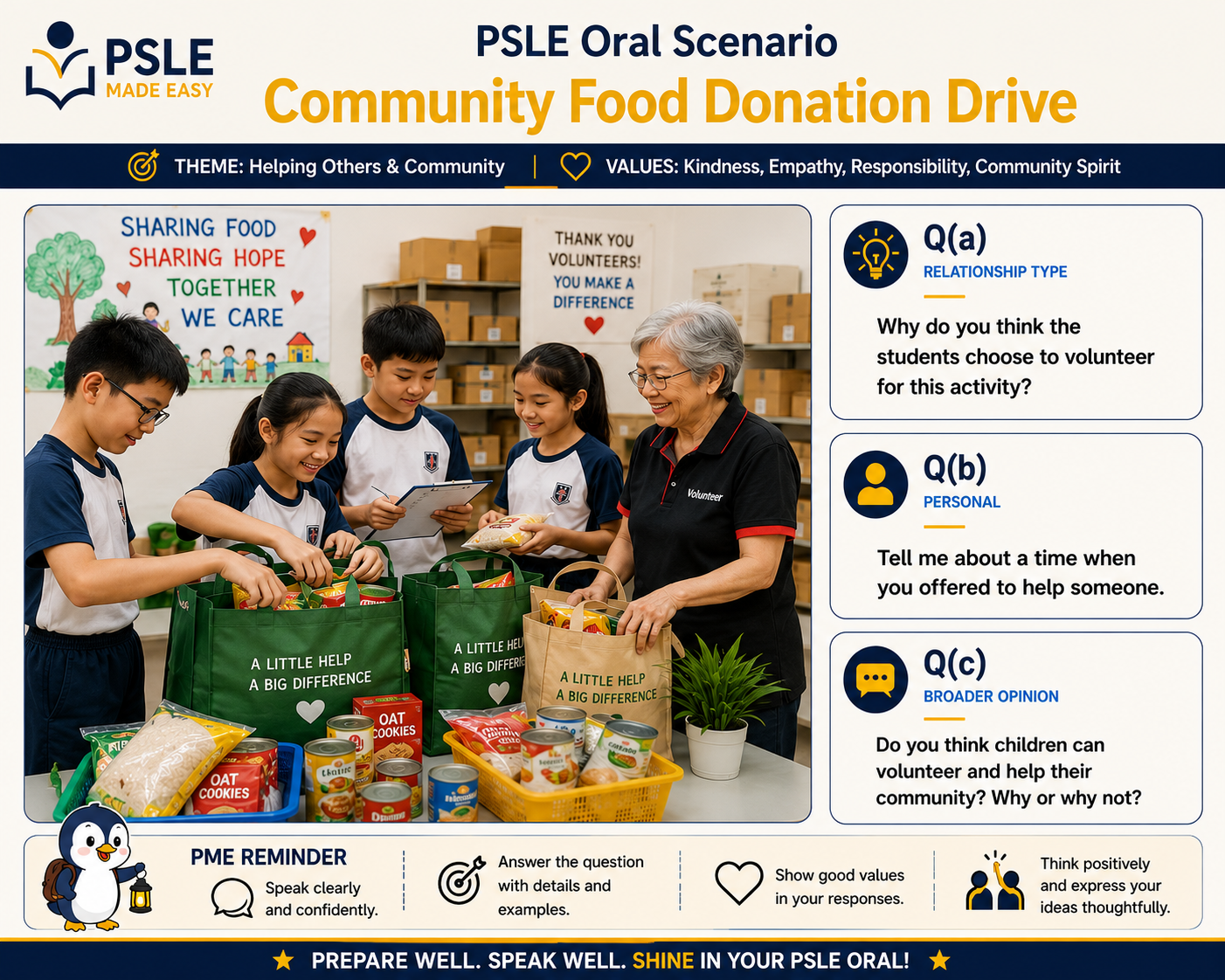
Before answering any question, spend ten seconds reading the picture properly. Not just "students helping out." Look at what the banners specifically say, since they carry most of the meaning here.
What you can see
Students appear to be packing or preparing food items — labelled "Oat Cookies" — as part of a community food donation drive. Banners around them read "Sharing Food, Sharing Hope, Together We Care," "Thank You Volunteers! You Make a Difference," and repeated smaller signs saying "A Little Help, A Big Difference."
Notice that the item being packed is specific (oat cookies, not just "food") — this is a concrete detail worth naming directly in your answer instead of speaking about "helping the needy" in the abstract.
What to notice for Q(a): This Q(a) is explicitly labelled a Relationship type on the infographic — it asks why the students chose to volunteer, not just what they are doing. Use the banners as evidence for their possible motivation.
② Q(a) — Relationship Type ▼
The Question
“Why do you think the students choose to volunteer for this activity?”
A Relationship Q(a) is asking you to explain why, not just describe what's happening. The banners around the students are your best evidence for their possible motivation.
Picture evidence you can use in your answer
- "Sharing Food, Sharing Hope, Together We Care" — this banner frames the activity as more than a task; it's about connection with people they'll likely never meet.
- "A Little Help, A Big Difference" repeated multiple times — suggests the organisers deliberately want volunteers to feel their small individual effort matters, which is itself a motivating message.
- The specific item, "Oat Cookies" — a concrete, tangible product makes the effort feel real and finished, unlike a vague donation of money.
- "Thank You Volunteers! You Make a Difference" — shows the students are being actively acknowledged, which may be part of what sustains their motivation to keep helping.
What a weak answer sounds like
“I think the students volunteer because they want to help people and it makes them feel good.”
A generic statement about volunteering in general, with nothing from the actual picture.
What a stronger answer sounds like
“I think the students choose to volunteer because the activity gives them something concrete to point to — a packet of oat cookies that will actually reach someone, rather than a vague idea of 'doing good.' The banner 'A Little Help, A Big Difference' is repeated so many times around them that it feels like the organisers specifically want the students to understand that packing a few cookies isn't a small, meaningless task — it genuinely adds up when many students do it together. Being publicly thanked with a 'Thank You Volunteers' banner probably also makes the effort feel valued and worth repeating.”
Why this works: Names the specific product (oat cookies), the repeated banner message, and the thank-you sign — and uses all three to build a believable explanation of motivation.
Going Beyond — add this
“I also think working alongside other student volunteers matters — doing this activity as a group, rather than alone, probably makes the task feel less like a chore and more like a shared, almost social experience.”
③ Q(b) — Personal Question ▼
The Question
“Tell me about a time when you offered to help someone.”
Q(b) doesn't have to be a big, organised event — helping a classmate, a neighbour, or a family member all count, as long as it's a specific, real moment.
What a weak answer sounds like
“I once helped my classmate with her homework. I felt happy that I could help.”
No specific subject, no specific difficulty, no real detail about what "helping" actually involved.
What a stronger answer sounds like
“Last year, my elderly neighbour was struggling to carry her groceries up the stairs because our lift was under maintenance for almost a week. I offered to carry them up for her every evening after school during that period, even though it meant I had less time to start my homework. On the last day, she gave me a small box of kueh she had made herself, which she didn't have to do, and it made me realise she'd been genuinely worried about managing on her own, not just inconvenienced.”
Why this works: Specific person, specific problem (broken lift), a real cost to the helper (less homework time), and a small, honest detail at the end that adds emotional depth.
Going Beyond — add this
“That week made me realise how much of an impact a small, repeated gesture can have, compared to one big grand act of help — she needed the groceries carried every day, not just once.”
④ Q(c) — Broader Opinion ▼
The Question
“Do you think children can volunteer and help their community? Why or why not?”
Q(c) invites an easy "yes, children can always help." A stronger answer acknowledges real limits on what children can do, then explains why their contribution still matters within those limits.
What a weak answer sounds like
“Yes, children can volunteer because everyone can help others no matter their age.”
True but empty — doesn't consider what children specifically can and can't do.
What a stronger answer sounds like
“I think children can genuinely help, but usually through smaller, supporting tasks rather than the big organising decisions — like the students in this picture packing cookies rather than managing the entire donation drive. That doesn't make the contribution less real; a food drive still needs someone to prepare and pack every single item. I think children volunteering also matters for a different reason beyond the immediate help — it builds the habit of noticing when people need something, which is a habit that's much harder to develop as an adult if you never practised it as a child.”
Why this works: Honestly acknowledges the scale of a child's contribution, still argues it's meaningful, and adds a longer-term reason (habit-building) beyond the immediate act.
Going Beyond — add this
“I also think it matters that children see the actual outcome of their effort, like a finished packet of cookies — seeing the result is probably what turns volunteering from an assigned chore into something a child wants to do again.”
⑤ Going Beyond Yourself — for This Topic ▼
Volunteering is a topic every student can say something virtuous-sounding about, which is exactly why most answers blur together. The way to stand out is honesty about what volunteering actually felt like — including the parts that were inconvenient or uncomfortable.
Ask yourself: after sharing your personal moment of helping, can you take one more step?
How my thinking has changed
Ask: “What did I used to believe about helping others that I no longer believe?”
“I used to think helping someone only counted if it was a big, obvious gesture. Now I think the small, repeated kind of help — showing up again and again — often matters more than one large act.”
Realising others must feel this too
Ask: “Who else quietly relies on this kind of small help regularly?”
“It made me think about elderly people living alone in my estate who might need this kind of small daily help far more often than I ever notice, since they rarely ask for it directly.”
What this makes me want to become
Ask: “Did this change what I want to do or who I want to be?”
“It made me want to be someone who notices when help is needed without waiting to be asked, instead of only helping when it's organised for me, like a school event.”
⑥ Values to Anchor Your Answers To ▼
The values printed on the infographic — Kindness, Empathy, Responsibility, Community Spirit — are four distinct angles, not one blurred idea of "being nice."
💛 Kindness
What it means in oral: kindness here is an action, not a feeling — packing a cookie for someone you'll never meet, without expecting thanks in return.
Anchor line: “Kindness that expects nothing back is the version that actually counts.”
🤍 Empathy
What it means in oral: empathy means imagining the specific person receiving the food, not just thinking about "the needy" as a vague, faceless group.
Anchor line: “It's easier to help 'the needy' in the abstract than to picture one real person opening that packet.”
📋 Responsibility
What it means in oral: responsibility means doing your part of the task properly, since someone else's meal depends on how carefully it's packed or prepared.
Anchor line: “When your task ends with someone else's meal, doing it carelessly isn't really an option.”
🤝 Community Spirit
What it means in oral: community spirit means understanding that many small individual contributions only add up to something meaningful when people do them together.
Anchor line: “One packet of cookies is small. A hundred volunteers each packing one is not.”
“Every student says helping others feels good. The ones who score at Band 5 are the ones who can name who they helped, what it actually cost them, and why they'd do it again.”