Learning to Cook at Home
Theme: Family & Life Skills · Values: Independence, Responsibility, Cooperation
Parent Note
Independence does not have to mean doing something difficult completely alone. For a Primary 6 child, it can be learning to prepare a simple meal, pack a school bag, manage homework, travel somewhere familiar or complete a household task without an adult taking over.
Ask your child to recall one specific moment when they learnt to do something for themselves. Encourage them to explain what was difficult at first, who guided them, and what changed once they could manage it independently.
Student Note
“Don't just say that learning to cook makes the children independent. Look closely at what they are doing. Explain what they are learning to manage for themselves, then connect it to a real experience of your own.”
① Read the Picture First ▼
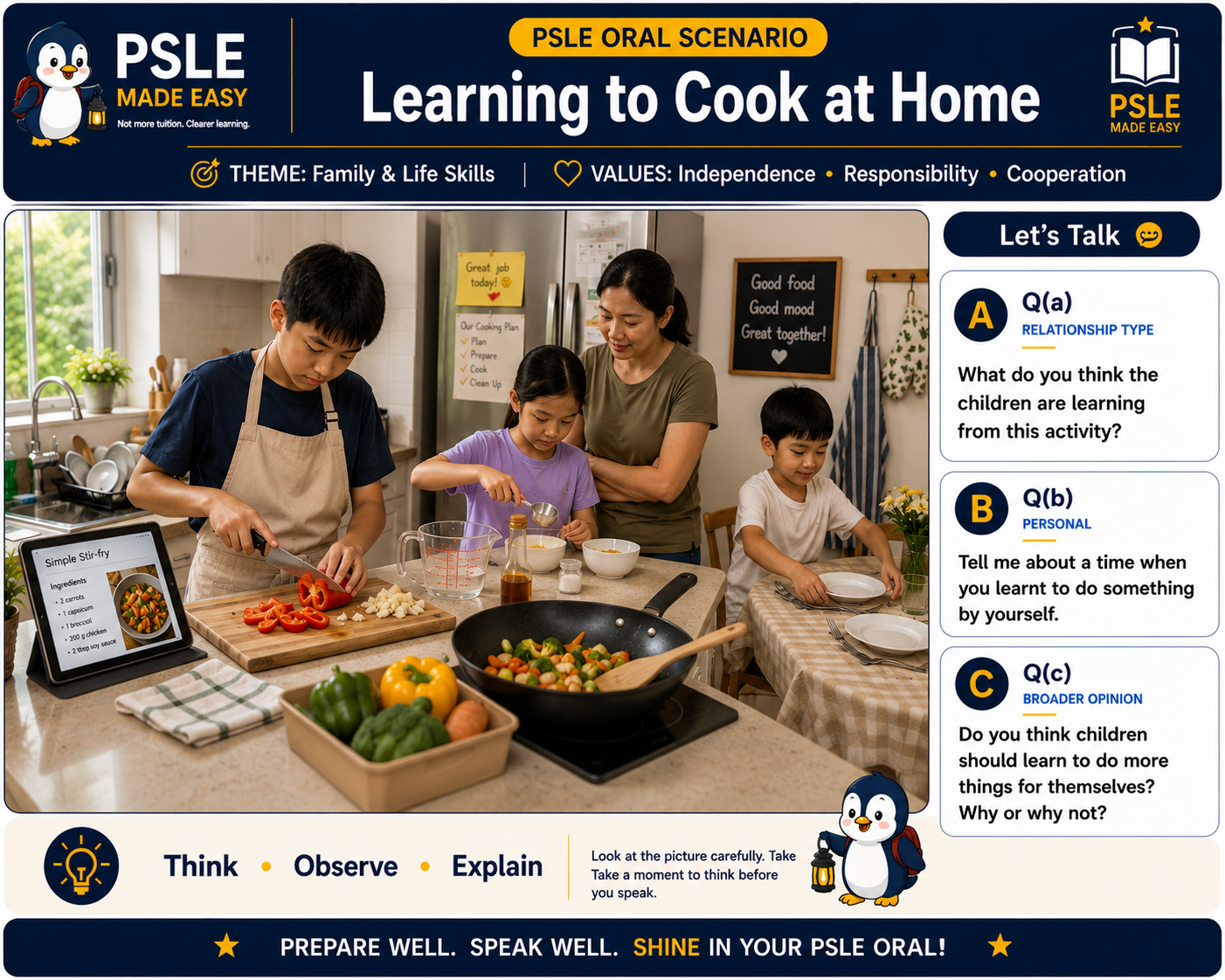
Before answering, look beyond the obvious idea that “a family is cooking”. Notice who is actually doing the work, how the adults are helping, and the different responsibilities being handled.
What you can see
The children are actively helping to prepare a meal rather than simply watching an adult cook. One child is working with the ingredients while another is helping with a different part of the preparation.
An adult is nearby to guide them, but is not taking over the entire task. Cooking utensils, ingredients and a recipe are visible around the work area.
Other details in the scene — such as preparing the table, organising ingredients and cleaning up — suggest that making a meal involves several responsibilities, not just cooking the food.
What to notice for Q(a): Do not stop at “they are learning to cook”. Use something you can actually see in the picture, explain what it shows about what the children are learning, then connect that idea to independence or responsibility.
② Q(a) — Picture Inference ▼
The Question
“What do you think the children are learning from this activity?”
Start with what the picture shows. Then explain what those actions tell you. Cooking is the activity, but the deeper learning can include independence, responsibility, cooperation and confidence.
Picture evidence you can use
- The children are doing the preparation themselves — this suggests that they are learning practical skills rather than relying completely on an adult.
- The adult is guiding instead of taking over — this suggests that the children are being given a chance to try and learn.
- Different family members have different jobs — this shows cooperation and shared responsibility.
- The ingredients and cooking tools need to be handled carefully — this gives the children a chance to practise being responsible.
What a weak answer sounds like
“I think the children are learning how to cook and how to be independent.”
The ideas are relevant, but there is no picture evidence and no explanation of how the activity develops independence.
What a stronger answer sounds like
“I think the children are learning how to take care of themselves and become more responsible. In the picture, they are actually helping to prepare the meal instead of just watching the adult do everything. The adult is nearby to guide them, but the children still have to handle their own tasks. This can help them become more confident because, after enough practice, they may be able to prepare a simple meal without depending on their parents. I think learning this way is useful because children need chances to try things for themselves before they can become independent.”
Why this works: It identifies visible actions, interprets what those actions mean and then connects the scene to the broader idea of becoming independent.
Going Beyond — add this
“I also think the adults are learning something too — they have to know when to help and when to step back so that the children get a chance to learn from doing things themselves.”
③ Q(b) — Personal Question ▼
The Question
“Tell me about a time when you learnt to do something by yourself.”
Choose one real experience. It does not have to be impressive. What matters is that you explain what you could not do before, how you learnt, and what changed afterwards.
Experiences you could draw on
- Preparing a simple breakfast or meal.
- Travelling to a familiar place independently.
- Managing your own homework or school materials.
- Learning to wash, organise or care for your own belongings.
- Learning a new skill after someone first showed you how.
What a weak answer sounds like
“I learnt how to make breakfast by myself. My mother taught me and now I can do it myself.”
There is an experience, but almost no detail about the learning process or why it mattered.
What a stronger answer sounds like
“I learnt to prepare my own breakfast when my mother showed me how to make scrambled eggs. At first, I was nervous about using the stove, so she stayed beside me and showed me what to do. After practising a few times, she let me prepare it on my own while she was nearby. Now I can make a simple breakfast without asking her to do it for me. I felt proud because it was a small sign that I was becoming more independent. It also made me realise how many everyday things my parents usually do for me without me noticing.”
Why this works: There is a clear moment, a learning process, a result and an insight that goes beyond simply mastering the skill.
Going Beyond — add this
“After that, I started wondering what other things I was old enough to learn instead of automatically asking my parents to do them for me.”
④ Q(c) — Broader Opinion ▼
The Question
“Do you think children should learn to do more things for themselves? Why or why not?”
A strong answer should go beyond “yes, because children need to be independent”. Explain why independence matters now and how learning small responsibilities prepares children for later life.
What a weak answer sounds like
“Yes, children should learn to do more things for themselves because they need to be independent when they grow up.”
The opinion is clear, but the reason is too general and stops before explaining what independence actually looks like.
What a stronger answer sounds like
“Yes, I think children should gradually learn to do more things for themselves. If adults always solve every problem for us, we may reach secondary school or even adulthood without knowing how to manage simple responsibilities. Children can start with manageable things such as preparing simple food, organising their schoolwork or helping with household chores. Adults should still guide us when something is difficult or unsafe, but they do not need to take over every task. I think independence grows when children are trusted with small responsibilities and are allowed to make mistakes and learn from them.”
Why this works: It explains the long-term importance of independence, gives concrete examples and recognises that becoming independent still involves appropriate adult guidance.
Going Beyond — add this
“Being independent also does not mean refusing help. I think real independence means knowing what you can handle yourself and knowing when you genuinely need someone to guide you.”
⑤ Going Beyond Yourself — for This Topic ▼
Independence is more than saying, “I can do it myself.” A stronger oral answer shows what changed in your thinking after you learnt to take responsibility for something.
After sharing your experience, ask yourself: What did this make me realise beyond the skill itself?
How my thinking has changed
Ask: “What did I used to think that I no longer believe?”
“I used to think adults did these jobs because children were not capable of doing them. Now I realise that sometimes adults do them simply because it is faster, and children still need opportunities to learn.”
Appreciating the people who taught me
Ask: “Who helped me become more independent?”
“Learning to do it myself also made me appreciate how patient my mother was. She could have completed the task much faster herself, but she took the time to teach me instead.”
What this makes me want to do next
Ask: “What responsibility could I take on next?”
“It made me want to learn other useful skills instead of waiting until I am older. If I can start with small responsibilities now, bigger responsibilities may not feel so frightening later.”
⑥ Values to Anchor Your Answers To ▼
Independence, Responsibility and Cooperation each give you a different way to develop your answer beyond simply saying that learning to cook is useful.
🌱 Independence
Independence means gradually becoming able to manage age-appropriate tasks without always waiting for someone else to do them for you.
Anchor line: “You do not suddenly become independent when you grow up. You build it through small responsibilities while you are growing up.”
📋 Responsibility
Responsibility means completing your part carefully, dealing with mistakes and understanding that other people are depending on you.
Anchor line: “Being trusted with a job also means accepting responsibility for doing it properly.”
🤝 Cooperation
Learning to be independent does not mean doing everything alone. People can have their own responsibilities while still working together and helping one another.
Anchor line: “Being independent means being able to contribute, not separating yourself from everyone else.”
“Don't stop at telling the examiner what you can do by yourself. Explain how you learnt it, what changed, and what becoming more independent now means for the person you are growing into.”