Family Exercising Together
Theme: Health & Well-being · Values: Healthy Lifestyle, Family Bonding, Discipline
Parent Note
"Exercise is good for you" is a fact every child already knows and repeats without thinking. What turns it into a strong oral answer is a specific family activity, a specific benefit beyond "it's healthy," and an honest account of whether it was actually enjoyable.
Ask your child to recall one actual family activity — a walk, a badminton game at the court downstairs, cycling at a park — rather than answering in general terms about exercise.
Student Note
“The examiner has heard 'exercise keeps you healthy' a hundred times today. What they have not heard is a specific family activity, a specific benefit that goes beyond fitness, and whether you actually enjoyed it.”
① Read the Picture First ▼
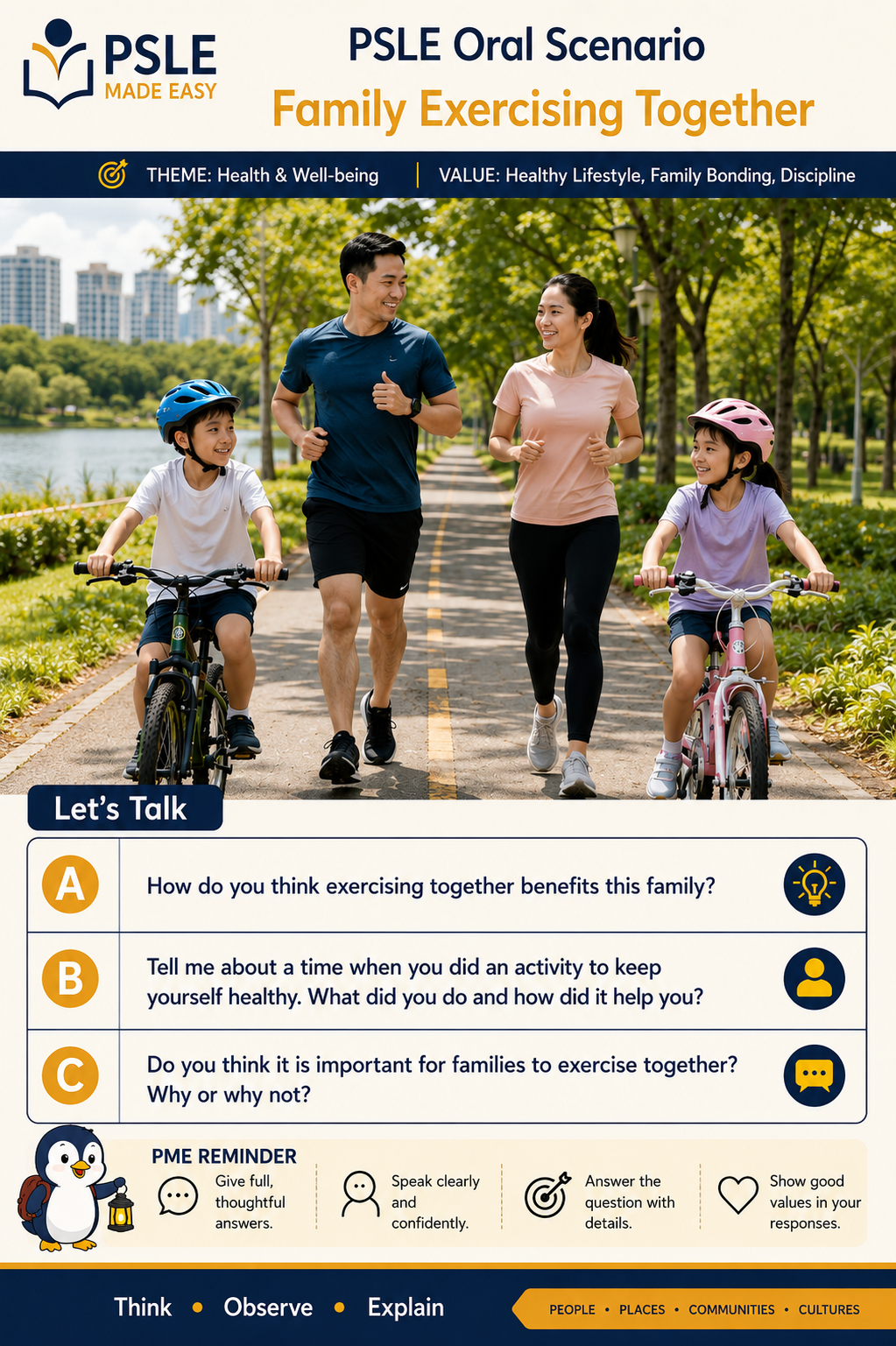
Before answering any question, spend ten seconds reading the picture properly. Not just "a family exercising." Look at what the infographic explicitly tells you about theme and values, since those are your anchors here.
What you can see
This infographic is explicitly labelled "Theme: Health & Well-being" with values "Healthy Lifestyle, Family Bonding, Discipline" — meaning the scenario is built around three distinct angles, not just physical fitness. A PME Reminder box also appears, coaching full, detailed, confident answers.
The word "together" in the title is doing the same work it does in other scenarios — it signals this is about the relationship formed by the shared activity, not the exercise itself in isolation.
What to notice for Q(a): This Q(a) is a Relationship type — it asks how the shared activity benefits the family, not simply what exercise does for a body. Your answer should focus on what happens between people, not physical fitness facts.
② Q(a) — Relationship Type ▼
The Question
“How do you think exercising together benefits this family?”
A Relationship Q(a) wants you to explain what the shared activity does for the people involved, not just what exercise does for the body. "It keeps them healthy" answers a different, more generic question.
Picture evidence you can use in your answer
- The infographic's own stated values: Healthy Lifestyle, Family Bonding, Discipline — this tells you the scenario itself is asking you to look beyond fitness to bonding and discipline.
- The word "Together" in the title — signals the benefit is at least partly about the shared experience, not each person's individual fitness gain.
- The theme "Health & Well-being" — well-being is broader than physical health; it includes mental and emotional benefits too.
What a weak answer sounds like
“Exercising together benefits the family because it keeps everyone healthy and fit.”
This is true of exercising alone too. It ignores the word "together" completely.
What a stronger answer sounds like
“I think exercising together benefits this family beyond just fitness — it gives them a regular chunk of time where everyone is doing the same thing at the same time, without any screens involved. In a lot of families, members are often busy with separate things, so a shared activity like this becomes one of the few moments where conversations happen naturally, without anyone having to force it. It also models discipline for the children — seeing parents commit to a routine teaches that healthy habits require consistency, not just good intentions.”
Why this works: Goes beyond "healthy" to name two specific relationship benefits — shared, unstructured time and modelling discipline — both pulled directly from the infographic's own stated values.
Going Beyond — add this
“I also think it changes the tone of conversations. Talking while walking or playing a sport side-by-side often feels less pressured than a face-to-face conversation at the dinner table, so some families actually open up more during exercise than at other times.”
③ Q(b) — Personal Question ▼
The Question
“Tell me about a time when you did an activity to keep yourself healthy. What did you do and how did it help you?”
This question has two clear parts — what you did, and how it actually helped. Missing the second half is the most common way students lose marks here.
What a weak answer sounds like
“I went jogging with my father. It helped me stay fit.”
Answers "what" but barely answers "how did it help" — "stay fit" is too generic to count as a real explanation.
What a stronger answer sounds like
“Last year, I started cycling around my neighbourhood with my brother every Saturday morning, mainly because I was falling asleep in class and my mother suggested I needed more physical activity. At first I could barely finish two rounds without needing to stop, but after about two months I noticed I was sleeping better at night and actually had more energy to concentrate during afternoon lessons, instead of feeling drowsy after lunch.”
Why this works: Names the specific activity, the reason it started, a real struggle at the beginning, and a concrete, believable benefit (better sleep, more focus) rather than a vague "stayed fit."
Going Beyond — add this
“That routine also taught me something about discipline — the mornings I didn't feel like cycling were exactly the mornings I needed it most, and pushing through that was harder than the cycling itself.”
④ Q(c) — Broader Opinion ▼
The Question
“Do you think it is important for families to exercise together? Why or why not?”
Q(c) invites a simple "yes, it's healthy" answer — resist that. A stronger answer considers when it might not work for every family, then still lands on a reasoned position.
What a weak answer sounds like
“Yes, it is important because exercise is good for health and families should be healthy together.”
Circular reasoning — restates the question as the answer without adding anything new.
What a stronger answer sounds like
“I think it's important, but I don't think every family needs to exercise together every week for it to count. Some families have very different schedules or fitness levels, which can make a shared activity frustrating rather than bonding — for example, if one person is much fitter and keeps having to wait for everyone else. What matters more, I think, is finding some shared physical activity that genuinely works for that specific family, even if it's just an occasional walk, rather than forcing a rigid routine that ends up causing arguments instead of closeness.”
Why this works: Acknowledges a real obstacle (mismatched fitness levels or schedules) before arriving at a still-clear, still-positive position — nuance instead of a flat yes.
Going Beyond — add this
“I also think it matters more at certain life stages — for example, teenagers often want more independence, so a family that insists on exercising together at that age might actually create friction rather than closeness.”
⑤ Going Beyond Yourself — for This Topic ▼
Health and exercise are topics every student can recite facts about, which is exactly why most answers sound identical. The way to stand out is to be honest about the actual experience of trying to build a healthy habit — including the parts that were hard.
Ask yourself: after sharing your personal activity, can you take one more step?
How my thinking has changed
Ask: “What did I used to believe about exercise that I no longer believe?”
“I used to think exercise was only about how you look or how fast you can run. Now I realise its biggest effect on me was actually my sleep and focus, not my fitness level.”
Realising others must feel this too
Ask: “Who else has to work at building this same habit?”
“It made me think about my mother, who tries to exercise before work every day. If it's this hard for me to keep a Saturday routine, I can only imagine how much more discipline it takes to do it on a workday before 7am.”
What this makes me want to become
Ask: “Did this change what I want to do or who I want to be?”
“It made me want to be someone who keeps a habit going even after the initial motivation fades, instead of quitting the moment it stops feeling new and exciting.”
⑥ Values to Anchor Your Answers To ▼
The values printed on the infographic — Healthy Lifestyle, Family Bonding, Discipline — are not interchangeable. Each gives your answer a distinct angle beyond "exercise is good for you."
🏃 Healthy Lifestyle
What it means in oral: a healthy lifestyle is a pattern of small, repeated choices — not one big effort. It's about consistency, not intensity.
Anchor line: “A healthy lifestyle isn't one big workout — it's the same small choice, repeated.”
👨👩👧 Family Bonding
What it means in oral: bonding through exercise happens through side-by-side shared effort, not face-to-face conversation — a different, sometimes easier, kind of closeness.
Anchor line: “Some of the easiest family conversations happen side-by-side, not face-to-face.”
📋 Discipline
What it means in oral: discipline means showing up on the days you don't feel like it — the value isn't in loving every session, it's in continuing anyway.
Anchor line: “Discipline is doing it on the day you don't feel like it — that's the only day it's actually being tested.”
“Every student knows exercise is healthy. The ones who score at Band 5 are the ones who can name the specific activity, the specific benefit, and admit when it was actually hard to keep going.”