Grandchild Teaching Grandparent a New Skill
Theme: Family & Technology · Values: Patience, Respect, Responsibility
Parent Note
Teaching a grandparent to use a smartphone is a scene many children have actually lived, which makes it tempting to answer in vague, sweet-sounding terms — "it felt nice to help." What earns marks is a child who can name the actual moment of friction (the grandparent forgetting a step, feeling frustrated, or needing something repeated) and how they handled it.
Ask your child to recall a real instance of teaching a grandparent, parent, or even a younger sibling something on a device, rather than answering in general terms.
Student Note
“The examiner has heard 'it felt good to help my grandparent' a hundred times today. What they have not heard is the actual moment it got difficult — when they forgot a step, or got frustrated — and what you did about it.”
① Read the Picture First ▼
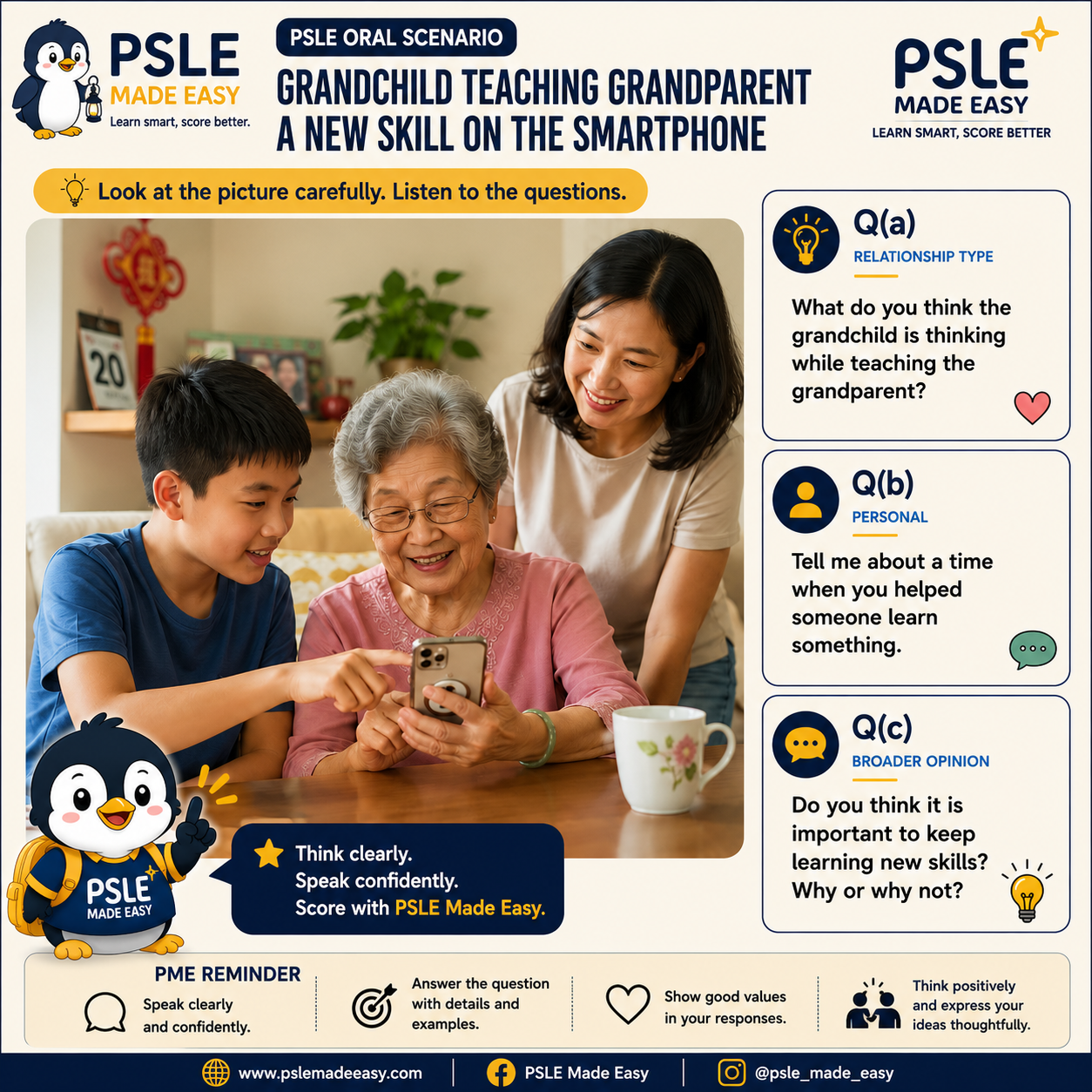
Before answering any question, spend ten seconds reading the picture properly. Not just "someone helping an old person with a phone." Look at what the scene tells you about the roles each person is playing.
What you can see
The scenario is explicitly titled "Grandchild Teaching Grandparent a New Skill on the Smartphone." This is a specific, named role reversal — usually it's the grandparent teaching the grandchild something, and here it's flipped. That reversal itself is worth noticing.
The instruction accompanying the scenario, "Look at the picture carefully. Listen to the questions," is a reminder that the specific details in front of you (not a generic idea of "teaching tech to grandparents") are what your answer should be built from.
What to notice for Q(a): This Q(a) is explicitly labelled a Relationship type on the infographic — it asks what the grandchild is thinking, which means your answer should explore the internal dynamic of the relationship, not just describe the teaching steps.
② Q(a) — Relationship Type ▼
The Question
“What do you think the grandchild is thinking while teaching the grandparent?”
A Relationship Q(a) wants you inside the dynamic between the two people — not just "they are teaching them how to use the phone." Think about what it's actually like to teach someone older than you, who may need more patience than a peer would.
Picture evidence you can use in your answer
- The title's role reversal — a grandchild teaching a grandparent flips the usual direction of learning in a family, which is itself worth commenting on.
- The specific device (smartphone) — this isn't an abstract skill; it's something the child likely already knows intuitively and takes for granted, unlike the grandparent.
- The setting being at home, implied by the informal, one-on-one framing — this is patient, personal teaching, not a classroom lesson.
What a weak answer sounds like
“I think the grandchild is thinking about how to explain the phone to their grandparent.”
Restates the picture rather than interpreting the emotional or relational experience of the moment.
What a stronger answer sounds like
“I think the grandchild is probably thinking carefully about how to explain something they find completely obvious in a way that doesn't make their grandparent feel slow or embarrassed. Something like using a smartphone is second nature to the grandchild, so they likely have to consciously slow down and remember what it felt like before they knew how to do it themselves. There's probably also a bit of pride involved — being the one who knows more, for once, instead of always being the one being taught.”
Why this works: Names the specific emotional challenge (avoiding making someone feel slow), connects it to the role reversal, and adds a believable, slightly complex emotion (quiet pride) rather than a flat, single feeling.
Going Beyond — add this
“I also think the grandchild might be thinking about how many times their grandparent patiently taught them something when they were younger — this could be a chance to return that patience.”
③ Q(b) — Personal Question ▼
The Question
“Tell me about a time when you helped someone learn something.”
Q(b) doesn't have to be about a grandparent or a smartphone — teaching a sibling to ride a bike, helping a classmate with a maths problem, or showing a friend a game all work, as long as it's a real, specific memory.
What a weak answer sounds like
“I helped my grandmother learn how to use WhatsApp. I taught her patiently and she learnt it.”
No specific difficulty, no specific moment — just a summary with no texture.
What a stronger answer sounds like
“My grandmother kept accidentally muting herself during video calls with my aunt overseas, and she was getting quite frustrated because she thought her phone was broken. I sat with her for almost twenty minutes showing her exactly where the mute button was and had her practise tapping it a few times until she was confident. She still messages me sometimes to double check she's doing it right before an important call, which used to slightly annoy me, but now I don't mind — I know it's really about her wanting to make sure she doesn't miss the chance to speak to my aunt.”
Why this works: Specific problem (the mute button), a specific process (twenty minutes of practice), and an honest, evolving feeling about the follow-up messages rather than a tidy, one-note ending.
Going Beyond — add this
“That experience taught me that teaching someone isn't finished the moment they get it right once — real learning means they can still do it later, on their own, without me there.”
④ Q(c) — Broader Opinion ▼
The Question
“Do you think it is important to keep learning new skills? Why or why not?”
Q(c) is broad enough to invite a shallow "yes, learning is good" answer. A stronger response narrows in on why it's specifically important, at any age, rather than treating it as an obvious truth.
What a weak answer sounds like
“Yes, it is important to keep learning new skills because learning is good for us.”
Circular — restates the question as its own answer.
What a stronger answer sounds like
“I think it's especially important for older people to keep learning new skills, because the world doesn't wait for anyone — things like banking or keeping in touch with family have moved almost entirely onto apps and phones. If someone stops learning new things as they get older, they can end up isolated, not because people stopped caring about them, but because they can no longer access the tools everyone else is using to stay connected. So learning isn't just about staying sharp mentally — it's about staying included.”
Why this works: Identifies a specific, real consequence of not learning new skills (isolation from communication tools) rather than a generic statement about mental sharpness.
Going Beyond — add this
“I also think being willing to learn from someone younger, like a grandchild, takes a specific kind of humility that not everyone has — it means accepting that you don't automatically know more just because you're older.”
⑤ Going Beyond Yourself — for This Topic ▼
Teaching a grandparent something on a smartphone is a topic almost every student can describe, which is exactly why the answers tend to sound identical. The way to stand out is honesty about the actual patience it takes, not just the sweetness of the moment.
Ask yourself: after sharing your personal experience, can you take one more step?
How my thinking has changed
Ask: “What did I used to believe about teaching older family members that I no longer believe?”
“I used to get impatient explaining the same thing more than once. Now I understand that needing something repeated isn't the same as not trying — it's just a different pace of learning.”
Realising others must feel this too
Ask: “Who else has to be this patient regularly?”
“It made me think about my own teachers, who probably explain the same concept to different students many times a day. If I found it hard to stay patient once with my grandmother, I have new respect for how they do it constantly.”
What this makes me want to become
Ask: “Did this change what I want to do or who I want to be?”
“It made me want to be someone who teaches without making the other person feel small — because I know exactly how that feels from the other side, when adults explain things to me impatiently.”
⑥ Values to Anchor Your Answers To ▼
These three values — Patience, Respect, Responsibility — each give your answer a different angle beyond "it was nice to help."
⏳ Patience
What it means in oral: patience here means being willing to repeat something without sighing or making the other person feel like a burden.
Anchor line: “Real patience isn't just waiting quietly — it's being willing to explain the same thing a third time without any change in tone.”
🙏 Respect
What it means in oral: respecting a grandparent while teaching them means never making them feel embarrassed for not already knowing something.
Anchor line: “Teaching someone older than you only works if they never feel talked down to.”
📋 Responsibility
What it means in oral: responsibility means following up — checking that the skill actually stuck, not just that it worked once while you were watching.
Anchor line: “Teaching someone a skill isn't finished when they get it right once — it's finished when they can do it without you there.”
“Every student says teaching a grandparent 'felt nice.' The ones who score at Band 5 are the ones who can name the exact moment it got hard, and what patience actually looked like in that moment.”