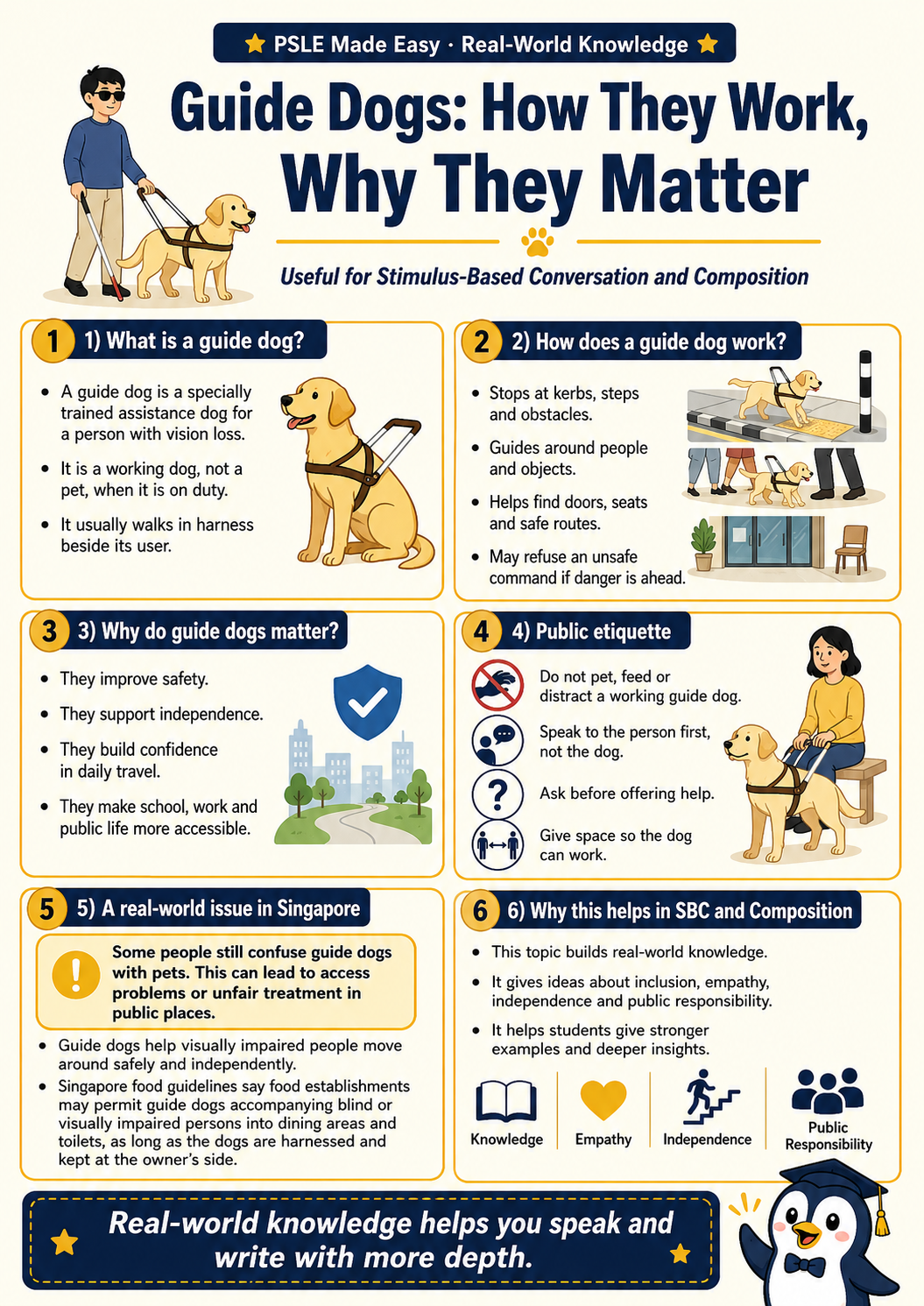
Guide Dogs: How They Work, Why They Matter
A page to help students build stronger examples, deeper insights and better awareness for Stimulus-Based Conversation and composition writing.
Stimulus-Based Conversation and Continuous Writing do not depend only on language skills. They also depend on real-world knowledge.
When students know more about the world, they have stronger examples to use. They can explain issues more deeply, show empathy, offer alternative perspectives and avoid giving shallow answers.
Guide dogs are a useful topic because they connect to many PSLE-friendly themes: pets, responsibility, inclusion, disability awareness, public behaviour, empathy, independence and community support.
Parent Note
Many students struggle in oral conversation and composition not because they have no language, but because they have limited examples and limited awareness of real-life issues.
If the topic is about pets, a student may only talk about feeding a pet or playing with it. But a stronger student may bring in guide dogs and explain how animals can support people with vision loss, help them move around safely, and give them greater independence.
This is the kind of knowledge that helps students move from a basic answer to a more thoughtful one.
Use this page as a conversation starter. Ask your child: What is a guide dog? Why does it matter? What should members of the public do or not do? Why might some people misunderstand guide dogs?
Student Note
“A better oral answer often comes from knowing more about the world.”
“Do not just say pets are cute. Think about how animals can help people.”
“Use real examples to show empathy, awareness and deeper thinking.”
① What Is a Guide Dog?
A guide dog is a specially trained assistance dog that helps a person with vision loss move around more safely and confidently.
A guide dog is not simply a pet when it is working. It is a working animal trained to support its user in daily movement and travel.
A guide dog usually wears a harness and walks beside its user. The dog helps the user navigate spaces, avoid obstacles and travel with greater independence.
“A guide dog is not just a pet. It is a working companion that supports independence.”
② How Does a Guide Dog Work?
A guide dog helps its user move through the environment more safely. It may stop at kerbs, steps and obstacles, guide around people or objects, and help the user find safer routes.
Guide dogs are also trained not to follow unsafe commands blindly. If there is danger ahead, the dog may refuse a command to protect its user.
This shows that a guide dog is not simply obeying. It is using training, awareness and judgement to support the user.
“Guide dogs do not just walk. They help their users travel with safety and confidence.”
③ Why Guide Dogs Matter
Guide dogs matter because they support independence. For a person with vision loss, moving around public spaces can be challenging. A guide dog can help make daily travel safer, smoother and less dependent on others.
They can also improve confidence. When a person can move around more independently, it becomes easier to travel to school, work, appointments, public places and social activities.
This is why guide dogs are connected to larger ideas such as accessibility, dignity, inclusion and public responsibility.
“Guide dogs matter because independence matters.”
④ Public Etiquette: What Should We Do?
When a guide dog is working, members of the public should be respectful and careful.
- Do not pet, feed or distract the dog.
- Do not call the dog or make noises to attract it.
- Speak to the person first, not the dog.
- Ask before offering help.
- Give enough space so the dog can work.
The dog may look friendly, but it is working. Distracting it can affect the safety of its user.
“Do not distract a working guide dog. Respect the work it is doing.”
⑤ A Real-World Issue in Singapore
One real-world issue in Singapore is whether guide dogs should be allowed in food and beverage places.
Some people may confuse guide dogs with pets. They may worry about hygiene, fear dogs, or feel uncomfortable seeing a dog in a dining area.
However, guide dogs are working assistance animals. Singapore Food Agency guidance states that food establishments may permit guide dogs accompanying blind or visually impaired persons into dining or refreshment areas and toilets, as long as conditions are observed — including keeping the guide dog under proper control, leashed, and not fed within the establishment.
This makes the issue more complex than simply “dogs should not enter food places”. It is about balancing public comfort, food hygiene concerns, disability access, inclusion and fair treatment.
“A guide dog is not a pet in a restaurant. It is part of someone’s access to public life.”
⑥ Singapore Case Study: The Starbucks East Coast Park Debate
In May 2026, a sign at Starbucks’ East Coast Park outlet sparked discussion in Singapore. The sign said that pets would no longer be allowed in both the indoor and outdoor seating areas from 25 May as part of the outlet’s transition towards halal-certified operations. However, the same sign also stated that guide dogs would remain welcome.
After the sign was shared online, people debated whether pets should be allowed in such spaces. Starbucks later clarified that there would be no change to current store operations for the time being, pets would continue to be welcome on the premises, and it apologised for the confusion caused by the earlier communication.
This case is useful for students because it shows how real-world issues are often more complex than they first appear. Some people may focus on pet owners’ convenience. Others may think about food hygiene, religious concerns, customer comfort, business rules or fairness. Guide dogs add another important perspective because they are not simply pets — they support people with vision loss in moving around safely and independently.
A strong answer should recognise the difference between a pet and a working assistance animal. It should also consider different groups of people before forming a view.
Possible SBC angle:
“I think this issue shows that we should not treat all animals in public spaces the same way. A pet may be there for companionship, but a guide dog is helping someone with vision loss move around safely. While food hygiene and public comfort are important, society also needs to make space for people with disabilities to access public places with dignity.”
“A thoughtful answer does not choose one side too quickly. It considers the different needs in the situation.”
⑦ Why This Helps in Stimulus-Based Conversation
If an SBC question is about pets, public spaces, helping others, kindness, inclusion or responsibility, guide dogs can become a strong example.
A basic answer may say that pets make people happy. A stronger answer may explain that some animals do more than provide companionship — they help people live more independently.
Students can use guide dogs to discuss empathy, public awareness, accessibility and how society treats people with different needs.
Possible SBC idea:
“I think animals can play an important role in people’s lives. For example, guide dogs are trained to help people with vision loss move around safely. This shows that animals are not only companions but can also support independence and confidence. However, the public must also learn not to distract guide dogs when they are working.”
“A strong oral answer uses real examples to show deeper thinking.”
⑧ Why This Helps in Composition Writing
Guide dogs can also help students create more meaningful composition ideas.
Instead of writing a simple story about a pet, students can write about misunderstanding, fear, responsibility, courage, kindness or learning to see a situation from another person’s perspective.
This makes the story more mature because the conflict is not only about the dog. It is about how people respond to difference.
Possible composition angle:
A child is afraid when a guide dog enters a café. At first, the child thinks the dog should not be there. Later, the child learns that the dog is helping its visually impaired owner move safely. The child realises that kindness sometimes begins with understanding before judging.
“A stronger story is not just about what happened. It is about what the character learns.”
⑨ Useful Ideas and Vocabulary
Students can use this topic to build better vocabulary and stronger explanations.
| Idea | Useful Words |
|---|---|
| Helping others | support, assist, guide, protect, serve |
| Independence | confidence, mobility, freedom, dignity, self-reliance |
| Inclusion | accessibility, fairness, acceptance, awareness, empathy |
| Public behaviour | respectful, considerate, responsible, informed, patient |
| Problems | misunderstanding, discomfort, fear, prejudice, lack of awareness |
“Use precise words to show precise thinking.”
Sources and Further Reading
- Guide Dogs Singapore — guide dogs and their role in supporting confidence, safety and efficient travel: Guide Dogs Singapore: Guide Dogs
- Guide Dogs Singapore — overview of services for the blind and visually impaired: Guide Dogs Singapore
- Singapore Food Agency — guidelines for licensed food retail premises, including serving blind or visually impaired persons with guide dogs: SFA Guidelines for Licensed Food Retail Premises
- Animal & Veterinary Service — assistance dog import information: AVS Importing Assistance Dogs
- Singapore case study — Starbucks East Coast Park pet policy notice and guide dog discussion: Mothership report
“Real-world knowledge helps you speak with insight and write with feeling.”