Healthy Choices — Hawker Centre
Theme: Health & Wellbeing · Values: Responsibility, Self-Discipline, Wellbeing
Parent Note
A hawker centre is one of the most ordinary family scenes a Singaporean child knows — which is exactly why this topic tempts children into vague, one-line answers. "We discuss what to eat" tells the examiner nothing.
What earns marks is a child who can describe the actual negotiation that happens at a stall — who wants what, who compromises, and why a family might choose the healthier board over the familiar order. Ask your child to recall a real meal out, not just describe the picture.
Student Note
“The examiner has heard 'they are discussing what to eat' a hundred times today. What they have not heard is you naming the actual prices on that board and explaining why a family might choose Brown Rice at 80 cents over something else. That is what separates an answer from a guess.”
① Read the Picture First ▼
Before answering any question, spend ten seconds reading the picture properly. Not just "a family at a hawker centre." Look at exactly what is on the board, and what the prices themselves are telling you.
What you can see
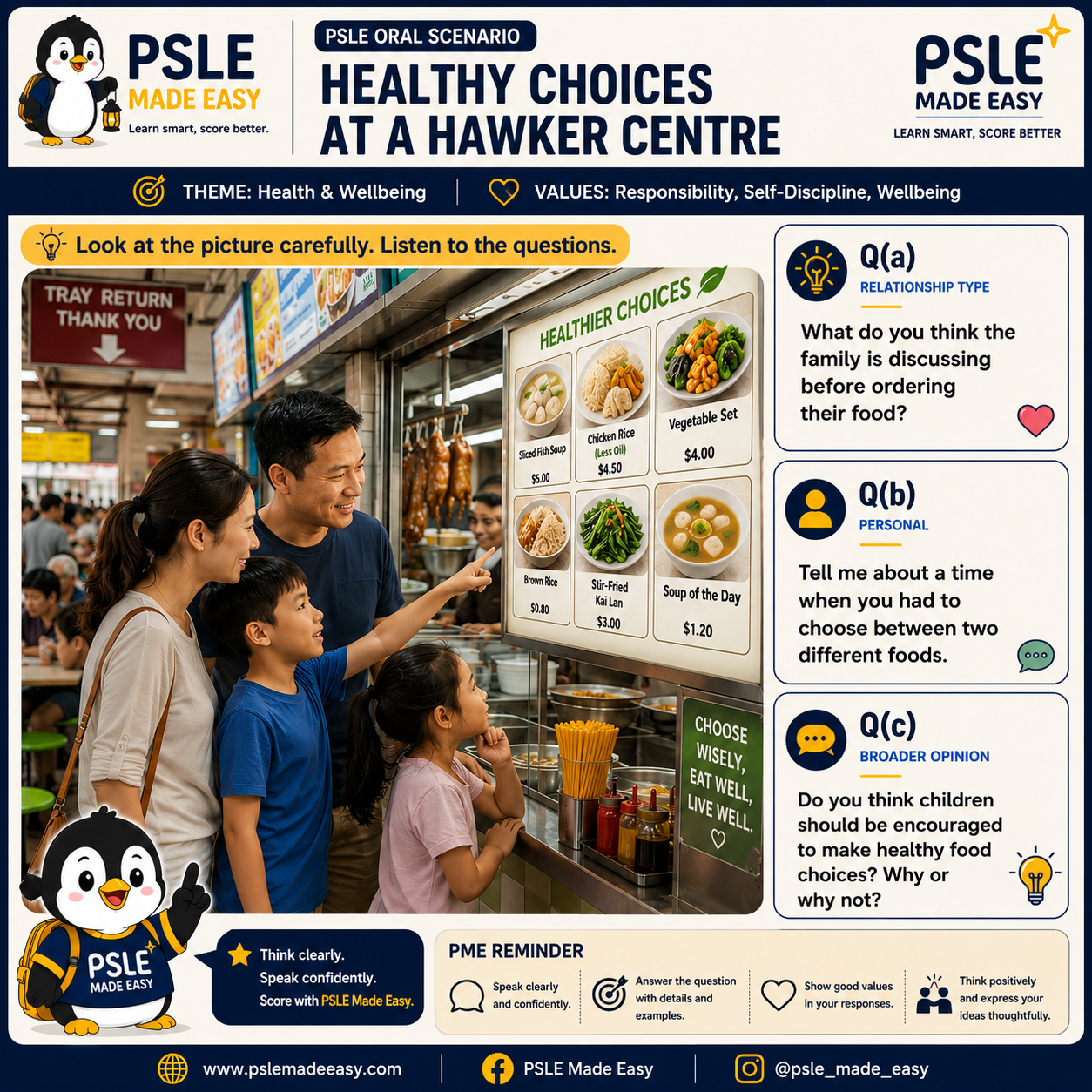
A family is standing together at a hawker stall, looking at a "HEALTHIER CHOICES" board listing: Sliced Fish Soup $5.00, Chicken Rice (Less Oil) $4.50, Vegetable Set $4.00, Brown Rice $0.80, Stir-Fried Kai Lan $3.00, and Soup of the Day $1.20.
Nearby, a sign reads "TRAY RETURN · THANK YOU," and the stall's tagline is "CHOOSE WISELY, EAT WELL, LIVE WELL."
Notice that the board doesn't just list food — it lists a modified version of a familiar dish (Chicken Rice, but "Less Oil") next to the cheapest item on the board (Brown Rice, at 80 cents). That pairing is deliberate.
What to notice for Q(a): The Q(a) for this scenario is a Relationship type — it asks what the family is discussing, which means your answer needs to describe an interaction (who is pointing at what, who is undecided) and not just a single person's feelings.
② Q(a) — Relationship Type ▼
The Question
“What do you think the family is discussing before ordering their food?”
A Relationship Q(a) asks you to explain the dynamic between the people in the picture — not just guess a topic. Use the board itself as evidence for what the discussion is actually about.
Picture evidence you can use in your answer
- The "HEALTHIER CHOICES" board with prices — Sliced Fish Soup $5.00, Chicken Rice (Less Oil) $4.50, Vegetable Set $4.00, Brown Rice $0.80, Stir-Fried Kai Lan $3.00, Soup of the Day $1.20. Real prices mean a real decision about value, not just taste.
- "Chicken Rice (Less Oil)" — a modified version of a dish most Singaporean children already love, suggesting someone in the family wants the familiar option but a healthier version of it.
- Brown Rice at $0.80 — the cheapest item on the board, which could be why a parent points to it, or why a child resists it.
- The tagline "CHOOSE WISELY, EAT WELL, LIVE WELL." positioned right above where the family is standing.
- "TRAY RETURN · THANK YOU" signage nearby — the family is clearly at the ordering stage, not yet seated.
What a weak answer sounds like
“I think the family is discussing what food to eat.”
Technically true, but it doesn't use anything the picture actually shows — no board, no prices, no sense of who wants what.
What a stronger answer sounds like
“I think the family is deciding between the Chicken Rice with less oil and the Brown Rice, because the board shows the Chicken Rice at $4.50 and the Brown Rice at only $0.80. Maybe one of the children wants the Chicken Rice because it's more familiar, while a parent is pointing at the Brown Rice because it's the healthier and cheaper choice. It looks like a small negotiation — not disagreement, just weighing what everyone wants against what is actually good for them.”
Why this works: Names the specific dishes and prices, and builds a believable family dynamic out of them instead of guessing generally.
Going Beyond — add this
“I also think the fact that this stall has a 'HEALTHIER CHOICES' board at all tells us something — the hawker itself is trying to make the decision easier for families, so the discussion isn't just between the parents and children, it's shaped by what the stall has chosen to offer in the first place.”
③ Q(b) — Personal Question ▼
The Question
“Tell me about a time when you had to choose between two different foods.”
Q(b) wants a real memory of two specific foods and what made the choice difficult — not a general statement about eating habits.
What a weak answer sounds like
“I once had to choose between healthy food and unhealthy food, and I chose the healthy one.”
No specific foods, no real tension, and an outcome that sounds too perfect to be believable.
What a stronger answer sounds like
“Two weeks ago, my family went to a hawker centre for dinner, and I couldn't decide between the char kway teow, which I really love, and a fish soup that my mother suggested. I actually stood at the stall for almost a minute deciding. In the end I chose the fish soup, not because I didn't want the char kway teow, but because I remembered feeling really sluggish the last time I had it for dinner and then couldn't sleep well. It wasn't an easy choice — I still think about the char kway teow sometimes.”
Why this works: Two named foods, a real moment of hesitation, and an honest reason grounded in personal experience — not a moral lesson.
Going Beyond — add this
“That moment taught me that a healthy choice doesn't always feel good in the moment — it felt like giving something up. But feeling more rested the next day made me realise the trade-off was actually worth it.”
④ Q(c) — Broader Opinion ▼
The Question
“Do you think children should be encouraged to make healthy food choices? Why or why not?”
Q(c) requires holding two sides. The trap here is answering "yes, because health is important" without considering when encouragement crosses into pressure.
What a weak answer sounds like
“Yes, children should be encouraged to eat healthily because it is good for their health and growth.”
One side only, and a reason so obvious it adds nothing to the answer.
What a stronger answer sounds like
“I think children should be encouraged, but there's a difference between encouragement and pressure. If a child is constantly told they can't eat something they enjoy, they might end up craving it even more, or eating it secretly. I think a better kind of encouragement is what this stall is doing — putting a healthier option right next to the familiar one, at a fair price, so the child still feels like they have a choice. Encouragement works better when it doesn't feel like a punishment.”
Why this works: Takes a clear position, acknowledges the risk of the opposite approach, and uses a detail from the picture as supporting evidence.
Going Beyond — add this
“I also think who does the encouraging matters. When a parent explains why a choice is healthier, it feels different from a stranger or an advertisement telling you what to eat. Encouragement from someone who actually knows and cares about you tends to stick longer.”
⑤ Going Beyond Yourself — for This Topic ▼
Eating out with family is something almost every student can talk about, which is exactly why the answers tend to sound the same. Being honest about the actual tension — wanting something and choosing differently — is what makes an answer memorable.
Ask yourself: after sharing your personal story, can you take one more step?
How my thinking has changed
Ask: “What did I used to believe about eating out that I no longer believe?”
“I used to think eating out meant it was fine to eat whatever I wanted, because it was a treat. Now I realise a treat doesn't have to mean the least healthy option — it can just mean eating somewhere different.”
Realising others must feel this too
Ask: “Who else has to make this same kind of decision regularly?”
“It made me think about my parents, who eat out almost every day for work lunches. If it's hard for me to choose the healthier stall once in a while, it must take real discipline for them to do it day after day.”
What this makes me want to become
Ask: “Did this change what I want to do or who I want to be?”
“It made me want to be someone who can enjoy food without letting it control my mood or my health — someone who can say no to something I like without feeling like I'm missing out.”
⑥ Values to Anchor Your Answers To ▼
The values on the infographic — Responsibility, Self-Discipline, Wellbeing — are not just labels for eating well. Each one gives your answer a different, more grown-up angle.
📋 Responsibility
What it means in oral: at a hawker centre, no one is forcing your choice — you are the one standing at the board, deciding. Responsibility means owning that decision instead of blaming convenience.
Anchor line: “No one hands you the healthier option at a hawker stall — you have to choose it yourself, every time.”
💪 Self-Discipline
What it means in oral: self-discipline isn't refusing everything you enjoy — it's being able to choose the less exciting option sometimes, even when the tastier one is right there on the same board.
Anchor line: “Self-discipline is choosing the Brown Rice when the Chicken Rice is sitting right next to it on the same board.”
🌿 Wellbeing
What it means in oral: wellbeing is bigger than one meal — it's about how a choice today affects how you feel tomorrow, physically and even emotionally.
Anchor line: “A meal is one choice, but wellbeing is what happens when you keep making that same choice over time.”
“Every family has stood in front of a menu board deciding what to order. The ones who score at Band 5 are the ones who can describe that negotiation honestly — not just say the family 'discussed what to eat.'”