Healthy Choices — School Canteen
Theme: Health & Well-being · Values: Respect, Responsibility, Caring
Parent Note
Every child knows the line "eat more vegetables, drink more water." That is exactly the problem — this topic is so familiar that answers become a recitation instead of a real thought. "We should eat healthy" is not an answer the examiner remembers.
What earns marks is a child who can point to something specific in the picture — the specials board, the tray-return sign, the poster — and use it to say something they actually believe about food. Use this page to help your child notice the details before they open their mouth.
Student Note
“The examiner has heard 'we should eat more vegetables and drink more water' from every single student today. What they have not heard is you actually looking at the specials board and explaining what the students in the picture are weighing up. That is what separates an answer from a recitation.”
① Read the Picture First ▼
Before answering any question, spend ten seconds reading the picture properly. Not just "students in a canteen." Look at what is written on the board behind them, and what that suggests about what they are actually deciding.
What you can see
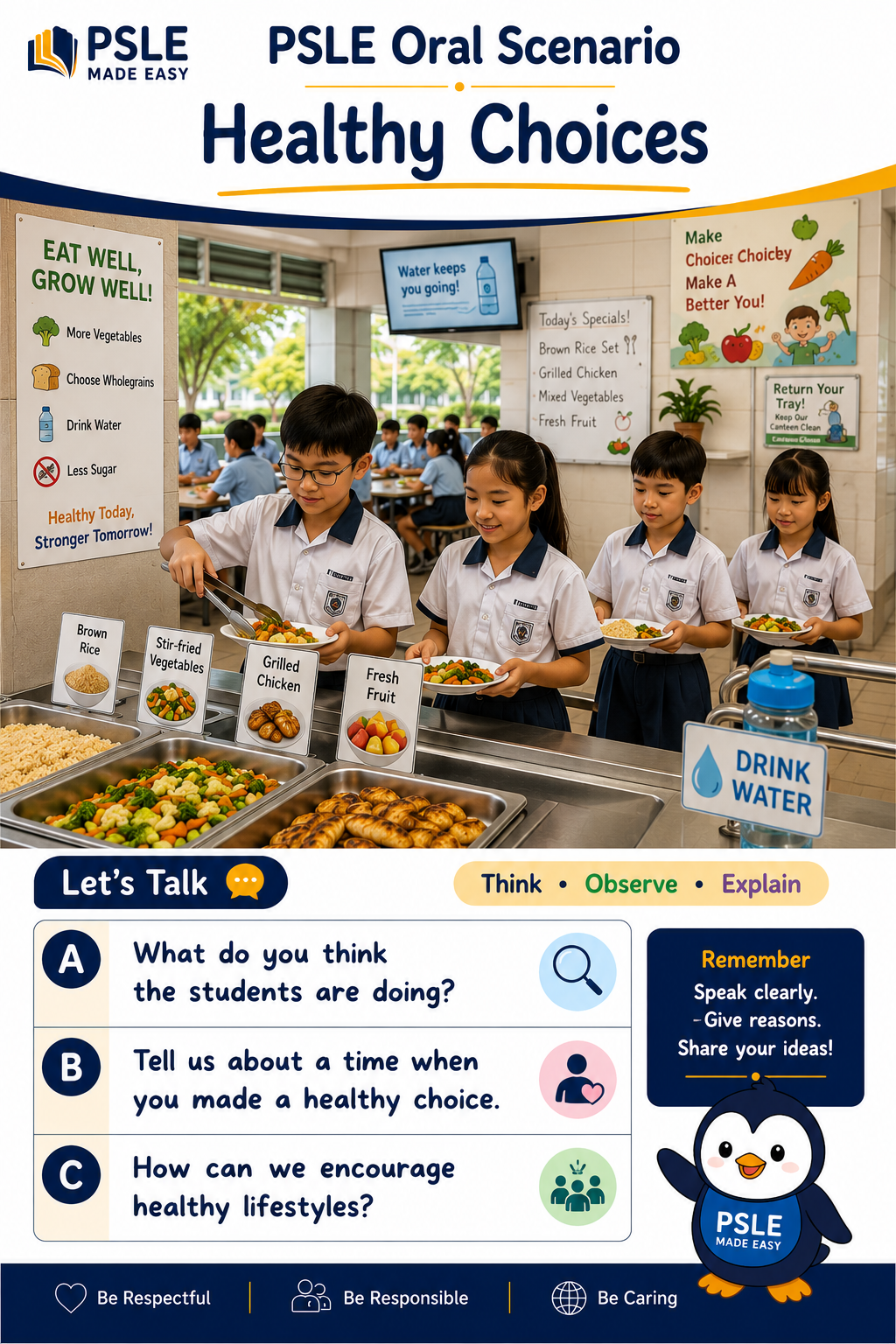
Students are at a food stall in the school canteen, looking up at a board that reads "Today's Specials! Brown Rice Set · Grilled Chicken · Mixed Vegetables · Fresh Fruit." Beside them, a poster titled "Make Healthy Choices" lists four habits: More Vegetables, Choose Wholegrains, Drink Water, Less Sugar.
Nearby signage reminds students to "Return Your Tray!" and "Keep Our Canteen Clean," and a smaller sign near the drink station says "Water keeps you going!" Two taglines frame the whole scene: "Eat Well, Grow Well!" and "Healthy Today, Stronger Tomorrow!"
At the bottom of the picture are the school's values: Be Respectful · Be Responsible · Be Caring.
What to notice for Q(a): This Q(a) does not ask how anyone feels — it asks what the students are doing. That means your answer needs to describe the specific action (reading the board, comparing options, deciding what to drink) and then explain what that action tells you about their attitude toward food, not just describe the canteen scene in general.
② Q(a) — Action Type ▼
The Question
“What do you think the students are doing?”
An Action Q(a) is asking you to interpret behaviour, not just narrate it. "They are buying lunch" describes the scene. A stronger answer names the specific action and explains what it reveals — are they comparing, hesitating, discussing?
Picture evidence you can use in your answer
- The "Today's Specials!" board — Brown Rice Set, Grilled Chicken, Mixed Vegetables, Fresh Fruit. This is a deliberately healthier set, singled out from the rest of the menu.
- The "Make Healthy Choices" poster right beside the queue — More Vegetables, Choose Wholegrains, Drink Water, Less Sugar. The students are standing exactly where this poster is impossible to miss.
- "Water keeps you going!" near the drink station — suggests the decision is not only about food, but about what to drink too.
- "Return Your Tray!" and "Keep Our Canteen Clean" — canteen conduct signs, showing the picture is about more than eating; it is about how students behave in a shared space.
- The taglines "Eat Well, Grow Well!" and "Healthy Today, Stronger Tomorrow!" framing the whole board.
- The footer values — Be Respectful, Be Responsible, Be Caring.
What a weak answer sounds like
“I think the students are buying their lunch in the canteen.”
True, but it says nothing the picture doesn't already show. No board, no poster, no reasoning — just a label for the setting.
What a stronger answer sounds like
“I think the students are standing at the counter looking closely at the 'Today's Specials' board, deciding between the Brown Rice Set and the other options, because the poster right beside them lists 'Choose Wholegrains' as one of the habits to build. It looks like they are weighing the specials against what they already know about eating well, rather than just picking whatever is fastest or most familiar. The 'Water keeps you going!' sign near the drink station suggests they might also be thinking about what to drink, not only what to eat.”
Why this works: Names the specials board, the poster, and the drink reminder specifically — and uses all three to explain what the action reveals, not just what it looks like.
Going Beyond — add this
“I also think the 'Return Your Tray!' and 'Keep Our Canteen Clean' signs tell us this picture isn't only about what goes on the tray — it's about how the students treat a shared space. A healthy choice here isn't just eating well; it's also being responsible for the canteen everyone uses.”
③ Q(b) — Personal Question ▼
The Question
“Tell us about a time when you made a healthy choice.”
Q(b) is always personal. The examiner wants a specific moment, not a habit you claim to have. "I always eat vegetables" is not a memory — it's a slogan. Give a moment: what you chose, what you gave up, and why it was actually a choice, not automatic.
What a weak answer sounds like
“Once, I chose to eat vegetables instead of junk food because I know vegetables are good for my health.”
No moment, no temptation, no actual choice being made. This could be said by any student without having experienced anything.
What a stronger answer sounds like
“Last month, my class had a birthday celebration and someone brought a huge box of curry puffs and fried chicken wings. I was really hungry after PE, and I almost took two pieces of chicken. But I remembered my mother had packed me a small container of grapes for recess, and I decided to eat those first before deciding if I still wanted the fried food. In the end I only took one piece, because I was already quite full from the grapes. It wasn't that I refused the fried food completely — I just chose to slow myself down first.”
Why this works: A real moment, a real temptation, a specific decision — and an honest outcome that isn't exaggerated into perfect discipline.
Going Beyond — add this
“That moment changed how I think about healthy eating. I used to think it meant never eating fried food at all. Now I think it just means pausing before you eat, instead of reaching for whatever is closest.”
④ Q(c) — Broader Opinion ▼
The Question
“How can we encourage healthy lifestyles?”
Q(c) asks for a broader view. The trap here is a list — "eat vegetables, exercise, sleep early" — recited without connecting to anything real. A stronger answer picks one method, explains why it actually works on people (not just what it is), and grounds it in something specific.
What a weak answer sounds like
“We can encourage healthy lifestyles by telling people to eat more vegetables, drink more water, and exercise regularly.”
A list of facts everyone already knows. Telling people what to do is not the same as explaining how to get them to actually do it.
What a stronger answer sounds like
“I think just telling people to eat healthily doesn't work very well, because most people already know that. What actually changes behaviour is making the healthy option the easy option — like how our canteen puts the 'Today's Specials' board right where everyone queues, so the healthier set is the first thing you see, not something you have to search for. If healthy food is placed in front of people and made convenient, they are more likely to choose it, even without being told to.”
Why this works: Takes a clear position, explains the reasoning behind it, and uses a specific detail from the picture as evidence — not a general statement.
Going Beyond — add this
“I also think encouragement works better than rules. A sign that says 'Water keeps you going!' feels different from a sign that says 'You must drink water.' One invites you to make a choice; the other just gives an order. I think people are more likely to build a habit when they feel like they chose it themselves.”
⑤ Going Beyond Yourself — for This Topic ▼
Healthy eating is a topic every student has an opinion on, which is exactly why most answers sound the same. The way to stand out is to be honest about how your own habits and thinking have actually changed — not to pretend you have always eaten perfectly.
Ask yourself: after sharing your personal choice, can you take one more step?
How my thinking has changed
Ask: “What did I used to believe about healthy eating that I no longer believe?”
“I used to think being healthy meant never eating anything unhealthy at all. Now I think it means noticing your choices most of the time, and not feeling guilty about the rest.”
Realising others must feel this too
Ask: “Who else has to make this same kind of decision every day?”
“It made me think about my grandmother, who has to be careful about her sugar intake because of her health. If it's hard for me to choose the healthier option once in a while, it must be much harder for her to do it every single day for years.”
What this makes me want to become
Ask: “Did this change what I want to do or who I want to be?”
“It made me want to be someone who chooses the healthier option without needing anyone to remind me — not because I'm told to, but because I've actually thought about why it matters.”
⑥ Values to Anchor Your Answers To ▼
The values on the infographic — Respect, Responsibility, Caring — are not just canteen rules. Each one gives your answer a different angle beyond "eating healthy is good for you."
🙏 Respect
What it means in oral: respecting the food and effort that goes into a meal, and respecting a shared space like the canteen enough to keep it clean for the next person.
Anchor line: “Returning my tray isn't just a rule — it's a small way of respecting the person eating at that table after me.”
📋 Responsibility
What it means in oral: taking responsibility for your own body — not waiting for a parent or teacher to choose your food for you, but actually thinking before you order.
Anchor line: “Being responsible for my health means making the healthier choice even when no one is checking what's on my tray.”
💛 Caring
What it means in oral: caring about your own body enough to notice how food actually makes you feel, and caring enough about others to encourage a friend's healthier choice without mocking them.
Anchor line: “Caring about my health isn't about being strict with myself — it's about paying attention to how I actually feel after I eat.”
“Every student has heard 'eat more vegetables' a hundred times. The ones who score at Band 5 are the ones who can point to something specific on that board and tell you what it actually made them think.”