How to Rank Your Ideas for Oral
A stronger oral answer does not come from saying more things. It comes from choosing the best idea for the question.
In oral, many students are able to think of something to say. However, the first idea that comes to mind may not always be the strongest idea.
Some answers are too general. Some answers are too personal. Some answers do not link closely enough to the question.
This is why students need a thinking routine. Before speaking, they can quickly consider different angles and decide which one gives the clearest, most relevant and most thoughtful response.
Parent Note
Many children struggle with oral not because they have no ideas, but because they do not know how to choose and organise their ideas.
At PSLE Made Easy, students are guided to rank their ideas before speaking. They learn to consider school, learning, personal experience, family, empathy and wider community impact.
The aim is not to make children memorise model answers. The aim is to help them make better thinking choices during oral.
Student Note
"I should not just say the first idea. I should choose the strongest idea for the question."
When you get an oral question, do not rush to say the first thing in your mind. Pause and ask yourself:
"Which angle gives me the strongest answer for this question?"
① Why Students Need to Rank Their Ideas
In oral, many students can think of something to say. But the first idea is not always the strongest idea.
Before speaking, students can quickly consider different angles and decide which one gives the clearest, most relevant and most thoughtful response.
For some questions, a personal example is strongest. For others, a family example feels more natural. For deeper questions, the strongest answer may come from empathy, wider perspective or community impact.
"A good oral answer is clear, relevant, supported and thoughtful."
② Example Topic: Technology / AI / Screen Time
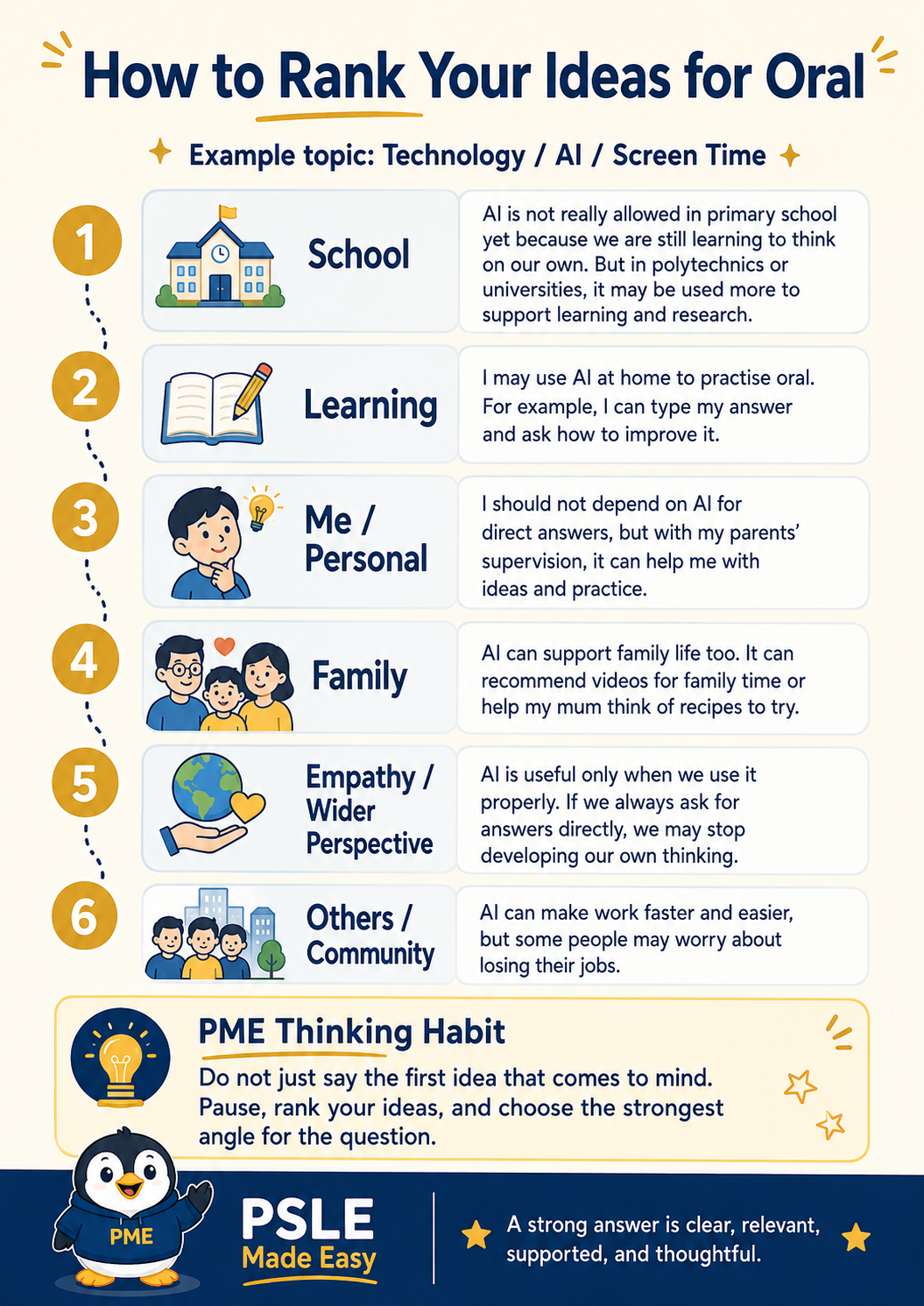
For a broad topic like technology, AI or screen time, students can think through six possible angles. Each angle points to a different type of idea — from personal experience to wider community impact.
School
AI is not really allowed in primary school yet because students are still learning to think on their own. However, in polytechnics or universities, AI may be used more to support learning, research and project work.
Learning
Even if AI is not freely used in school, a student may use it responsibly at home. For example, the student can type an oral answer and ask how the answer can be improved.
Me / Personal
A student may say that AI is useful but should not be used for direct answers. With a parent's supervision, AI can help the student get ideas, practise oral responses and improve explanations.
Family
AI can also support family life. It can recommend videos for family time, suggest places to visit, or help parents think of interesting recipes to try at home.
Empathy / Wider Perspective
AI is useful only when it is used properly. If students only ask AI for direct answers, they may take the easy way out and stop developing their own critical thinking.
Others / Community
AI can make work faster and easier for many people. However, some workers may worry about losing their jobs if machines can do certain tasks more quickly or cheaply.
③ The PME Thinking Habit
The goal is not to memorise one fixed answer. The goal is to help students think before they speak.
This helps students move from short, safe answers to more developed responses.
"Which angle gives me the strongest answer for this question?"
④ How This Helps in Oral
Ranking ideas helps students avoid one-line answers. It also prevents them from giving answers that sound memorised or disconnected from the question.
Instead of rushing, students learn to pause, choose and build.
Before speaking, students can quickly ask:
- Is my idea linked to the question?
- Can I give a real example?
- Can I explain why it matters?
- Can I move beyond myself when the question needs deeper thinking?
"I know what I want to say, why it matters, and how it connects to the question."
"A good oral answer is not just long. It is clear, relevant, supported and thoughtful."