Litter in the Park Pond
Theme: Environment & Community · Values: Responsibility, Care for Nature, Community Spirit
Parent Note
"We should keep the environment clean" is a sentence every child can say without thinking. What earns marks is a child who can describe a specific moment of noticing litter or mess, and what they actually did — not just a general statement of concern.
Ask your child to recall an actual instance of picking up litter, reminding someone not to litter, or joining a cleanup — at school, in the neighbourhood, or at a park — rather than answering in the abstract.
Student Note
“The examiner has heard 'we should keep our environment clean' a hundred times today. What they have not heard is what the children in this picture are actually feeling as they look at that pond, and a real moment when you did something about litter yourself.”
① Read the Picture First ▼
Before answering any question, spend ten seconds reading the picture properly. Not just "a dirty pond." Look at who else is in the scene and what they're each doing about it.
What you can see
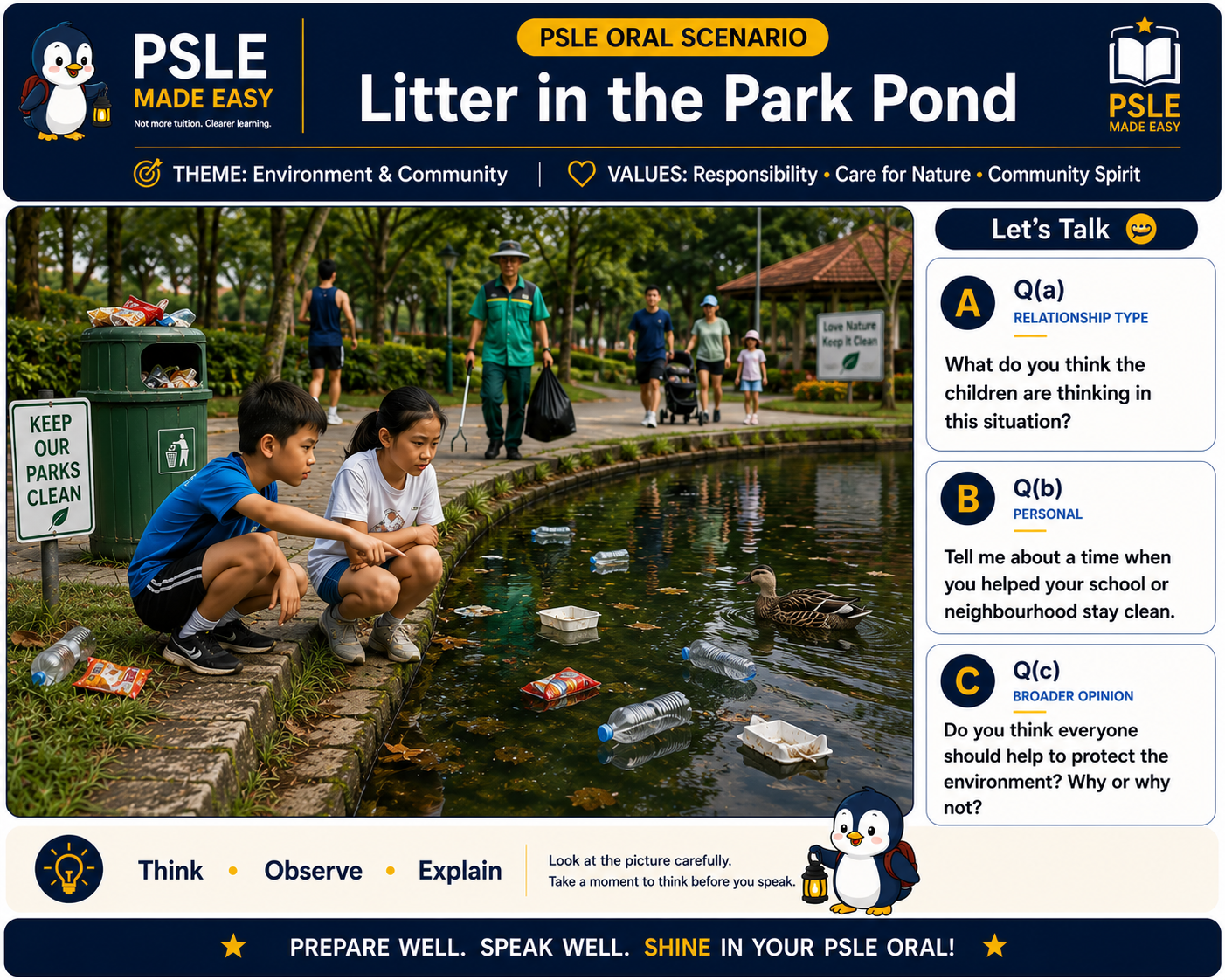
Two children are crouched at the edge of a park pond, looking at litter floating in the water — plastic bottles, food packaging, and a styrofoam container — while a duck swims nearby, seemingly unbothered. A "Keep Our Parks Clean" sign stands right next to them, beside a rubbish bin that's visibly overflowing.
In the background, a park maintenance worker walks along the path carrying a litter-picker and a rubbish bag, while joggers and a family with a stroller pass by without stopping. The children are the only ones actually pausing to look closely at the pond.
What to notice for Q(a): This Q(a) is explicitly labelled a Relationship type — it asks what the children are thinking, which means your answer should explore their internal reaction to the scene, not just describe the litter itself.
② Q(a) — Relationship Type ▼
The Question
“What do you think the children are thinking in this situation?”
A Relationship Q(a) wants their internal reaction, not just "they see litter." Use the contrast between the children and everyone else in the scene to build a real answer.
Picture evidence you can use in your answer
- The duck swimming among the litter — a living creature sharing the water with the rubbish makes the problem feel immediate, not abstract.
- The overflowing bin right next to the "Keep Our Parks Clean" sign — the sign and the overflowing bin sitting side by side is an obvious contradiction, worth pointing out directly.
- The park cleaner in the background — shows someone is already employed to deal with this, which raises the question of why it's still happening.
- Everyone else walking past without stopping — the joggers and the family with a stroller continue on, while only the children pause — this contrast is the heart of a strong answer.
What a weak answer sounds like
“I think the children are thinking that the pond is dirty and people should not litter.”
States the obvious fact of the scene without any real interpretation of what the children might specifically be feeling.
What a stronger answer sounds like
“I think the children are probably confused and a little upset, because right next to them is a sign that says 'Keep Our Parks Clean,' and yet the bin beside it is overflowing and the pond is full of rubbish anyway. It might make them wonder why a sign and a bin aren't enough to stop people from littering. I also think they might feel sorry for the duck swimming through the mess, since it has no way to understand or avoid the litter the way a person could. Everyone else in the picture — the joggers, the family — is walking past without stopping, so the children might also be noticing that they seem to be the only ones actually bothered enough to stop and look.”
Why this works: Uses the sign-versus-bin contradiction, the duck, and the passing crowd to build a layered, specific interpretation instead of one flat emotion.
Going Beyond — add this
“I also think the children might be deciding whether to do something themselves — like telling an adult or picking up a piece of litter — or just accepting that it's someone else's job to fix, since a cleaner is right there in the background.”
③ Q(b) — Personal Question ▼
The Question
“Tell me about a time when you helped your school or neighbourhood stay clean.”
This can be something small — picking up a wrapper, reminding a classmate, joining a class cleanup duty — as long as it's a specific, real moment, not a general habit.
What a weak answer sounds like
“I always throw my rubbish in the bin and never litter.”
Not littering isn't the same as helping — this describes an absence of bad behaviour, not an actual moment of effort.
What a stronger answer sounds like
“Last term, my class was assigned recess cleanup duty for a week, which most of us saw as a chore at first. On the second day, I noticed a group of younger students had left a whole tray of food wrappers under a table, clearly in a rush to get back to class. Instead of just clearing it myself, I found them at assembly the next day and explained why it mattered, since our own class would be blamed if the area was found messy during inspection. A few of them actually apologised and started being more careful after that.”
Why this works: Specific assignment, a real problem encountered, and an action that goes beyond personal tidiness into actually influencing someone else's behaviour.
Going Beyond — add this
“That experience taught me that keeping a place clean isn't really about picking up rubbish — it's about getting other people to care enough not to leave it there in the first place.”
④ Q(c) — Broader Opinion ▼
The Question
“Do you think everyone should help to protect the environment? Why or why not?”
This question almost guarantees a "yes, of course" answer. The trap is stopping there — a stronger answer explains what "helping" actually requires from an individual, and whether that's realistic for everyone.
What a weak answer sounds like
“Yes, everyone should help protect the environment because the environment is important for everyone.”
Circular reasoning — the environment being "important" doesn't explain why individual action follows from that.
What a stronger answer sounds like
“I think everyone should help, but I don't think that means everyone needs to do the same thing, like joining a beach cleanup. For some people, helping might just mean being careful never to litter and correcting a friend who does. What I think matters more than everyone doing something big is nobody assuming it's someone else's responsibility — like the park cleaner in this picture — because that's exactly the thinking that lets an overflowing bin sit right next to a sign asking people not to litter.”
Why this works: Distinguishes between different scales of "helping," and ties the reasoning directly back to a specific contradiction visible in the picture (the sign next to the overflowing bin).
Going Beyond — add this
“I also think signs alone rarely change behaviour — the 'Keep Our Parks Clean' sign in this picture clearly hasn't stopped the littering, which suggests real change needs something more than a reminder, like a genuine sense of ownership over a shared space.”
⑤ Going Beyond Yourself — for This Topic ▼
Keeping the environment clean is a topic every student can recite the "correct" view on, which is exactly why the answers tend to blur together. The way to stand out is honesty about a moment you actually did something, even something small, rather than a general claim to always be tidy.
Ask yourself: after sharing your personal moment, can you take one more step?
How my thinking has changed
Ask: “What did I used to believe about keeping public places clean that I no longer believe?”
“I used to think it was mainly the cleaners' job to deal with litter, since that's literally what they're paid to do. Now I think relying only on them is part of why the problem keeps happening — cleaning up after people doesn't stop them from littering again.”
Realising others must feel this too
Ask: “Who else has to deal with this problem regularly, without much recognition?”
“It made me think about park cleaners and school janitors, who clean up the same kind of mess every single day, probably without anyone ever thanking them or even noticing the work.”
What this makes me want to become
Ask: “Did this change what I want to do or who I want to be?”
“It made me want to be someone who says something in the moment, like reminding a friend not to litter, instead of just quietly judging and walking past like everyone else in that picture.”
⑥ Values to Anchor Your Answers To ▼
The values printed on the infographic — Responsibility, Care for Nature, Community Spirit — each give your answer a different angle beyond "littering is bad."
📋 Responsibility
What it means in oral: responsibility means not waiting for someone else — a cleaner, a sign, a rule — to solve a problem you noticed yourself.
Anchor line: “Noticing litter and walking past it anyway is its own kind of choice.”
🌿 Care for Nature
What it means in oral: care for nature means thinking about the creatures actually affected — like the duck in this picture — not just the appearance of a clean park.
Anchor line: “A clean-looking park still isn't clean if the animals living in it are swimming through rubbish.”
🤝 Community Spirit
What it means in oral: community spirit means treating a public pond or park the way you'd treat your own home, since it belongs to everyone equally and no one exclusively.
Anchor line: “A shared space stays clean only when everyone treats it like it's partly theirs to look after.”
“Every student knows they should keep the environment clean. The ones who score at Band 5 are the ones who can describe a real moment they actually did something, not just a general promise never to litter.”