PSLE Maths: Build the Number Spine
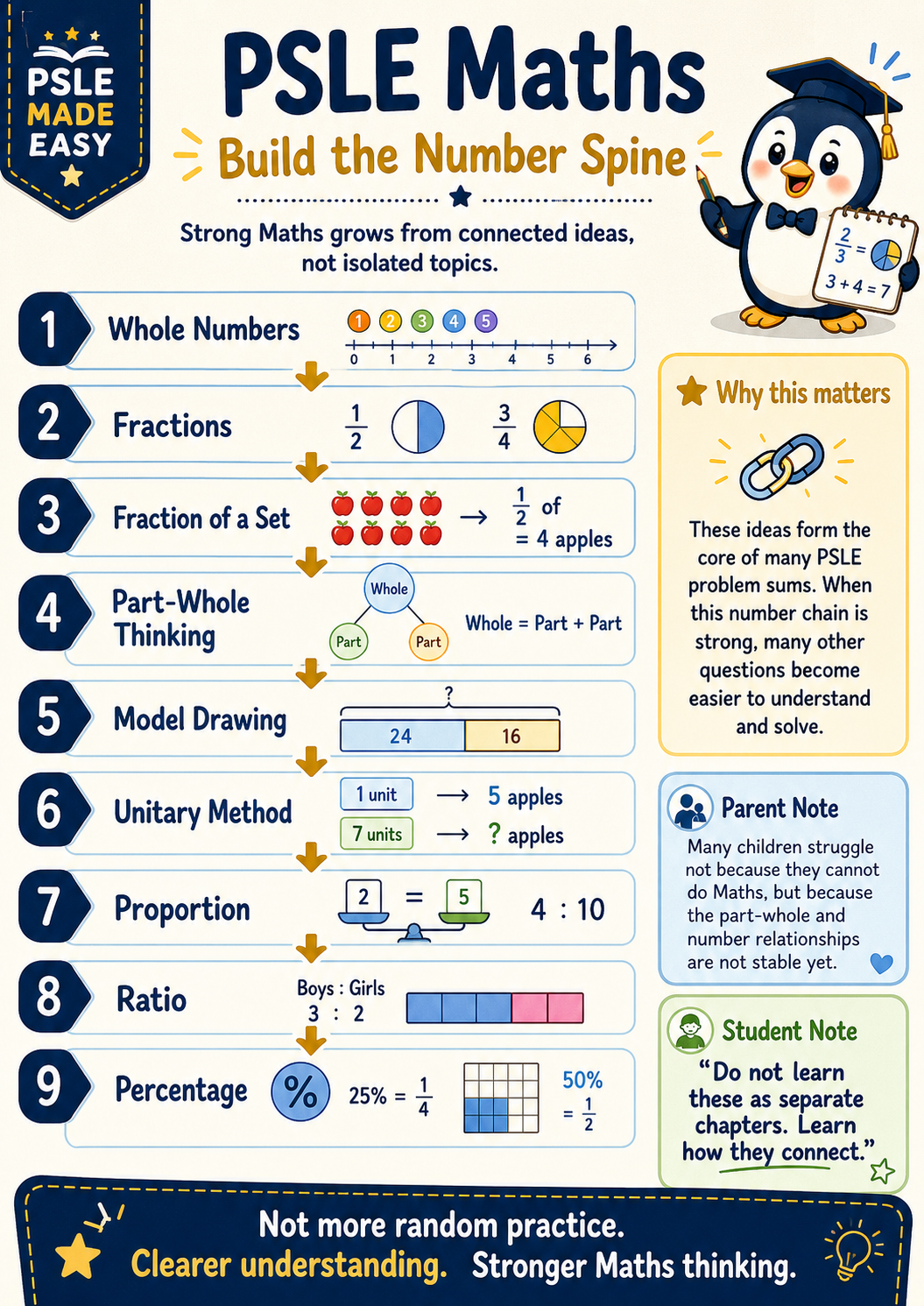
Build the Number Spine
Strong Maths grows from connected ideas, not isolated topics.
PSLE Maths should not be treated as many separate chapters to memorise one by one.
At the heart of many problem sums is a connected number-thinking chain:
whole numbers → fractions → fraction of a set → part-whole thinking → model drawing → unitary method → proportion → ratio → percentage
When this chain is strong, students can understand many questions more clearly. When this chain is weak, students may know the “topic” but still struggle when the question mixes ideas together.
“The centre of PSLE Maths is not random practice. It is connected number thinking.”
Parent Note
Many children do not struggle with Maths because they are incapable. They struggle because the part-whole number relationships are not stable enough yet.
A child may learn fractions, ratio and percentage as separate chapters. But PSLE problem sums often require the child to see how these ideas connect inside one situation.
This is why revision should not only be about doing more papers. The child must understand the number relationships behind the question.
Once the number spine is stronger, model drawing, unitary method, ratio, percentage and proportion questions become easier to understand and solve.
Student Note
“Do not learn whole numbers, fractions, ratio and percentage as separate chapters.”
“Learn how they connect.”
“When you understand the part-whole relationship, the question becomes clearer.”
① Whole Numbers: The Starting Point
Whole numbers build calculation sense. Students need to be comfortable with the four operations, comparison, estimation, place value and number relationships.
If whole-number sense is weak, later topics become shaky. Students may know the method but still make careless calculation errors, misread quantities or fail to compare values properly.
Whole numbers are not just “easy marks”. They are the foundation for later reasoning.
“Before the question becomes difficult, the number sense must be steady.”
② Fractions: The First Big Part-Whole Idea
Fractions teach students to think in parts and wholes. This is one of the most important shifts in upper primary Maths.
Students must know what the denominator represents, what the numerator represents, and whether the question is referring to a part, a whole, a remaining amount, a changed amount or a comparison.
A fraction is not just a number to calculate. It is a relationship.
“A fraction always tells you something about the whole.”
③ Fraction of a Set: Where Many Problem Sums Begin
Fraction of a set helps students connect fractions to real quantities.
For example, one-half of eight apples is four apples. This may look simple, but it prepares students for much harder questions involving groups, units, sharing, comparison and change.
Many model-drawing questions begin with this idea: a fraction is used to describe part of a set, and students must work out what the whole or another part is.
“Fraction of a set helps you turn parts into actual quantities.”
④ Part-Whole Thinking: The Bridge to Model Drawing
Part-whole thinking is one of the most important ideas in PSLE Maths.
Students must be able to ask: What is the whole? What are the parts? Has one part changed? Are we comparing two parts? Are we finding the original whole or the new whole?
This thinking leads naturally into model drawing. A model is not just a drawing. It is a way to show the relationship between parts and wholes.
“Before drawing the model, know what the whole is.”
⑤ Model Drawing: Showing the Relationship
Model drawing helps students see the structure of a problem sum.
A good model shows what is known, what is unknown, what is being compared and how the quantities relate to one another. It helps students avoid guessing which operation to use.
However, models only work when students understand the relationship. Drawing boxes without understanding the part-whole situation will not help.
“The model is not the answer. The model shows the thinking.”
⑥ Unitary Method: Finding One Unit First
The unitary method is one of the most powerful tools in upper primary Maths.
The idea is simple: find the value of one unit first, then use that to find the value of many units.
This method supports fraction questions, ratio questions, percentage questions and many word problems involving comparison or proportion.
“Find one unit first. Then the rest of the question becomes clearer.”
⑦ Proportion: When Quantities Move Together
Proportion is about how quantities change in relation to one another.
If one quantity doubles, does the other double? If one quantity becomes half, what happens to the other? Does the relationship stay the same?
Students who understand proportion can handle many questions involving scaling, comparison, ratio and percentage more confidently.
“Proportion helps you see how quantities move together.”
⑧ Ratio: Comparing Parts
Ratio is another way of describing part-whole and part-part relationships.
Students must know whether the ratio compares one part to another part, or whether they need to find the total number of units first.
Many ratio questions become easier when students see the units clearly and connect them back to model drawing and unitary method.
“Ratio is not just two numbers with a colon. It is a relationship between quantities.”
⑨ Percentage: Another Language for Parts and Wholes
Percentage is another way to describe part of a whole.
Students should connect percentage to fractions and decimals. For example, 25% is one-quarter and 50% is one-half.
Percentage questions often involve original amount, new amount, increase, decrease, discount or comparison. Students must know what the 100% refers to.
“In percentage questions, always ask: 100% of what?”
⑩ Why This Number Spine Matters
The number spine matters because many PSLE Maths problem sums do not test topics in isolation.
A question may look like a fraction problem, but require model drawing. A ratio question may require unitary method. A percentage question may depend on part-whole thinking. A word problem may require students to identify the original whole before calculating anything.
This is why students should not only ask, “What topic is this?” They should also ask, “What is the relationship between the quantities?”
“The topic tells you where the question comes from. The relationship tells you how to solve it.”
⑪ How Students Should Revise
Instead of doing random practice, students should revise the number spine in order.
- Check whole-number calculation and comparison.
- Revise fractions as parts of a whole.
- Practise fraction of a set.
- Identify parts and wholes in word problems.
- Draw models to show relationships.
- Use unitary method to find one unit first.
- Connect proportion, ratio and percentage back to units and wholes.
The goal is not to memorise every possible question type. The goal is to understand the relationships well enough to handle unfamiliar questions.
“Do not just practise the answer. Practise seeing the relationship.”
Already have Koobits through school?
Most students have access but do not use it intentionally. Find out how to use it well for targeted Maths revision.
Using Koobits Well →Sources and Further Reading
- PSLE Mathematics 2026 syllabus: SEAB PSLE Mathematics 0008
- Primary Mathematics syllabus: MOE Primary Mathematics Syllabus
“Not more random practice. Clearer understanding. Stronger Maths thinking.”