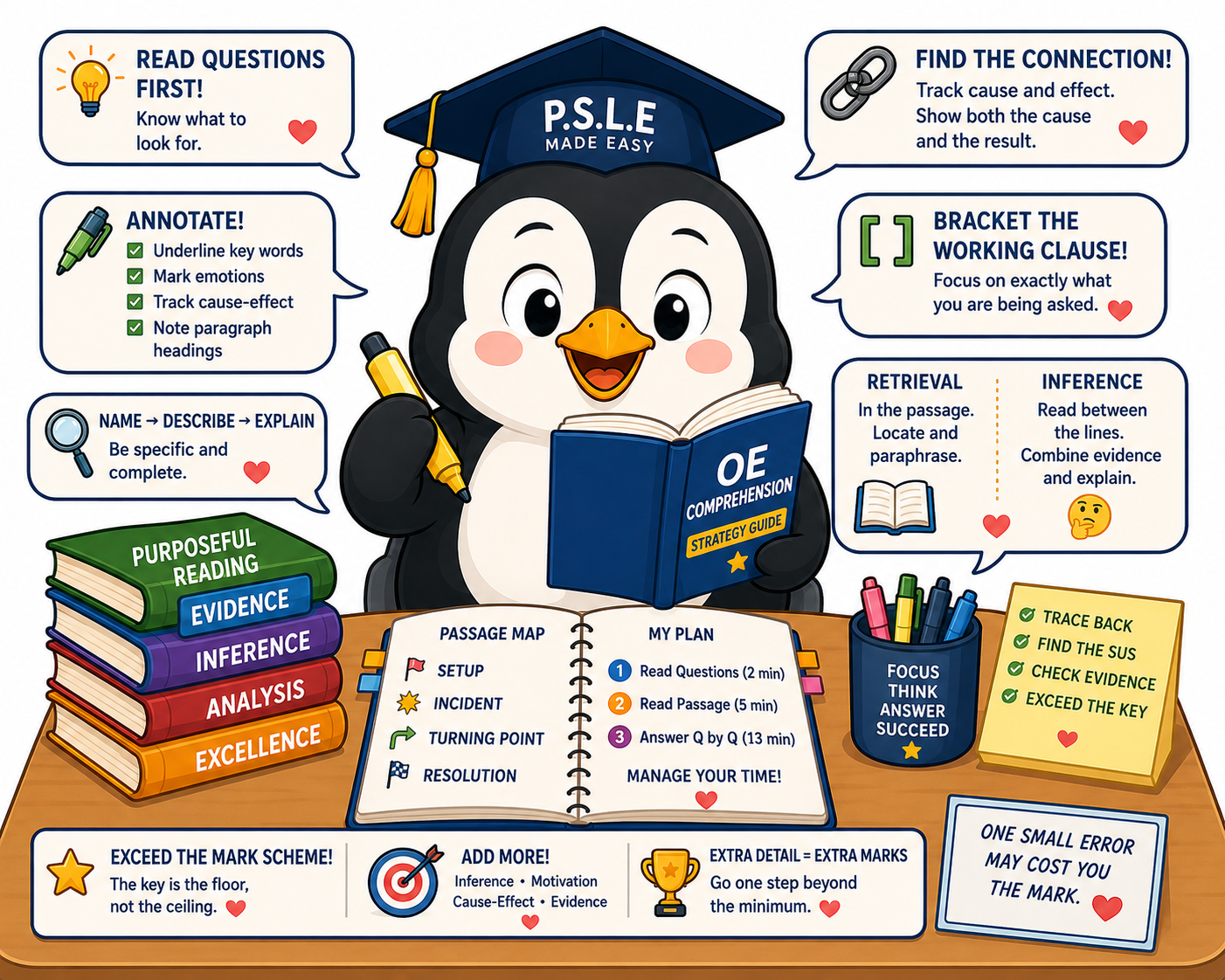
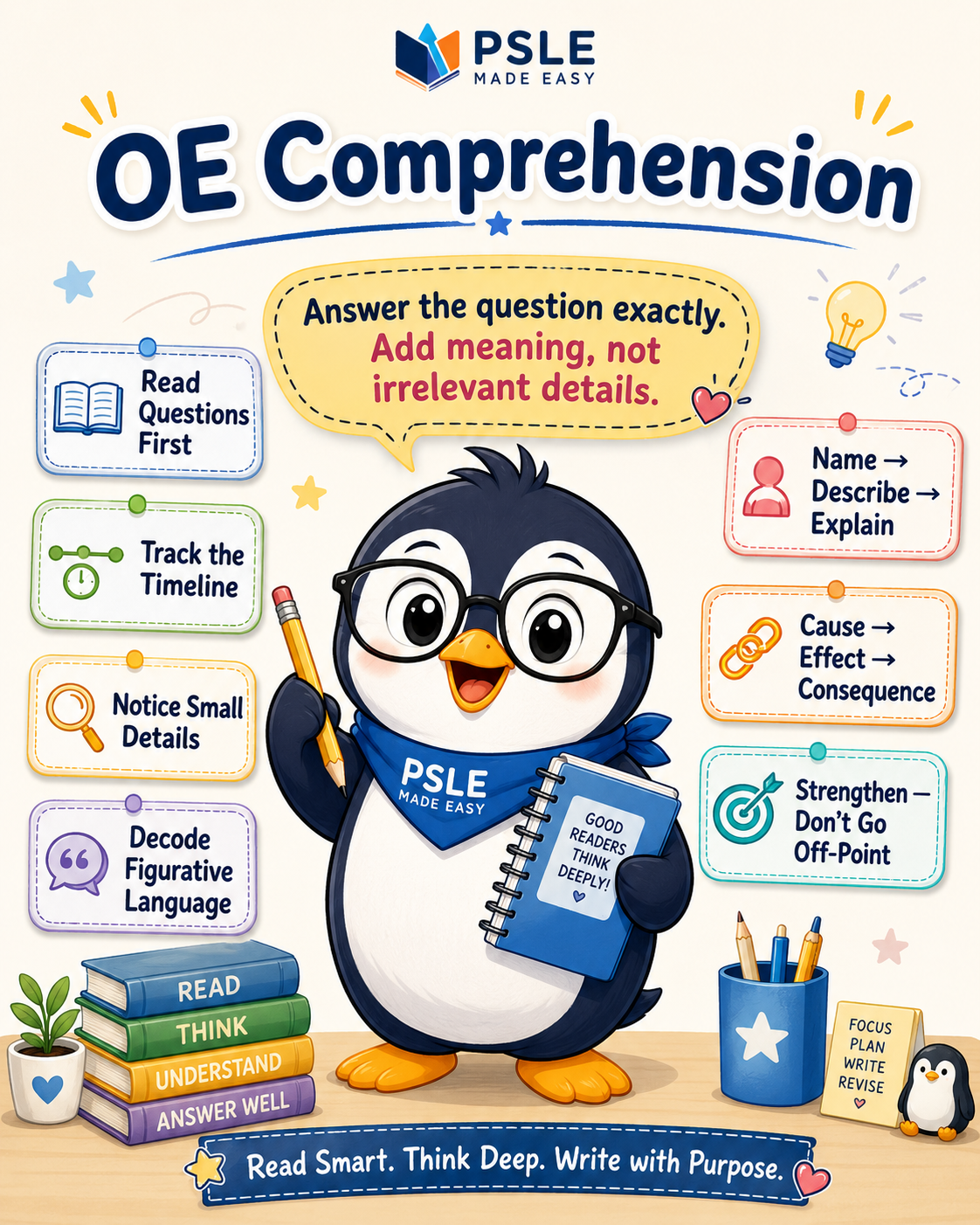
Read With Purpose. Answer With Evidence.
Answer the question exactly. Add meaning, not irrelevant details.
OE Comprehension tests purposeful reading, evidence selection and clear answering. Every question has a specific demand — bracket it, answer it exactly, then add meaning.
The mark scheme is the floor, not the ceiling. Students who exceed it consistently score higher.
Parent Note
OE Comprehension answers lose marks most often because students are vague — they use pronouns instead of names, quote without explaining, or explain without evidence. When checking your child’s answers, ask three questions: who or what are they talking about? What is the evidence? What does it show or mean?
Encourage your child to go one step beyond the minimum. Add inference, motivation, cause-effect or extra textual evidence. The mark scheme is the floor, not the ceiling — and the habit of exceeding it is what separates AL1 answers from AL2 answers.
Student Note
“Answer the question exactly. Add meaning, not irrelevant details.”
“Name. Describe. Explain. Never answer with pronouns only.”
“The key is the floor, not the ceiling. Exceed it.”
“Go one step beyond the minimum, but do not wander away from the question.”
① Read Questions First
Scan ALL questions before reading the passage. Know what to look for before your eyes hit the text.
Each question points to a specific part of the passage. Reading the questions first turns passive reading into purposeful scanning.
“Know what to look for before reading. The questions are your map.”
② Read for Timeline and Little Details
As you read, track:
- Sequence of events — what happened first, next, last?
- What changed — how is the situation different by the end?
- What caused the change — what triggered the turning point?
- Why small details matter — minor details often carry the marks.
“Little details are not decoration. They are often where the marks live.”
③ Annotate While Reading
Mark the passage actively as you read:
- Underline key phrases.
- Number paragraphs.
- Mark emotions, turning points and cause-effect moments.
- Label margins: Setup / Problem / Incident / Turning Point / Realisation / Resolution.
“A marked passage is faster to search when answering.”
④ Name → Describe → Explain
Every OE answer should follow this structure:
- Name — who or what specifically? Never use pronouns only.
- Describe — what happened? What is the evidence from the passage?
- Explain — why does it matter? What does it show?
“Vague answers lose marks. Be specific and complete.”
⑤ Cause and Effect Tracking
Track the full chain: Cause → Immediate Effect → Later Consequence.
2-mark questions require BOTH parts. One part alone earns 1 mark maximum.
“Show both the cause and the result. One side is not enough.”
⑥ Bracket the Working Clause [ ]
Bracket the quoted phrase or line reference in the question. Answer only the bracketed part — not everything around it.
This focuses the answer and prevents students from writing everything they know about a paragraph.
“Focus on exactly what you are being asked. Bracket it. Answer it.”
⑦ Decode Figurative Language
Translate figurative language into plain meaning first. Never copy it blindly into the answer.
- “His heart sank” → he felt disappointed or worried.
- “She was rooted to the spot” → she was too shocked or frightened to move.
- “The weight of the world was on his shoulders” → he felt heavily burdened or overwhelmed.
“Translate first. Then use the plain meaning in your answer.”
⑧ Inference vs Retrieval
Know which type of question you are answering:
- Retrieval — the answer is directly in the passage. Locate it and paraphrase. Do not copy word for word.
- Inference — the answer is not stated. Read between the lines. Combine evidence from different parts and explain what it shows.
“Retrieval finds. Inference connects.”
⑨ True / False — Find the SUS Part
The false option usually has ONE suspicious part. Locate the passage line that contradicts it.
The option is not fully false — one suspicious word or phrase makes the whole option false. Find that part.
“Trace back. Find the suspicious part. Check it against the passage.”
⑩ Referencing — Trace Back
Trace the pronoun or reference word back to the nearest noun, person, object or event it replaces.
The answer must describe clearly — not just name vaguely.
“Trace back to the exact referent. Name it specifically.”
⑪ Exceed the Mark Scheme
The official key is the floor, not the ceiling. After giving the minimum required answer, add:
- Specific textual evidence.
- The connection between evidence and meaning.
- Character motivation — why did they do or feel this?
- Consequence — what resulted from this action or feeling?
“Extra detail equals extra marks. Stay focused but go one step beyond.”
⑫ Answer Once, Then Return to Strengthen
Complete the full OE section once, then return if time allows. When returning:
- Add missing evidence.
- Improve weak explanations.
- Remove irrelevant details that do not answer the question.
“First pass: answer all. Second pass: strengthen the weakest answers.”
“Evidence first. Explanation next. Relevance always.”