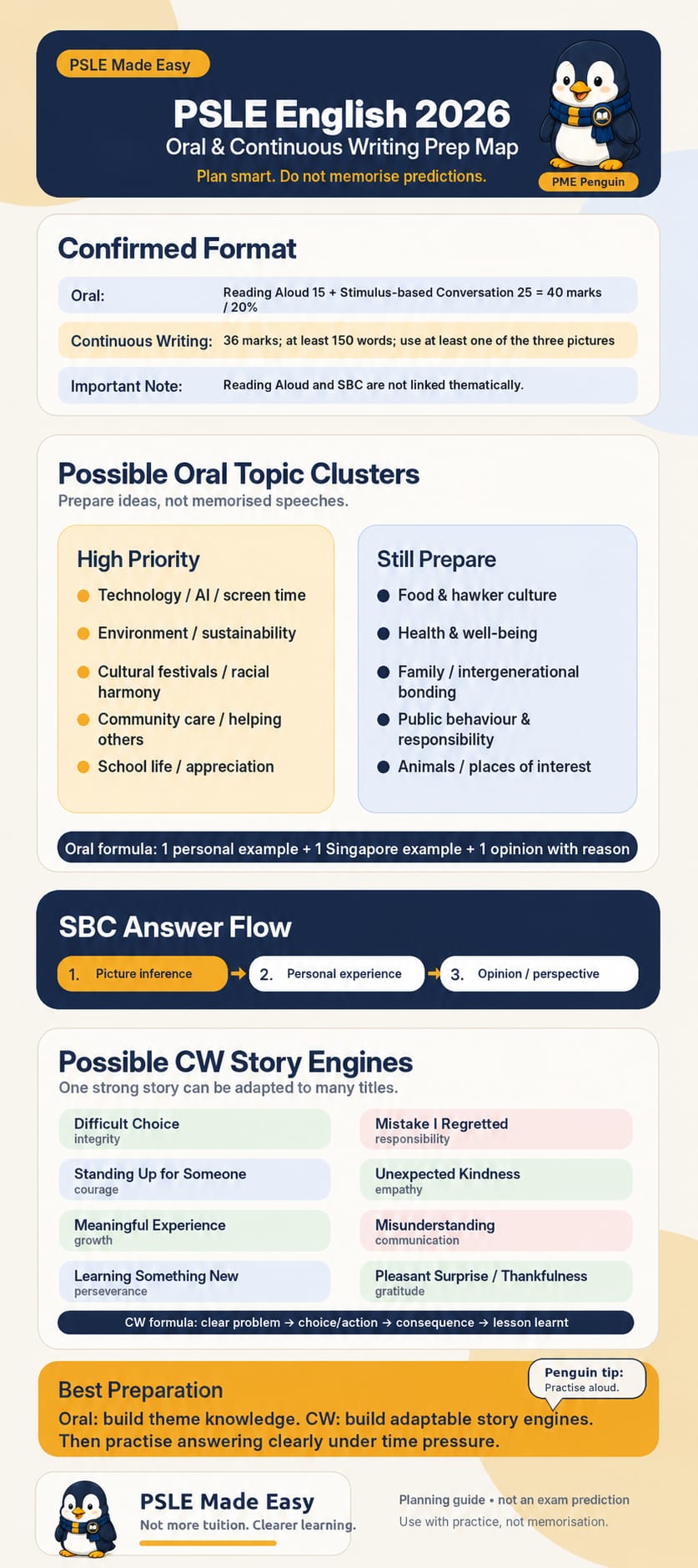
PSLE English 2026: Oral & CW Prep Map
This is what I gave my class. Here is the thinking behind it.
This prep map is built for PSLE 2026 — specifically for my students preparing now. It is not a prediction. It is a planning tool.
The infographic above shows the big picture. This page explains the reasoning behind each section, so students and parents understand not just what to prepare, but why.
Parent Note
The instinct when PSLE approaches is to do more. More papers. More topics. More memorisation. This page is asking your child to do something different — to prepare smarter.
Oral and Continuous Writing together account for 38% of the total English mark. They are also the two components where a student who understands the task clearly has the biggest advantage over one who is just grinding through practice.
Student Note
"Plan smart. Do not memorise predictions."
① The Format — What Is Actually Being Tested
Oral is worth 40 marks and carries 20% of the total English score. That is more than Continuous Writing, which carries 18%. Many students treat Oral as secondary. The marks say otherwise.
Oral is split into Reading Aloud (15 marks) and Stimulus-Based Conversation (25 marks). Reading Aloud tests pronunciation, fluency and expressiveness. The SBC tests whether you can observe, connect to personal experience and give a considered opinion.
One important thing the infographic flags: Reading Aloud and the SBC picture are not linked thematically. The passage you read aloud is separate from the topic you will be asked to discuss. Do not waste time trying to predict the connection — there is none.
Continuous Writing is 36 marks and requires at least 150 words. At least one of the three pictures provided must be used. That is a rule, not a suggestion.
② Oral Topic Clusters — Why These, and Not Others
The clusters on the prep map are not guesses. They are based on the types of topics that appear repeatedly in PSLE and school-based oral assessments — topics where students are expected to have genuine ideas, not scripted answers.
The High Priority cluster — Technology and AI, Environment, Cultural harmony, Community care, School life — represents areas where most students already have real experiences to draw from. They also represent topics where a Singapore example is easy to find and a personal example is natural.
The Still Prepare cluster — Food and hawker culture, Health, Family, Public behaviour, Animals — is not less likely. It just requires slightly more deliberate preparation because students sometimes struggle to find a strong personal angle quickly.
The goal is not to memorise a speech for each topic. The goal is to have enough genuine ideas that when the examiner asks a question, you are not scrambling.
"Prepare ideas, not memorised speeches."
③ The SBC Answer Flow — Picture → Personal → Opinion
Every SBC answer follows the same flow: start with what you observe in the picture, connect it to a personal experience, then give your opinion or perspective with a reason.
Most students rush to the opinion. They skip the picture or mention it briefly and jump straight to what they think. This loses marks. The picture is the starting point of the conversation — the examiner chose it deliberately. Showing that you can read a picture carefully and infer what is happening is part of what is being assessed.
The personal experience step is where students connect the picture to something real in their own life. It does not have to be dramatic. It has to be specific. A vague answer — "I also care about the environment" — is weaker than a specific one: "When my class did the recycling drive last year, I noticed that most students did not know which bin to use."
The oral formula on the prep map — 1 personal example + 1 Singapore example + 1 opinion with reason — is the structure that carries a Band 4 or 5 answer. All three parts need to be present.
"Read the picture. Connect to your life. Give your view with a reason."
④ CW Story Engines — One Strong Story, Many Titles
The eight story engines on the prep map — Difficult Choice, Mistake I Regretted, Standing Up for Someone, Unexpected Kindness, Meaningful Experience, Misunderstanding, Learning Something New, Pleasant Surprise — are not eight separate stories to memorise. They are eight frames for the same kind of story.
Each frame has a value underneath it: integrity, responsibility, courage, empathy, growth, communication, perseverance, gratitude. That value is what the story must demonstrate. A student who has one strong personal story — something real that happened to them, something that changed how they thought or acted — can usually adapt that story to fit most of these frames by adjusting the emphasis.
The CW formula is: clear problem → choice or action → consequence → lesson learnt. A composition that follows this structure clearly and honestly will score better than one packed with impressive phrases but no clear story direction.
The question students need to answer before they start writing is not "what sounds good?" It is: "what is the real problem in this story, and what did the character choose to do about it?"
"One strong story can be adapted to many titles. Build the story first."
⑤ The Best Preparation — What It Actually Looks Like
For Oral: build theme knowledge. Read about the High Priority topics. Know one or two real Singapore examples for each. Practise speaking your ideas aloud — not reading a script, but actually forming sentences under mild time pressure. The examiner is not looking for a rehearsed speech. They are looking for a student who can think and speak at the same time.
For CW: build adaptable story engines. Identify two or three real experiences from your own life that carry emotional weight. Practise fitting them to different title types. Then practise writing under time pressure — 150 words minimum, with a clear structure and a picture used.
The prep map closes with the most important line: practise answering clearly under time pressure. Preparation that never involves any pressure is not preparation for an exam. It is preparation for calm conditions that do not exist on the day.
"Oral: build theme knowledge. CW: build adaptable story engines."
"Then practise answering clearly under time pressure."
This page was created by John C. for PSLE 2026 students at Huamin Primary School.
It is part of the PSLE Made Easy system — planning guide, not exam prediction.
© PSLE Made Easy · pslemadeeasy.com · Not more tuition. Clearer learning.