School Project Teamwork
Theme: School & Learning · Values: Teamwork, Responsibility, Respect
Parent Note
School projects and teamwork are familiar to every P6 child — which is exactly why answers tend to sound the same. "We worked together." "We divided the tasks." "We finished on time." These are not wrong, but they are not memorable either.
What the examiner is looking for is a child who can describe what it actually felt like to be in a team — the friction, the negotiation, the moment when something clicked. Use this page to help your child recall a specific group project and practise talking about it honestly.
Student Note
“The examiner has heard 'we cooperated and finished the project' a hundred times today. What they have not heard is your story — the specific moment when something went wrong, or someone stepped up, or you realised what your role really was. That is what you should be preparing.”
① Read the Picture First ▼
Before answering any question, spend ten seconds reading the picture properly. Not just "students in a classroom." Look at what each person is doing and what it tells you about who they are in this group.
What you can see
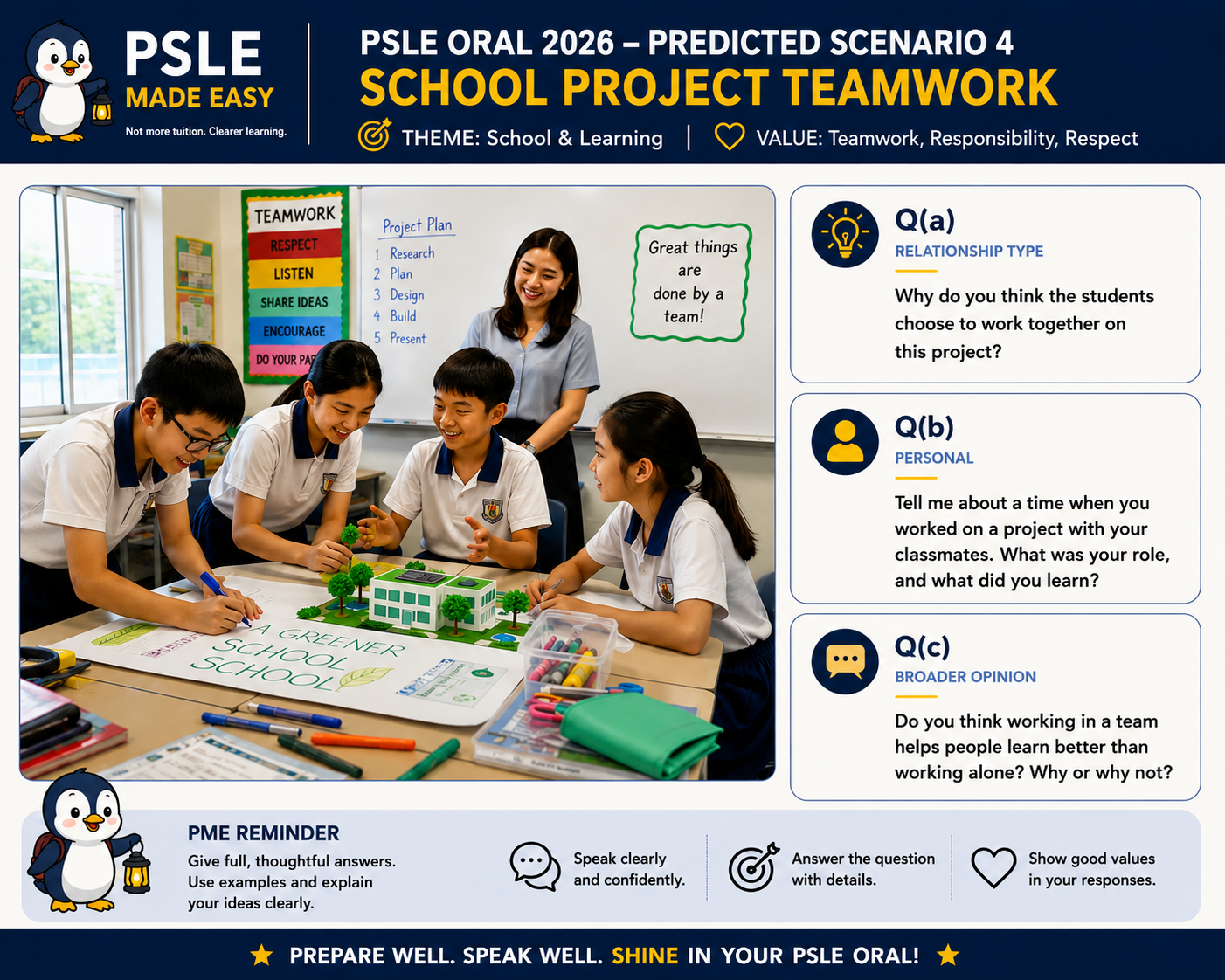
Four students are gathered around a table with a model of a building and drawings — clearly a group project. Their teacher stands in the background, watching. One student appears to be pointing or explaining something; another is leaning in to look; the others are engaged.
On the board behind them: Teamwork · Respect · Listen · Share Ideas · Encourage · Do Your Part. These are not decorations — they are the values the picture is built around.
The project title visible on the drawing: A Greener School.
What to notice for Q(a): The Q(a) for this scenario is a Relationship type — it asks why the students chose to work together, not just how they feel. This means your answer needs to go beyond emotions and explain the relationship dynamic or purpose behind the collaboration.
② Q(a) — Relationship Type ▼
The Question
“Why do you think the students chose to work together on this project?”
A Relationship Q(a) is asking you to explain why — not just describe what you see. The picture gives you a lot to work with. Use it. Answers that name specific things in the picture always land better than answers that stay general.
Picture evidence you can use in your answer
- The project name on the drawing: “A Greener School.” This is not a simple task — it requires research, planning, and building. One person alone could not do all of that well.
- The 3D model on the table. Someone built this. Someone else drew the plans. The work is divided by skill, not by chance.
- The board behind them lists: Teamwork · Respect · Listen · Share Ideas · Encourage · Do Your Part. These values did not appear by accident — they frame the entire project.
- The quote on the board: “Great things are done by a team.” The students chose to work together because they — or their teacher — believe this.
- Coloured pens, markers, and drawing materials spread across the table. Different people are working on different things simultaneously.
- The teacher watching from the background — not directing, just present. The students are leading the work themselves.
What a weak answer sounds like
“I think the students worked together because the teacher told them to and they wanted to finish the project.”
No picture evidence. No reasoning about the project itself. This answer ignores everything the picture actually shows.
What a stronger answer sounds like
“I think they chose to work together because the project — designing a greener school — is too big and too complex for any one person to do well. You can see this in the picture: there is a 3D model on the table, hand-drawn plans spread out, and different students handling different materials. One person is explaining something to the group, another is leaning in to look at the details. Each of them is contributing something different. The board behind them even has the words 'Share Ideas' and 'Do Your Part' — which suggests this class has been taught that a project like this only works when everyone takes ownership of their own role. No single student could have built the model, drawn the plans, and researched the topic all at once. That is why they chose to work as a team.”
Why this works: Names the project, references the model, the drawings, the board values, and the body language — and uses all of it to explain the why, not just the what.
Going Beyond — add this
“I also think the quote on the board — 'Great things are done by a team' — tells us something about what they believe. They are not just working together because it is required. They are working together because they have been taught, and perhaps have experienced, that the outcome is genuinely better when more people are involved. That is a different kind of motivation from just finishing a task.”
③ Q(b) — Personal Question ▼
The Question
“Tell me about a time when you worked on a project with your classmates. What was your role, and what did you learn?”
Q(b) is always personal. The examiner wants your story — a real experience, with a specific role, a specific challenge, and something you genuinely took away from it. Vague answers lose marks here.
What a weak answer sounds like
“I once worked with my friends on a school project. We divided the work and finished on time. I learnt that teamwork is important.”
No role. No challenge. No real learning. This answer could belong to any student in any school.
What a stronger answer sounds like
“Last year, my class was given a Values in Action project where we had to plan a recycling campaign for our school. I was the group leader, which I did not expect — our teacher assigned it, and honestly I was nervous. My role was to make sure everyone knew what to do and that we kept to our timeline. But halfway through, two of my group members disagreed about how the recycling bins should be labelled. I had to step in and help them find a way to agree without either of them feeling like they had lost. That was harder than any part of the actual project. What I learnt was that being a leader is less about having all the answers and more about making sure everyone feels heard.”
Why this works: Specific project, specific role, specific challenge, and a genuine insight about leadership — not a generic lesson.
Going Beyond — add this
“That experience changed how I see disagreements now. Before, I thought disagreements in a group meant something had gone wrong. Now I think they mean the people actually care — they just need someone to help them find common ground.”
④ Q(c) — Broader Opinion ▼
The Question
“Do you think working in a team helps people learn better than working alone? Why or why not?”
Q(c) is a broader opinion question. The examiner is not just asking for your view — they want to see that you can hold two sides of an idea at once and still come to a clear, justified position.
The trap here is to say "yes, teamwork is better" with generic reasons. A stronger answer acknowledges when working alone is actually more effective — and then explains why, on balance, you still think teamwork has the edge (or not).
What a weak answer sounds like
“Yes, I think teamwork helps us learn better because we can share ideas and help each other. Two heads are better than one.”
One side only. No nuance. No personal experience used as evidence.
What a stronger answer sounds like
“I think it depends on what you are trying to learn. When I need to memorise something — like vocabulary or maths formulas — working alone is actually better, because I can go at my own pace without distractions. But for projects that require problem-solving or creativity, I think teamwork leads to deeper learning. In my VIA project, I heard my groupmates suggest ideas I would never have thought of on my own. That made me see the topic differently. So I think the honest answer is: teamwork does not always help you learn faster, but it often helps you learn more.”
Why this works: Takes a clear position, acknowledges the other side honestly, uses a personal example, and ends with a specific, genuine insight.
Going Beyond — add this
“And I think there is something else that teamwork teaches that individual work cannot — it teaches you how to be part of something bigger than yourself. When you work alone, the only person you are accountable to is you. When you work in a team, you are responsible for how other people feel, not just how well you perform. That is a different kind of learning, and I think it matters even more than the content.”
⑤ Going Beyond Yourself — for This Topic ▼
Teamwork is one of the easiest topics to give a generic answer for. It is also one of the easiest topics to give a genuinely moving answer for — if you are willing to be honest about what is actually hard about working with others.
Ask yourself: after sharing your personal project story, can you take one more step?
How my thinking has changed
Ask: "What did I used to believe about teamwork that I no longer believe?"
“I used to think the best group project was one where everyone just did their own part quietly and combined it at the end. After that VIA project, I realised that the combining part — the discussion, the disagreement, the negotiating — that was actually where the learning happened. Avoiding conflict is not efficiency. It is just avoidance.”
Realising others must feel this too
Ask: "Who else carries this kind of responsibility every day?"
“After that project, I started thinking about my parents at work. They are both in teams — my mother in a hospital, my father at a construction site — and neither of them can just do their own part and go home. Everything they do affects other people's safety. What I experienced in a school project was a very small version of what most adults live with every day.”
What this makes me want to become
Ask: "Did this change what I want to do or who I want to be?"
“Working on that project made me realise I want to be the kind of person who makes groups function — not the loudest voice, but the one who notices when someone is being left out or when the tension is building, and does something about it before it becomes a problem.”
⑥ Values to Anchor Your Answers To ▼
The three values listed on the infographic — Teamwork, Responsibility, Respect — are not just labels. Each one gives you a different angle for your answer. Knowing which value to anchor to makes your answer feel principled, not just personal.
🤝 Teamwork
What it means in oral: not just "working together," but understanding that the strength of a team comes from differences — different strengths, different perspectives, different ways of thinking.
Anchor line: “The reason a team produces something better than an individual is not because there are more hands — it is because there are more minds, and they do not all think the same way.”
📋 Responsibility
What it means in oral: in a team, you are responsible for more than your own output. You are responsible for the team's morale, its pace, and the people who might be struggling to keep up.
Anchor line: “In a team, responsibility does not end when you finish your own part. It ends when everyone has finished theirs.”
🙏 Respect
What it means in oral: respecting a teammate means not dismissing their ideas before they have finished explaining them. It also means giving honest feedback without making the person feel small.
Anchor line: “Respect in a team does not mean agreeing with everyone. It means disagreeing in a way that the other person still feels valued.”
“Every student in the room has done a group project. The ones who score at Band 5 are the ones who can tell you what it felt like from the inside — not just what they did, but what it taught them about themselves and the people they worked with.”