Spending Time at the Park
Theme: Leisure & Well-being · Values: Balance, Friendship, Healthy Living
Parent Note
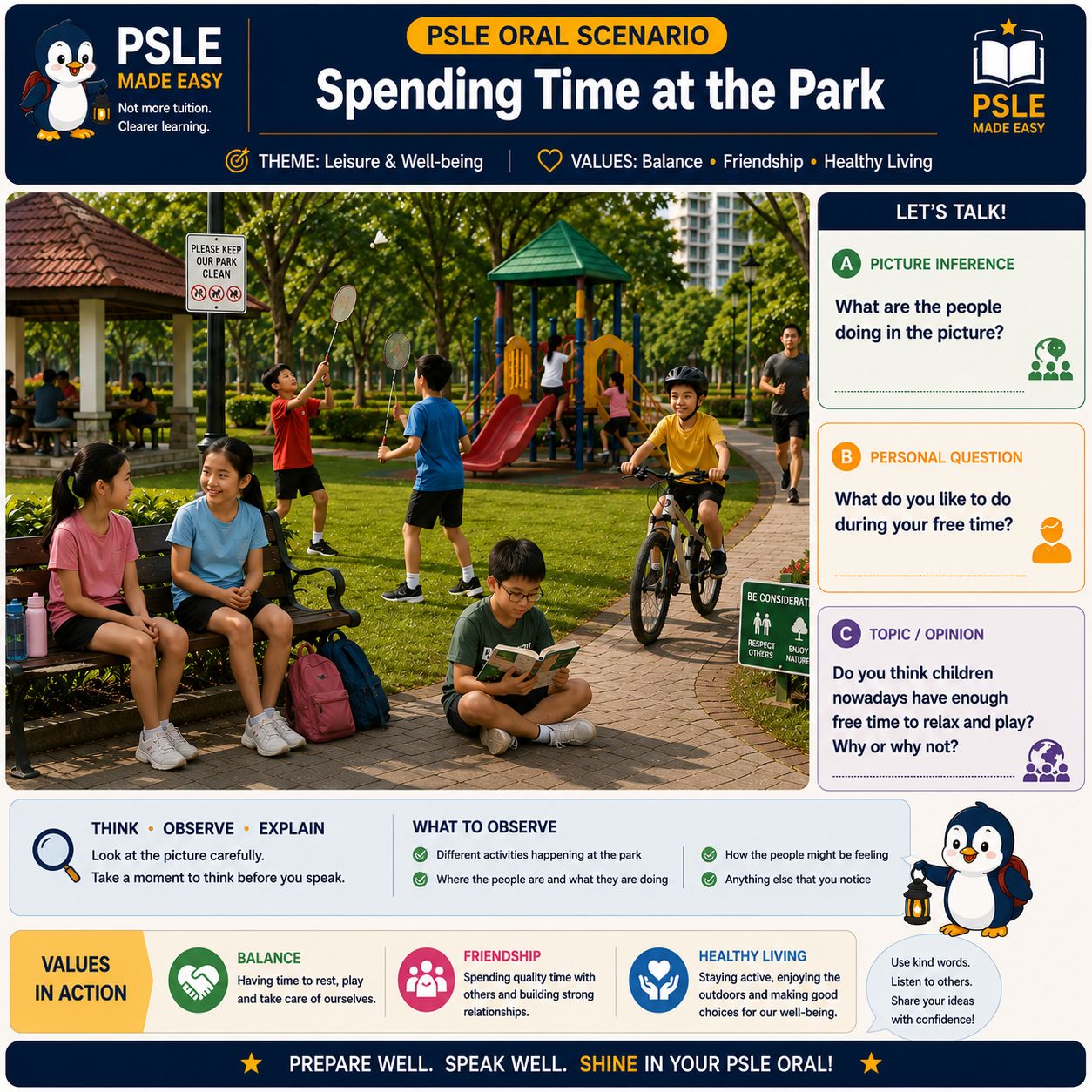
A park scene like this looks easy, which is exactly the trap. Every child can say "they are playing and having fun." What separates a Band 5 answer is a child who actually reads the picture — how many different activities are happening at once, and what that variety says about how people choose to spend free time.
For the personal question, help your child pick one real activity they actually do — not the answer they think sounds impressive. A specific, ordinary activity described honestly beats a generic list of hobbies every time.
Student Note
“The examiner has heard 'they are playing at the park' a hundred times today. What they have not heard is you naming three different things happening in that picture at once, and what that tells you about why people go to a park in the first place.”
① Read the Picture First ▼
Before answering any question, spend ten seconds reading the picture properly. Not just "kids at a park." Count how many different activities are actually happening, since that's the detail this Q(a) is built around.
What you can see
In a neighbourhood park with HDB blocks in the background, at least six different activities are happening at the same time. Two girls sit together on a bench, deep in conversation, their backpacks resting beside them. Two boys play badminton on the grass. A boy sits cross-legged on the ground, absorbed in a book. Another boy cycles past wearing a helmet. In the background, children climb on a playground structure, and a man jogs alone along the path. A gazebo in the corner shelters a few more people seated at tables.
Two signs frame the scene: "Please Keep Our Park Clean" and "Be Considerate — Respect Others, Enjoy Nature." Both point to something beyond individual leisure — this is a shared space, and everyone in it is making a small, quiet choice to use it responsibly.
What to notice for Q(a): This Q(a) is more direct than most — it doesn't ask you to infer a feeling or a relationship, just to observe accurately. That makes it easy to underperform on, because "just describing" tempts students into one flat sentence. The move that earns marks here isn't inference — it's organisation: grouping what you see into clear categories instead of listing activities at random.
② Q(a) — Direct Observation ▼
The Question
“What are the people doing in the picture?”
Unlike most Q(a) prompts, this one doesn't ask you to infer a feeling, a relationship, or a value — it asks you to observe accurately and organise what you see. The examiner isn't testing inference here; they're testing whether you can scan a busy picture and structure your answer instead of naming one activity and stopping. Group what you notice into categories, then add one closing thought about what the variety shows.
Picture evidence, grouped — not just listed
- Socialising: two girls sit together on a bench, deep in conversation, their backpacks resting beside them.
- Active play: two boys play badminton on the grass; another boy cycles past wearing a helmet.
- Quiet, solitary leisure: a boy sits cross-legged on the ground, absorbed in a book.
- Wider use of the same space: children on the playground, a man jogging alone, and people seated at the gazebo — three more uses visible in the background.
- Shared-space cues: the "Keep Our Park Clean" and "Be Considerate" signs, showing this variety only works because everyone treats the space responsibly.
What a weak answer sounds like
“The people are playing and relaxing at the park.”
Technically true, but it treats a picture with at least six distinct activities as if it showed only one. Names nothing specific.
What a stronger answer sounds like
“I can see people using the park in several different ways. Some are being social — two girls are sitting together on a bench, chatting. Some are being active — two boys are playing badminton, and another boy is cycling past on the path. One boy wants quiet time alone, reading by himself on the grass. And further back, there's even more variety — children on the playground, a man jogging, and a few people sitting at the gazebo. What stands out to me is that no two people are doing the same thing, even in this one small park. That tells me people don't come to a park for one reason — they come because it has room for very different kinds of people at once.”
Why this works: Groups the activities by type — social, active, solitary, background — instead of listing them at random, which is what makes the answer sound organised rather than rushed. Then it closes with one idea the grouping itself reveals, not just a list.
Going Beyond — add this
“I also think the two signs in the picture matter here — 'Keep Our Park Clean' and 'Be Considerate.' They remind me that all this different activity only works smoothly because everyone is quietly respecting everyone else's space, even without needing to be told directly.”
③ Q(b) — Personal Question ▼
The Question
“What do you like to do during your free time?”
This question doesn't need an impressive answer — it needs a real, specific one. Naming an activity and explaining why it actually matters to you beats listing three hobbies with no depth to any of them.
What a weak answer sounds like
“During my free time, I like to read books, play games and spend time with my family.”
A list, not an answer. Three activities named, none of them explained or made specific.
What a stronger answer sounds like
“I really enjoy cycling around my neighbourhood on weekend mornings, usually with my younger cousin. It's become something we both look forward to, not because it's exciting, but because it's the one time in the week we're not rushing to be anywhere. We usually stop at a park along the way, like the one in this picture, just to catch our breath before heading back. It's become less about the cycling itself and more about having that unhurried time together.”
Why this works: One specific activity, a specific person it's shared with, and an honest reason it matters (unhurried time, not excitement) rather than a generic justification.
Going Beyond — add this
“I've started encouraging my cousin to suggest where we cycle to next, instead of me always deciding — it's made the time feel like it belongs to both of us, not just something I organise for her.”
④ Q(c) — Broader Opinion ▼
The Question
“Do you think children nowadays have enough free time to relax and play? Why or why not?”
This question invites a complaint about busy schedules — and that's exactly the trap. A stronger answer moves past "we are too busy" to explain what's actually competing for that time, and whether the problem is the amount of time or how it gets used.
What a weak answer sounds like
“No, children nowadays do not have enough free time because we have too much homework and tuition.”
A common complaint with no reasoning behind it — doesn't explain why this is actually a problem, or consider any other view.
What a stronger answer sounds like
“I think the issue isn't always the amount of free time we have, but how much of it actually feels free. Even on a Saturday afternoon with nothing scheduled, a lot of children — including me sometimes — end up spending it on a screen instead of somewhere like this park. So I think it's not just about giving children more hours; it's about making sure the hours we do have are actually spent recovering, not just filling time. A park like the one in this picture works because it offers so many different, low-pressure ways to spend that time — you don't need a plan, you just need to show up.”
Why this works: Reframes "not enough time" into "not enough restorative time," which is a more precise and defensible position, and ties the reasoning back to a specific detail in the picture.
Going Beyond — add this
“I also think parents play a part here that isn't always talked about — a child is more likely to actually use free time well when a parent joins them occasionally, the way some families do at a park like this, rather than leaving a child to figure out rest on their own.”
⑤ Going Beyond Yourself — for This Topic ▼
Free time is a topic every student has an opinion on, which is exactly why the answers tend to sound the same. The way to stand out is honesty about how you actually spend free time, not how you think you're supposed to spend it.
Ask yourself: after sharing your personal activity, can you take one more step?
How my thinking has changed
Ask: “What did I used to believe about free time that I no longer believe?”
“I used to think free time meant doing something exciting, or it was wasted. Now I think the quiet, uneventful kind — sitting on a bench, reading alone — is doing just as much for me as anything more active.”
Realising others must feel this too
Ask: “Who else has to protect their own free time deliberately?”
“It made me think about my parents, who often say they're 'too busy' for a break. If I have to actively choose to protect my own free time now, I imagine it only gets harder to do that as an adult with more responsibilities.”
What this makes me want to become
Ask: “Did this change what I want to do or who I want to be?”
“It made me want to be someone who protects unstructured time on purpose, instead of letting every free hour get filled automatically with a screen or another activity.”
⑥ Values to Anchor Your Answers To ▼
The values printed on the infographic — Balance, Friendship, Healthy Living — each give your answer a different angle beyond "the park is fun."
⚖️ Balance
What it means in oral: balance means treating rest as necessary, not as something you're only allowed once every task is finished.
Anchor line: “Rest isn't the reward for finishing everything else — it's part of doing everything else well.”
🤝 Friendship
What it means in oral: friendship in this picture doesn't need an activity to justify it — two people talking on a bench is enough, with no equipment or plan involved.
Anchor line: “Some of the strongest friendships need nothing more than a bench and time.”
🏃 Healthy Living
What it means in oral: healthy living here isn't just the badminton or the cycling — it's also the choice to step outside instead of staying indoors on a device.
Anchor line: “The healthiest choice in this picture might just be showing up at the park at all.”
“Every student says the park is a place to relax. The ones who score at Band 5 are the ones who can name what they actually see happening, and explain what that variety says about how people spend free time.”