Sportsmanship on the Football Field
Theme: Sports & Values · Values: Respect, Fairness, Empathy
Parent Note
Sportsmanship is a topic children can define instantly — "playing fair, being nice to the other team" — but it's much harder to talk about honestly, because most children have also felt the pull to bend the rules or celebrate too hard when winning. What earns marks is a child who can admit that pull, not just recite the ideal.
Ask your child about a real match or game — a PE lesson, a CCA match, even a family board game — where the score mattered and something tested their sense of fair play.
Student Note
“The examiner has heard 'good sportsmanship means playing fair' a hundred times today. What they have not heard is a real moment when playing fair actually cost you something — a point, a win, or your pride — and you did it anyway.”
① Read the Picture First ▼
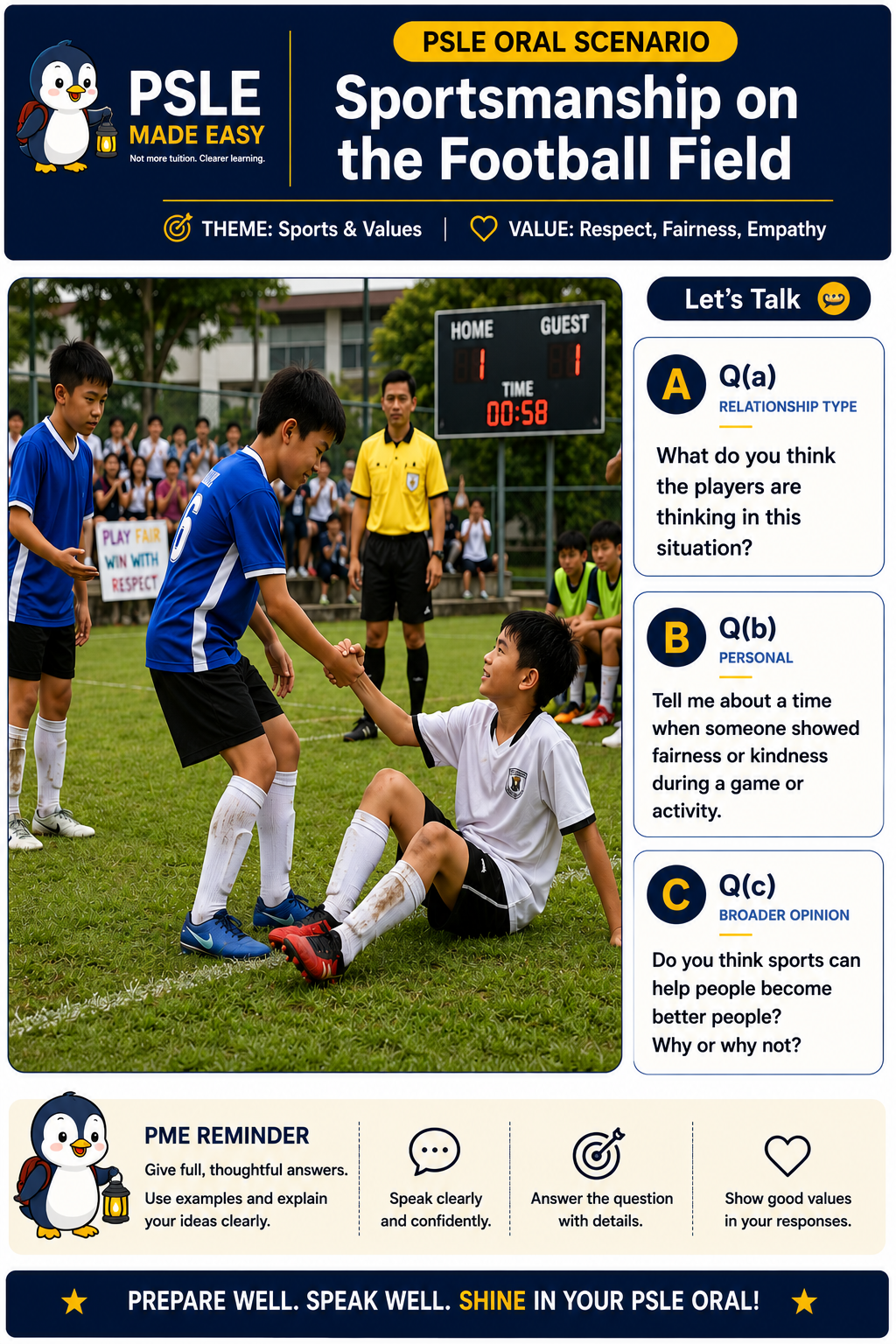
Before answering any question, spend ten seconds reading the picture properly. Not just "boys playing football." Look at what the scoreboard specifically shows, since it tells you exactly what's at stake in this moment.
What you can see
A scoreboard reads HOME 1 — GUEST 1, with the clock at 00:58 — this is a tied match, very close to the end. That specific detail matters: sportsmanship is far easier to talk about in a match that's already decided than in one still hanging in the balance.
A banner in the scene reads "Play Fair, Win With Respect" — placing the two ideas side by side suggests the tension the scenario wants you to think about: it's easy to want to win, and separately important to want to win the right way.
What to notice for Q(a): This Q(a) is explicitly labelled a Relationship type on the infographic — it asks what the players are thinking, which means your answer should explore the internal tension between competitiveness and fair play, not just describe the match.
② Q(a) — Relationship Type ▼
The Question
“What do you think the players are thinking in this situation?”
A Relationship Q(a) wants you inside the tension of the moment — not just "they want to win." With the score tied and time almost up, there's a specific pressure worth naming.
Picture evidence you can use in your answer
- The scoreboard: HOME 1 — GUEST 1 — a tied game, meaning neither side has already won or lost, which raises the stakes of every decision in these final moments.
- The clock at 00:58 — under a minute left, meaning any choice a player makes now happens under real time pressure, not with room to reconsider.
- The banner "Play Fair, Win With Respect" — placed deliberately in a moment of high tension, suggesting this specific scenario is testing whether values hold up when it's hardest to keep them.
What a weak answer sounds like
“I think the players are thinking about winning the game.”
True of any match at any point — ignores the specific score and time pressure shown on the scoreboard.
What a stronger answer sounds like
“With the score tied at 1-1 and under a minute left on the clock, I think the players are feeling a lot of pressure to do whatever it takes to score or defend that last goal. That's exactly the kind of moment where it becomes tempting to foul someone quietly, argue a call, or take a cheap shot, because there's so little time left to fix a mistake honestly. I think part of what they're thinking is a real pull between wanting to win badly and knowing that how they play in these last 58 seconds says more about their character than the actual result will.”
Why this works: Uses the exact score and time to explain why this specific moment is harder than an ordinary point in the match, and names the real internal conflict rather than a single simple feeling.
Going Beyond — add this
“I also think the players on both teams might be thinking about this differently — the ones trying to protect a tie might feel it's fair to play more cautiously, while the ones chasing the win in the last seconds might feel more justified in taking risks. Fairness might mean something slightly different depending on which side of the score you're on.”
③ Q(b) — Personal Question ▼
The Question
“Tell me about a time when someone showed fairness or kindness during a game or activity.”
Notice this question doesn't require you to be the one who was fair — you can describe a teammate, an opponent, or even yourself, as long as the moment is specific and real.
What a weak answer sounds like
“During a game, my friend was kind to the other team and helped them. It was a nice moment.”
No specific game, no specific action, no sense of what made it notable.
What a stronger answer sounds like
“During a class rounders game, an opposing player was clearly out at second base, but the umpire — who was actually another student — hesitated and looked unsure. I was standing close enough to know the call could easily have gone either way in our favour, but I told the umpire honestly that I'd seen her touch the base first. My own teammates were a little annoyed with me afterwards because it cost us the point, but I felt like admitting it was more important than winning that particular play.”
Why this works: Specific game, specific unclear moment, a real cost (teammates' annoyance, losing the point), and an honest reason for the choice rather than a morally tidy ending.
Going Beyond — add this
“That moment made me realise fairness is easiest to talk about and hardest to actually do when it costs your own side something real, not just something abstract.”
④ Q(c) — Broader Opinion ▼
The Question
“Do you think sports can help people become better people? Why or why not?”
Q(c) invites an easy "yes, sports teach teamwork" answer. A stronger response considers that sports can also bring out bad behaviour, and explains what actually determines which outcome happens.
What a weak answer sounds like
“Yes, sports can help people become better because they teach teamwork and discipline.”
A list of buzzwords with no reasoning about why or when this is true.
What a stronger answer sounds like
“I think sports can help people become better, but they can just as easily bring out someone's worst side — arguing with referees, blaming teammates, or even cheating when the pressure is high, like in a tied match with time running out. What actually makes the difference, I think, is whether the people around you — coaches, parents, teammates — treat winning as the only thing that matters, or treat how you played as equally important. Sports themselves are neutral; they just intensify whatever values were already being taught around them.”
Why this works: Acknowledges the negative possibility honestly, identifies the actual deciding factor (surrounding values, not the sport itself), and connects back to the tense moment shown in the picture.
Going Beyond — add this
“I also think losing well is actually a harder and more valuable skill than winning well — anyone can be gracious after a win, but staying respectful after a disappointing loss says more about character.”
⑤ Going Beyond Yourself — for This Topic ▼
Sportsmanship is a topic every student can define correctly, which is exactly why the answers tend to sound rehearsed. The way to stand out is honesty about how tempting it actually is to bend fairness when something real is at stake.
Ask yourself: after sharing your personal moment, can you take one more step?
How my thinking has changed
Ask: “What did I used to believe about winning that I no longer believe?”
“I used to think a win only counted if my side scored more points. Now I think how I played matters just as much as the final score, especially in the moments no one else was watching closely.”
Realising others must feel this too
Ask: “Who else has to make this same kind of decision under pressure?”
“It made me think about referees and umpires, who have to make fair calls instantly, under real pressure from both sides, without the luxury of pausing to think it over the way I did.”
What this makes me want to become
Ask: “Did this change what I want to do or who I want to be?”
“It made me want to be someone whose behaviour doesn't change depending on whether anyone's watching or how much is at stake in the moment.”
⑥ Values to Anchor Your Answers To ▼
The values printed on the infographic — Respect, Fairness, Empathy — each give your answer a different angle beyond "play nicely."
🙏 Respect
What it means in oral: respect on a sports field means accepting a referee's call even when you disagree, and acknowledging an opponent's good play rather than only your own team's.
Anchor line: “Respect is easiest to show when you're winning — it only really counts when you're not.”
⚖️ Fairness
What it means in oral: fairness means following the same rules whether they help or hurt your own side, especially in the moments when no one would notice if you didn't.
Anchor line: “Fairness that only shows up when it's convenient isn't really fairness.”
🤍 Empathy
What it means in oral: empathy on the field means remembering the other team also cares about the result just as much as you do, even in the middle of intense competition.
Anchor line: “The other team wanting to win just as badly as you do doesn't make them the enemy — just the other half of the same game.”
“Every student can define good sportsmanship. The ones who score at Band 5 are the ones who can describe a real moment fairness cost them something, and explain why they chose it anyway.”