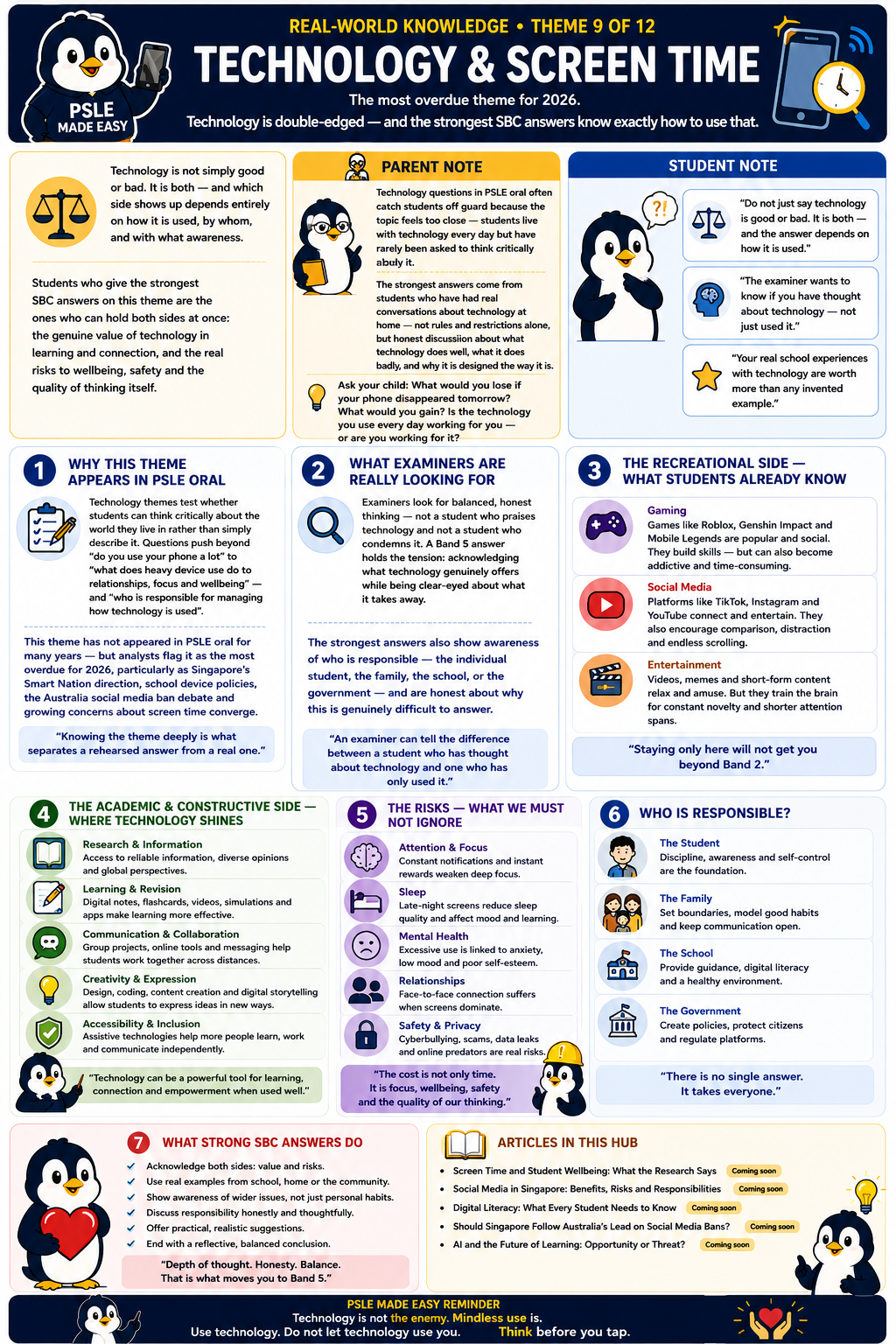
Technology & Screen Time
A page to help students build stronger examples for SBC and Composition on one of 2026's most overdue themes.
Jump to a section
Strong SBC and Composition answers need more than opinions. They need specific, grounded examples — the kind that only come from actually thinking about a topic before the exam begins.
Technology is the theme that most students feel they know — because they use it every day. But using something and thinking critically about it are different skills. The examiner is testing the second one.
This page covers what technology does well, what it does badly, and how your real school experiences connect to the biggest ideas this theme raises. It connects to PSLE themes on community, responsibility, education, health and wellbeing.
Parent Note
Technology questions in PSLE oral often catch students off guard — not because the topic is unfamiliar, but because students have never been asked to think about it. They have only used it.
The strongest answers come from children who have had real conversations at home — not about rules and restrictions, but honest discussions about what technology does well, what it costs, and who is responsible for managing how it is used.
Ask your child: What would you lose if your phone disappeared tomorrow? What would you gain? Is the technology you use most working for you — or are you working for it? There are no right answers. The value is in the thinking.
Student Note
“Do not just say technology is good or bad. It is both — and the answer depends on how it is used.”
“The examiner wants to know if you have thought about technology — not just used it.”
“Your real school experiences with technology are worth more than any invented example. Use them.”
① What Is This Theme Really About? ▼
Technology is not simply good or bad. It is both — and which side shows up depends entirely on how it is used, by whom, and with what awareness. That is the core idea this theme tests.
Students who give the strongest SBC answers are the ones who can hold both sides at once: the genuine value of technology in learning and connection, and the real costs to wellbeing, focus and the quality of thinking itself.
This theme has not appeared in PSLE oral for many years — but it is flagged as one of the most overdue for 2026, as Singapore's Smart Nation direction, school device policies, the global debate on social media and young people, and growing concerns about screen time all converge at once.
The deeper question examiners are pushing toward is not "do you use technology?" but "who controls how you use it — and to what end?"
“Knowing the theme deeply is what separates a rehearsed answer from a real one.”
② Technology in Singapore Schools — What You Have Already Used ▼
From MOE's perspective, technology is a learning tool — one that raises engagement, enables collaboration and gives students access to resources a textbook cannot. You have used these yourself. They are your evidence.
Student Learning Space (SLS)
MOE's official online learning platform gives every student access to curriculum-aligned resources, interactive activities and teacher feedback. Students who use SLS deliberately — not just to complete tasks but to revisit concepts — get more from it than those who rush through. The platform works when you drive it.
Koobits
Used widely in Singapore schools for Mathematics, Koobits makes practice feel less like homework. Students can identify weak areas and work on them independently. The gamification helps — but it also raises a real question worth thinking about: are you learning, or just collecting points?
Padlet and collaborative tools
Padlet and similar tools allow students to share ideas and respond to each other's thinking in real time. Used well, they give quiet students a voice that classroom discussion sometimes does not. The technology does not replace thinking — it creates a space for it.
“Educational technology works best when the student drives it — not when the student is driven by it.”
③ The Six Angles — How to Use This Topic Well ▼
Each angle is a different entry point into this topic. You do not need all six — pick the one or two that connect to something you have genuinely experienced.
🏫 School
Your school uses technology as a learning tool — SLS for curriculum access, Padlet for group work, Koobits for Maths practice. These give you direct, specific examples of technology enabling learning rather than replacing it.
Example starter: "In school, we used Padlet to share our ideas during a class discussion. I noticed that students who usually stayed quiet contributed more because typing felt less intimidating than speaking out…"
📖 Learning
A shift in thinking happened when you realised that fast-paced content — short videos, quick notifications — makes it harder to sit with a difficult idea for long enough to understand it. That awareness is itself a form of learning.
Example starter: "I noticed that after spending time watching short videos, I found it harder to concentrate when I had to read a long comprehension passage. I had to deliberately slow down…"
🏠 Personal
At home, you make choices about how technology fits into your time — whether that is gaming with friends online, watching content, or using devices for revision. The line between helpful and harmful is not fixed. It depends on what you choose and how aware you are of that choice.
Example starter: "I used to game for a couple of hours on weekends without thinking much about it. When PSLE preparation began, I had to make a conscious decision about when and how much…"
👨👩👧 Family
Technology shapes how families spend time together — and sometimes pulls attention away from it. Screen time rules, phone-free meals, or parents themselves being on their phones are all experiences you can draw from honestly.
Example starter: "My family has a rule about no phones during dinner. At first I thought it was unnecessary, but I noticed that the conversations we had during those meals were longer and more interesting…"
🤝 Empathy
Cyberbullying is different from physical bullying because it follows the person everywhere — there is no safe space to go home to. A friend who was excluded from a group chat, or who received hurtful messages online, helps you speak with genuine feeling about what technology can enable when used without empathy.
Example starter: "A classmate of mine was excluded from our CCA group chat without anyone saying why. Even though nothing physical happened, I could see how much it affected them — being left out in silence felt worse than being told directly…"
🌏 Awareness
Singapore's Smart Nation direction means digital literacy is not optional — it is a national priority. At the same time, countries like Switzerland reversed years of digital-first education and returned to pen-and-paper learning after research showed that retention and deep understanding suffered. These are real policy decisions with real consequences.
Example starter: "Switzerland introduced digital learning tools across schools, then reversed the decision because students were not retaining knowledge as well. Singapore faces the same question — how much technology is too much, even when the intentions are good…"
“You do not need all six angles. One angle, used honestly and developed with a real example, is worth more than six angles listed as bullet points.”
④ What a Band 5 Answer Looks Like ▼
Sample Question (Q(c) — Broader Topic)
Some people say that technology helps students learn better. Others say it makes learning worse. What do you think? Do you agree that technology is more helpful than harmful for students today?
I think technology can be genuinely helpful for learning — but only when students use it with a clear purpose. In my school, we use a platform called SLS, which gives us access to lessons and practice activities beyond what we do in class. When I use it deliberately — to check a concept I did not understand, or to revise before a test — I can feel that it is helping. But when I go on just to complete an assignment quickly and move on, I often cannot remember what I did five minutes later.
I think the honest answer is that technology works for some things and not for others. I noticed last year that after spending a lot of time watching short videos, I found it harder to read a long comprehension passage without my mind wandering. The videos were not bad — but they trained my attention to expect something new every fifteen seconds, and comprehension passages do not work that way.
So I do not think technology is more helpful or more harmful on its own. It depends entirely on how it is used, and whether the student is aware of what it is doing to them. That awareness is not something the technology gives you. You have to develop it yourself.
Why this is Band 5 — five moves unpacked
- Point stated immediately. The answer opens with a clear position — helpful, but only with purpose — rather than stalling with a general observation about technology.
- Real specific experience. SLS is named, and the contrast between using it deliberately versus rushing through it is concrete. The examiner can picture what is being described.
- Honest self-reflection. The student admits that short videos affected their reading focus. It shows self-awareness rather than telling the examiner what they want to hear.
- Awareness angle to close. The final paragraph draws the line clearly: awareness is not given by the technology, it has to be developed. This moves beyond the personal to a broader principle.
- Closing line is a new thought, not a summary. The answer ends with a specific insight — the student, not the platform, is responsible for developing awareness. That is a more advanced idea than what most answers reach.
⑤ Why This Helps in SBC ▼
A basic answer to a technology question describes how technology is used: "I use SLS for learning and I play games after school." It answers the surface question, but does not demonstrate thinking.
A stronger answer shows that the student has thought about the tension: technology enables things that were not possible before, and it also costs things that are harder to name. The stronger student can speak to both sides without being pushed to by the examiner.
The strongest answers connect to responsibility — who decides how technology is used: the student, the family, the school or the government. That question does not have a clean answer, and showing that you know it is complicated is itself part of what Band 5 looks like.
Possible SBC angle (Q(b) — personal)
"Tell me about a time you used technology for learning. What worked well — and what did not?"
“An examiner can tell the difference between a student who has thought about technology and one who has only used it.”
⑥ Why This Helps in Composition Writing ▼
Technology gives composition writers strong material because the tension is built in. A character who uses technology to solve one problem while creating another is already in conflict — and conflict is what drives a story forward.
The best compositions on technology-adjacent themes avoid the trap of making technology the villain or the hero. The most interesting stories show a character who makes a choice — and has to live with what that choice costs them.
Three composition angles for this theme:
- A student discovers that a classmate has been excluded from the class group chat for weeks — without anyone saying a word to them in person.
- A character sets a screen-time limit for themselves before an important exam, then breaks it, and has to decide whether the cost was worth it.
- A family adopts a no-phone-at-meals rule after a difficult conversation — and a child realises what they had been missing without noticing it.
“Technology is not the story. What a person chooses to do with it — and what they lose or gain — is the story.”
⑦ Useful Ideas and Vocabulary ▼
Use precise words to show precise thinking. A student who uses "addictive" and "distracted" for every point sounds vague. The words below help you say exactly what you mean.
| Idea | Useful words and phrases |
|---|---|
| Screen time and attention | fragmented attention, sustained focus, overstimulated, scroll fatigue, passive consumption, deliberate use |
| Platform design | algorithm-driven, engagement-maximising, designed to retain, recommendation loop, infinite scroll, curated feed |
| Educational technology | curriculum-aligned, self-paced learning, interactive feedback, gamified practice, collaborative tools, digital literacy |
| Online risks | cyberbullying, online anonymity, digital footprint, harmful content, misinformation, stranger danger online |
| Responsibility and awareness | self-regulation, digital wellbeing, intentional use, conscious choice, responsible consumption, media literacy |
| Bigger picture | Smart Nation, digital divide, screen-time guidelines, parental controls, school device policies, future-readiness |
“Use precise words to show precise thinking. Vague words signal vague understanding.”
“Real-world knowledge helps you speak with insight and write with feeling.”