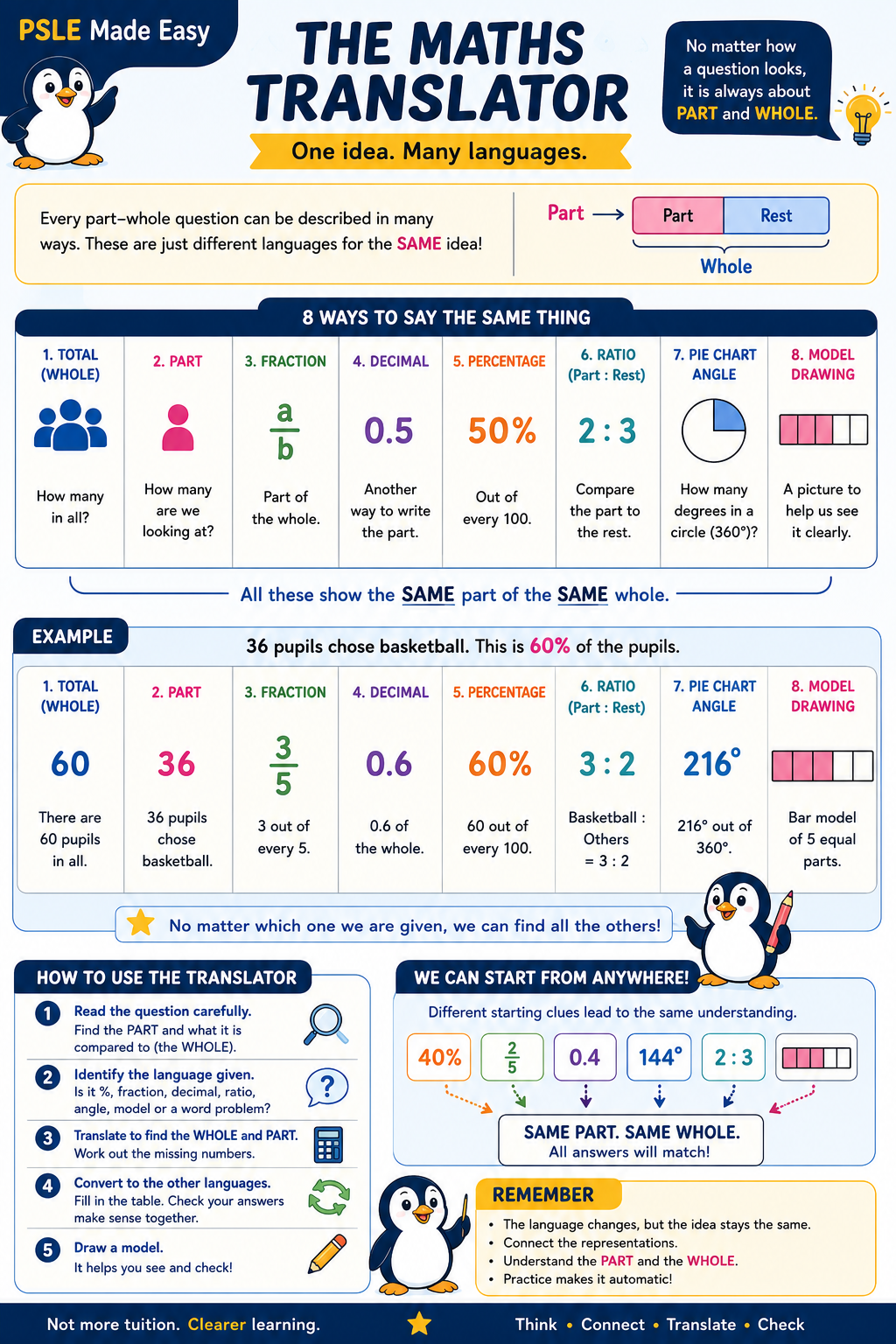
The Maths Translator
One idea. Many mathematical languages.
Have you ever noticed that P6 pupils often ask, “Is this a percentage question?”, “Is this a ratio question?”, or “Do I use fractions or model drawing?” Many students revise fractions, decimals, ratio and percentage as though they are separate chapters — hoping to recognise the “correct” method on the day. That way of thinking is often the biggest obstacle to solving an unfamiliar question.
Parent Note
If your child says “I don’t know this topic,” it is worth asking a follow-up question first: is it really an unfamiliar topic, or a familiar idea wearing an unfamiliar costume? Many PSLE Maths questions are not new content — they are a part-whole relationship dressed up as a percentage, a ratio, or a pie chart. Buying another worksheet pack rarely fixes this. What helps is practising the translation itself: given one representation, can your child produce the other seven?
Student Note
“You are not learning eight new topics. You are learning to hear the same idea spoken in eight different voices.”
① The Problem ▼
Many students revise fractions, decimals, percentage, ratio and pie charts as if each one belongs to its own separate world. Each comes with its own worksheet, its own method, its own chapter test. So when a question turns up in an unfamiliar form, the instinct is to search memory for “which topic is this,” rather than to think about what the question is actually describing.
This is not a knowledge gap. Most students who struggle here already know how to calculate a fraction, a percentage, or a ratio on its own. The gap is that they have never been asked to move between them — to see that a 60% question and a 3:2 ratio question and a 216° pie chart question can all be the exact same question.
“The topic is rarely the real difficulty. The disconnection between topics is.”
② The Inspiration Behind This Framework ▼
The Maths Translator came from a simple observation: many PSLE questions are built on the same underlying idea, even though the wording looks completely different. Almost always, that idea is a relationship between a part and a whole. The only thing that changes is the mathematical language used to describe it.
For example, a question may tell you any one of the following:
40% · 25 · 0.4 · 144° · 2 : 3 · a model drawing
At first glance these look like six different concepts. In reality, they can all be the same relationship between the same part and the same whole, simply written in six different languages.
③ Thinking Like a Translator ▼
Imagine someone describing the same object in English, Chinese or Malay. The words are different. The object is not. Mathematics works the same way. A percentage, a fraction, a decimal, a ratio, a pie chart angle and a model drawing are simply different ways of describing the same part of the same whole.
Old question
“What topic is this?”
Better question
“What mathematical language is this question speaking?”
Once a student identifies the language, they can translate it into whichever representation they feel more comfortable working with.
④ The 8 Ways to Say the Same Thing ▼
Every part-whole question can be described in at least eight ways. These are just different languages for the same idea.
| # | Language | What It Asks |
| 1 | Total (Whole) | How many in all? |
| 2 | Part | How many are we looking at? |
| 3 | Fraction (ab) | Part of the whole. |
| 4 | Decimal | Another way to write the part. |
| 5 | Percentage | Out of every 100. |
| 6 | Ratio (Part : Rest) | Compares the part to the rest. |
| 7 | Pie Chart Angle | Degrees out of 360°. |
| 8 | Model Drawing | A picture to help you see it clearly. |
Worked Example
“36 pupils chose basketball. This is 60% of the pupils.”
| Total (Whole) | 60 pupils in all. |
| Part | 36 pupils chose basketball. |
| Fraction | 35 — 3 out of every 5. |
| Decimal | 0.6 of the whole. |
| Percentage | 60 out of every 100. |
| Ratio | Basketball : Others = 3 : 2. |
| Pie Chart Angle | 216° out of 360°. |
| Model Drawing | A bar model of 5 equal parts, 3 shaded. |
“No matter which one you are given, you can find all the others.”
⑤ How to Use the Maths Translator ▼
Read the question carefully. Find the part and what it is being compared to — the whole.
Identify the language given. Is it a percentage, fraction, decimal, ratio, angle, model, or a word problem?
Translate to find the whole and the part. Work out the missing numbers.
Convert to the other languages. Fill in each representation and check that your answers agree with one another.
Draw a model. It helps you see the relationship — and check your working.
Whenever you solve a part-whole question, ask yourself:
What is the whole? · What is the part? · Can I write it as a fraction? · As a decimal? · As a percentage? · As a ratio? · As a pie chart angle? · Can I draw a model to show it?
“If every representation tells the same story, you know you have truly understood the concept — not just memorised a method.”
⑥ We Can Start From Anywhere ▼
Different starting clues lead to the same understanding. It does not matter whether a question gives you 40%, the fraction 25, 0.4, 144°, 2:3, or a model — if it is the same part of the same whole, every representation will match.
40% → 25 → 0.4 → 144° → 2:3 → model → same part, same whole
If your conversions don’t all agree, that is the signal to recheck — not the mathematical language you started from.
⑦ A Different Way to Revise ▼
Most revision focuses on doing more questions. The Maths Translator focuses on seeing more connections between the questions you already know how to do.
When a student recognises that many PSLE questions are simply different representations of the same relationship, solving problems becomes less about guessing the correct method and more about understanding the mathematics behind the question.
Old habit
“Which topic is this?”
New habit
“This is a part-whole relationship. I can enter from any representation.”
That shift in thinking — not another worksheet — is what this framework is meant to build.
“The language may change, but the mathematics stays the same. Every part-whole question tells the same story — it is simply spoken in a different mathematical language.”
← Back to PSLE Maths: Build the Number Spine