The Mirror Ending
A strong conclusion does more than end the story. It can bring the reader back to where everything began — and show how much has changed
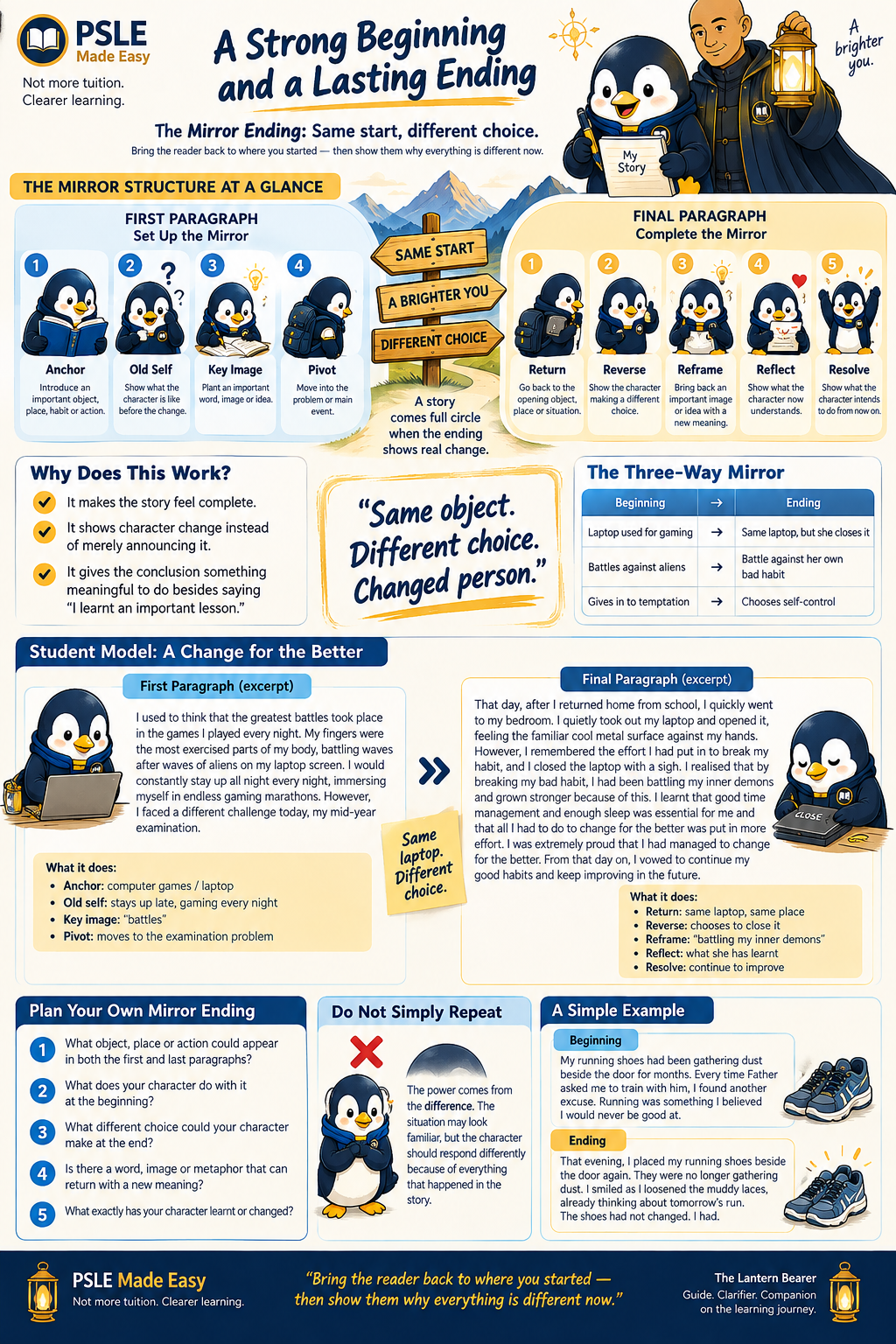
One effective way to make a composition feel complete is to connect the last paragraph back to the first paragraph.
However, this does not mean simply repeating the beginning. Something familiar returns, but the character now sees it, uses it or responds to it differently.
1. What Is a Mirror Ending?
A Mirror Ending returns to something important that appeared at the beginning of the composition.
• object
• place
• action
• habit
• image
• phrase or idea
The important part is the change. The reader sees something familiar from the beginning, but the character now responds differently because of what happened in the story.
2. First Paragraph — Set Up the Mirror
Introduce an important object, place, habit or action.
Show what the character is like before the experience changes him or her.
Plant an important word, image or idea that can return later.
Move from the opening into the actual problem or main event.
3. Final Paragraph — Complete the Mirror
Go back to the opening object, place, action or situation.
Show the character making a different choice.
Bring back an important image, phrase or idea — but give it a new or deeper meaning.
Show what the character now understands.
Show how the character intends to move forward.
📌
4. Student Model — A Change for the Better
“I used to think that the greatest battles took place in the games I played every night. My fingers were the most exercised parts of my body, battling waves after waves of aliens on my laptop screen. I would constantly stay up all night every night, immersing myself in endless gaming marathons. However, I faced a different challenge today, my mid-year examination.”
“That day, after I returned home from school, I quickly went to my bedroom. I quietly took out my laptop and opened it, feeling the familiar cool metal surface against my hands. However, I remembered the effort I had put in to break my habit, and I closed the laptop with a sigh. I realised that by breaking my bad habit, I had been battling my inner demons and grown stronger because of this. I learnt that good time management and enough sleep was essential for me and that all I had to do to change for the better was put in more effort. I was extremely proud that I had managed to change for the better. From that day on, I vowed to continue my good habits and keep improving in the future.”
5. Look Closer — The Three-Way Mirror
The ending does not connect to the beginning in only one way. The student creates three separate echoes.
| Beginning | → | Ending |
|---|---|---|
| Laptop used for gaming | → | Same laptop, but she closes it |
| Battles against aliens | → | Battle against her own bad habit |
| Gives in to temptation | → | Chooses self-control |
6. Why Is This Stronger Than “I Learnt a Lesson”?
A weak ending may simply announce:
The reader is told that the character changed.
In a Mirror Ending, the character faces something familiar again and behaves differently. The reader can see the change.
7. Do Not Simply Repeat the Beginning
The same object appears again, but nothing about the character's response has changed.
The situation is familiar, but the character now makes a different decision because of the experience in the story.
8. Plan Your Own Mirror Ending
9. Try a Simple Example
My running shoes had been gathering dust beside the door for months. Every time Father asked me to train with him, I found another excuse. Running was something I believed I would never be good at.
That evening, I placed my running shoes beside the door again. They were no longer gathering dust. I smiled as I loosened the muddy laces, already thinking about tomorrow's run. The shoes had not changed. I had.
Different choice: avoids running → chooses to run
Visible change: avoidance → determination
10. Before You Finish Your Composition
✓ Have I brought back something meaningful from my introduction?
✓ Is my character's response different now?
✓ Does that difference show what the character has learnt?
✓ Have I avoided simply repeating the introduction?
✓ Does my final line leave the reader with a clear sense of change?