The Tuition Fallacy
Why more lessons alone do not guarantee AL1 — and why strong results need attitude, thinking scope, reading maturity and ownership.
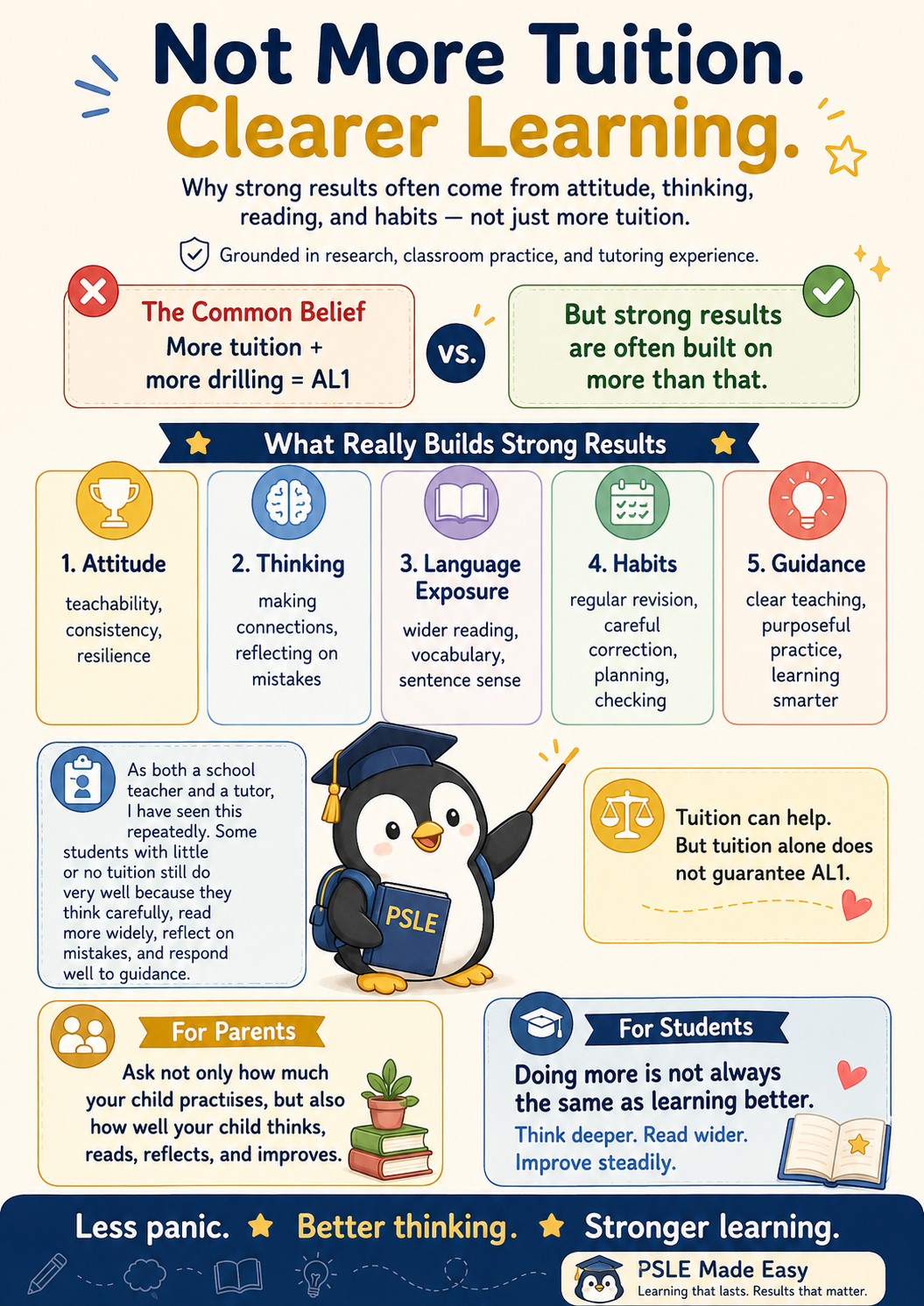
There is a common belief that if a child has enough tuition, enough worksheets and enough academic drilling, strong results should naturally follow.
It is understandable why parents think this way. Tuition can provide structure. It can give extra explanation. It can offer more practice and help students close gaps.
But there is a dangerous fallacy here.
More lessons do not automatically create deeper learning.
More worksheets do not automatically create stronger thinking.
More tuition does not automatically create ownership.
“Tuition can create opportunity. It cannot automatically create attitude.”
Parent Note
This page is not anti-tuition. Tuition can be useful when it is targeted, thoughtful and matched to the child’s needs. Research on private tutoring suggests that it can improve achievement, but the effect is not automatic and can vary depending on context, subject and how the support is used.
The issue is not whether a child has tuition. The more important question is: What is the child doing with the help given?
As both a school teacher and a tutor, I have seen this repeatedly. Some students receive a lot of help but still remain stuck because their learning habits do not change. Others do very well without heavy tuition because they are teachable, reflective, careful and willing to grow.
Student Note
“Doing more is not always the same as learning better.”
“Do not just attend lessons. Learn how to learn from them.”
“Do not just finish worksheets. Find out what each mistake is trying to tell you.”
① What Tuition Can Do
Tuition can be helpful when it explains difficult ideas clearly, gives targeted practice, helps students identify weak areas, provides feedback, creates routine, and supports students who need extra guidance.
Good support matters. But support is not the same as success. A child can receive a lot of help and still avoid the actual thinking. A child can be physically present in a lesson but mentally absent from the learning.
“Sitting through a lesson is not the same as growing from it.”
② The Tuition Fallacy
The tuition fallacy is the belief that:
But learning does not work that simply. A student may have tuition and still skim questions carelessly, repeat the same grammar errors, avoid reading widely, give shallow oral answers, write without proper planning, copy model answers without understanding, depend on the teacher to point out every mistake, and fail to connect ideas beyond the worksheet.
“The problem is not tuition. The problem is outsourcing the child’s thinking to tuition.”
③ Why AL1 Needs More Than Drilling
For English especially, strong results require more than practice quantity. Students need accuracy, reading maturity, vocabulary in context, inference, flexible thinking, clear expression, awareness of human behaviour, understanding of cause and effect, careful proofreading, and independence in applying strategies.
This is why reading level matters. Strong English students do not merely read words. They understand situations. They notice motivations. They track consequences. They connect people, events and ideas.
“To score well in English, you cannot only know words. You must understand people, situations and the world around you.”
④ Thinking Scope Matters
A strong student is not just a student who remembers more. A strong student thinks more widely and more carefully. This matters in Continuous Writing, where ideas must be developed; Oral, where examples and opinions must be thoughtful; Open-Ended Comprehension, where inference and explanation matter; Visual Text, where purpose and effect must be understood; and Vocabulary, where context decides meaning.
“A better answer usually comes from a better thought.”
⑤ What Strong Students Often Have
From both classroom and tutoring experience, the strongest students are not always the ones with the most tuition. Often, they are the ones who listen carefully, ask better questions, correct mistakes seriously, read beyond assigned work, notice patterns, think before answering, accept feedback, and take responsibility for improvement.
They may still receive help. But they do not outsource their thinking. They use help to become stronger, not more dependent.
“Good support should make a child more independent, not more helpless.”
⑥ What Parents Can Look For
Instead of asking only: “Does my child need more tuition?” — it may help to also ask:
- Does my child correct mistakes properly?
- Does my child know why the answer is wrong?
- Does my child repeat the same errors?
- Does my child read carefully?
- Does my child think before answering?
- Does my child explain ideas clearly?
- Does my child take feedback seriously?
- Does my child know what to work on next?
- Does my child show curiosity about the world?
- Does my child connect learning to real situations?
Parent Reminder
The question is not just whether the child has help. The question is whether the child is learning how to help himself or herself.
⑦ What Students Must Understand
A teacher can explain. A tutor can guide. A parent can support. A website can organise strategies. But the student must still do the learning.
The student must decide to read more carefully, think more deeply, correct more honestly, ask when unsure, practise with purpose, and stop making excuses for repeated mistakes.
“No one can want the result more than the student is willing to work for it.”
⑧ The PSLE Made Easy Position
PSLE Made Easy is not built on the idea of more random practice. It is built on clearer systems, purposeful revision, student ownership, careful correction, stronger thinking, wider reading, and better learning habits.
Tuition may be part of the journey. School may be part of the journey. Parents may be part of the journey. But the child’s attitude and thinking must also grow.
“Not more random practice. Clearer thinking. Better habits. More ownership.”
Sources and Further Reading
- Private tutoring and achievement: International Journal of Educational Research meta-analysis
- Reading literacy definition: OECD Reading Literacy
- Creative thinking in PISA 2022: MOE Singapore PISA 2022
- Metacognition and self-regulation: Education Endowment Foundation
“Tuition can support the child. But it cannot replace the child.”