Traditional Games Bring Us Together
Theme: Community & Culture · Values: Respect, Community, Togetherness
Parent Note
Traditional games (five stones, chapteh, hopscotch, zero point, and similar) are a topic children can name easily but rarely reflect on. "It's fun and brings people together" is true but says nothing the examiner hasn't heard already.
What earns marks is a child who can name a specific game, a specific person they played it with, and a real comparison to a modern game — not a vague nostalgia statement about "the good old days."
Student Note
“The examiner has heard 'traditional games bring people together' a hundred times today. What they have not heard is which game, played with whom, and an honest comparison to the games you actually play now.”
① Read the Picture First ▼
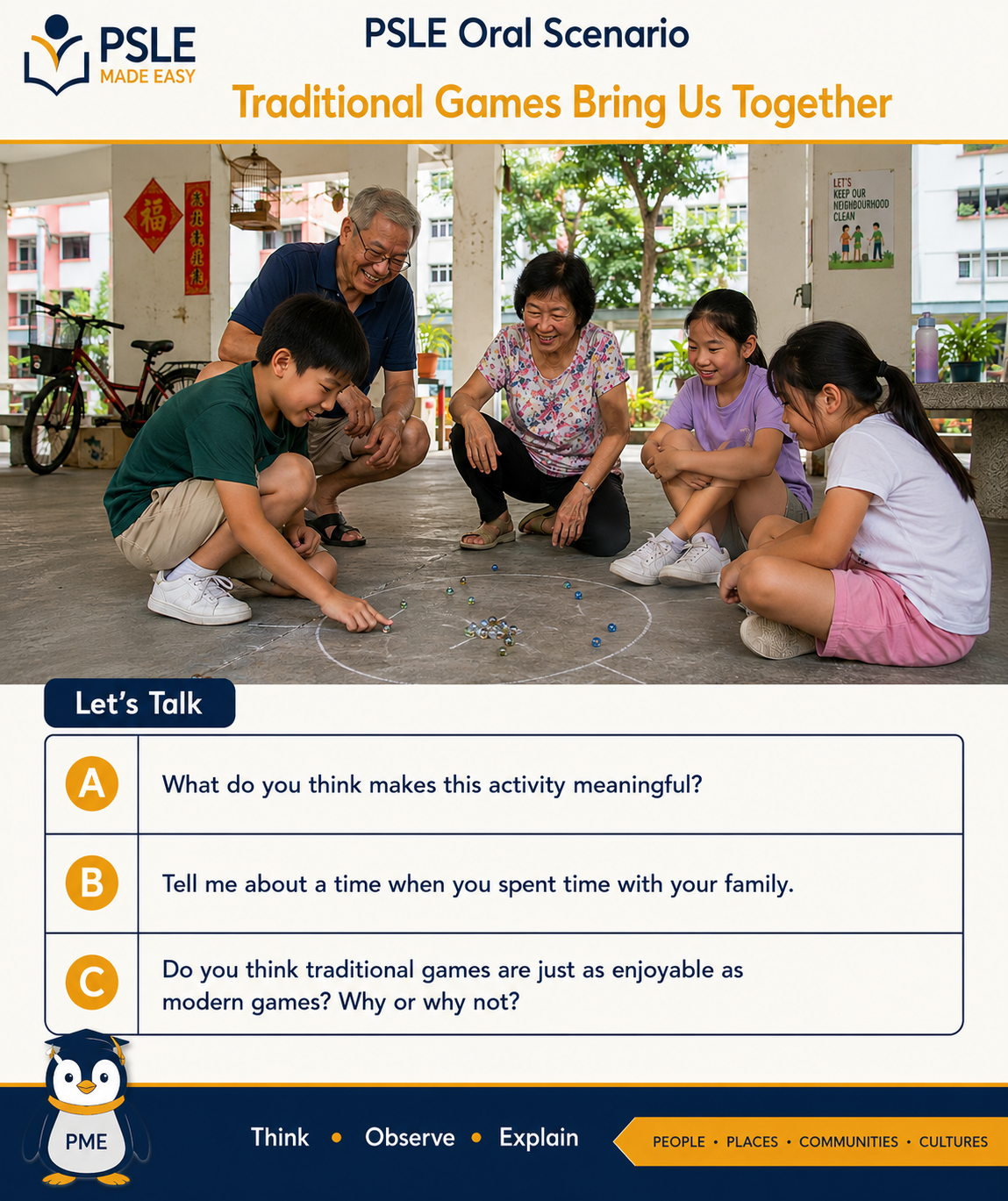
Before answering any question, spend ten seconds reading the picture properly. Not just "children playing a game." Look at the setting and the community elements around them.
What you can see
The scene is set in a neighbourhood or community space, signalled by a nearby "Let's Keep Our Neighbourhood Clean" sign — this is a shared public space, not a private backyard or school hall. The scenario is titled "Traditional Games Bring Us Together," and is tagged across four categories: People, Places, Communities, Cultures.
Notice how the picture doesn't need to show anything elaborate to carry meaning — it's the setting and the framing, not special effects, that do the work here.
What to notice for Q(a): This Q(a) asks what makes the activity meaningful — it wants an interpretation of significance, not a description of the rules of the game. Use the community setting and the "bring us together" framing as your entry point.
② Q(a) — Action Type ▼
The Question
“What do you think makes this activity meaningful?”
This question wants you to go past "it's fun" and explain what the activity actually does for the people in it — why it matters beyond entertainment.
Picture evidence you can use in your answer
- The title "Traditional Games Bring Us Together" — the word "together" is doing real work here; it frames the game as a social act, not a solo pastime.
- The community setting (suggested by the neighbourhood signage) — this isn't a private, solitary activity; it's happening in a shared space where others can see and potentially join in.
- The category tags: People, Places, Communities, Cultures — this scenario is explicitly framed around identity and belonging, not just recreation.
What a weak answer sounds like
“I think this activity is meaningful because it is fun and everyone enjoys playing games.”
"Fun" describes an emotion, not meaning. It doesn't explain what the game is doing for the people involved.
What a stronger answer sounds like
“I think what makes this meaningful is that a traditional game like five stones or chapteh doesn't need any equipment beyond a few simple objects, which means anyone in the neighbourhood can join in regardless of how much they own. That makes it different from a lot of modern games that need a device or a subscription. It becomes a way for people of different ages and backgrounds in the same community to actually interact face-to-face, instead of everyone playing separately on their own screens.”
Why this works: Names specific traditional games, explains the actual mechanism (low barrier to entry) behind why they bring people together, and contrasts it with modern alternatives.
Going Beyond — add this
“I also think these games carry meaning because they're often passed down — a grandparent teaching a grandchild a game they played decades ago connects two generations through the same simple activity.”
③ Q(b) — Personal Question ▼
The Question
“Tell me about a time when you spent time with your family.”
Q(b) wants a specific occasion — not "we spend time together every weekend." Name what you did, who was there, and one detail that made it memorable.
What a weak answer sounds like
“I spend time with my family every weekend. We have dinner together and talk.”
A routine, not a moment. No specific occasion, no specific memory.
What a stronger answer sounds like
“During the last Chinese New Year visit to my grandmother's flat, she taught my cousins and me how to play five stones, which she said she played every day as a child. None of us were any good at first, and my grandmother kept beating all four of us easily, which she found hilarious. It turned into almost an hour of everyone trying to win against her, and by the end even my father joined in.”
Why this works: Specific occasion, specific people, a specific game, and a small honest detail (losing repeatedly to a grandparent) that makes the memory feel real.
Going Beyond — add this
“That afternoon made me realise how much skill is actually involved in a game that looks so simple — my grandmother had decades of practice I didn't respect until I tried it myself.”
④ Q(c) — Broader Opinion ▼
The Question
“Do you think traditional games are just as enjoyable as modern games? Why or why not?”
Q(c) is deliberately a comparison, which means the trap is picking a side without engaging with the other. A strong answer takes both seriously before landing on a position.
What a weak answer sounds like
“Yes, traditional games are just as enjoyable because they are fun and simple.”
Doesn't engage with what modern games actually offer, so the comparison isn't really a comparison.
What a stronger answer sounds like
“I think they're enjoyable in different ways rather than equally enjoyable in the same way. Modern games, like the ones on a console or phone, often have better graphics and more complex challenges, which traditional games can't compete with. But traditional games offer something modern games usually can't — everyone playing is in the same physical space, reacting to each other in real time, which creates a different kind of energy than playing online with people you can't see. So I wouldn't say one is more enjoyable than the other; I'd say they're enjoyable for different reasons, and it depends what you're looking for in that moment.”
Why this works: Takes modern games seriously instead of dismissing them, identifies a genuine, specific advantage of traditional games (shared physical presence), and arrives at a nuanced rather than one-sided position.
Going Beyond — add this
“I also think traditional games are more forgiving of unequal skill levels — a much younger child can still play five stones with an adult and have a real chance, which isn't always true for a complex modern game.”
⑤ Going Beyond Yourself — for This Topic ▼
Traditional games are a topic that can easily slip into nostalgia without substance. The way to stand out is to explain what the games actually do socially, not just that they're "part of our heritage."
Ask yourself: after sharing your personal memory, can you take one more step?
How my thinking has changed
Ask: “What did I used to believe about traditional games that I no longer believe?”
“I used to think traditional games were just simpler, less exciting versions of modern games. Now I think they're solving a completely different problem — connecting people across ages, not competing on complexity.”
Realising others must feel this too
Ask: “Who else values these traditional games the way I'm starting to?”
“It made me think about my grandparents' generation, who might feel like the world has moved on from things they valued. Playing their games with them is one small way of showing that what mattered to them still matters.”
What this makes me want to become
Ask: “Did this change what I want to do or who I want to be?”
“It made me want to be someone who learns these games properly and maybe teaches them to younger cousins one day, instead of letting them disappear with my grandparents' generation.”
⑥ Values to Anchor Your Answers To ▼
This infographic didn't list explicit values, so these three — Respect, Community, Togetherness — are derived from the "bring us together" framing rather than pegged directly to the image. Each still gives your answer a different angle beyond "it's fun."
🙏 Respect
What it means in oral: respecting traditional games means taking them seriously as skill-based activities, not treating them as a lesser or old-fashioned version of "real" games.
Anchor line: “Respecting a traditional game means recognising the skill in it, not just its age.”
🤝 Community
What it means in oral: community means the game exists in a shared space where strangers or neighbours can watch, join, or be taught, not just among people who already know each other.
Anchor line: “A game played in a shared space belongs to more than just the players in it.”
💛 Togetherness
What it means in oral: togetherness here means being physically present with someone, reacting to them in real time — something a screen-based activity often can't replicate.
Anchor line: “Togetherness isn't just being in the same room — it's reacting to someone in the same moment.”
“Every student knows traditional games 'bring people together.' The ones who score at Band 5 are the ones who can name the game, the person, and explain exactly why it worked that way.”