Travelling Around Singapore
Theme: Public Transport & Daily Life · Values: Consideration, Awareness, Independence
Parent Note
This scenario looks familiar because most children in Singapore use buses or trains regularly. The challenge is to move beyond simple statements such as “the bus is crowded” or “Singapore has good transport”.
Ask your child to use specific details from the picture for Q(a), describe their own travel routine for Q(b), and then think more widely for Q(c): good signs and navigation apps help, but unfamiliar places, wrong stops, poor phone signal or a flat battery can still make someone feel lost.
Student Note
“For Q(a), do not just say ‘yes’ or ‘no’. Point to what you can actually see — who is standing, who has a seat, how crowded the aisle is, what people are carrying — and explain what those details suggest about their comfort.”
① Read the Picture First ▼
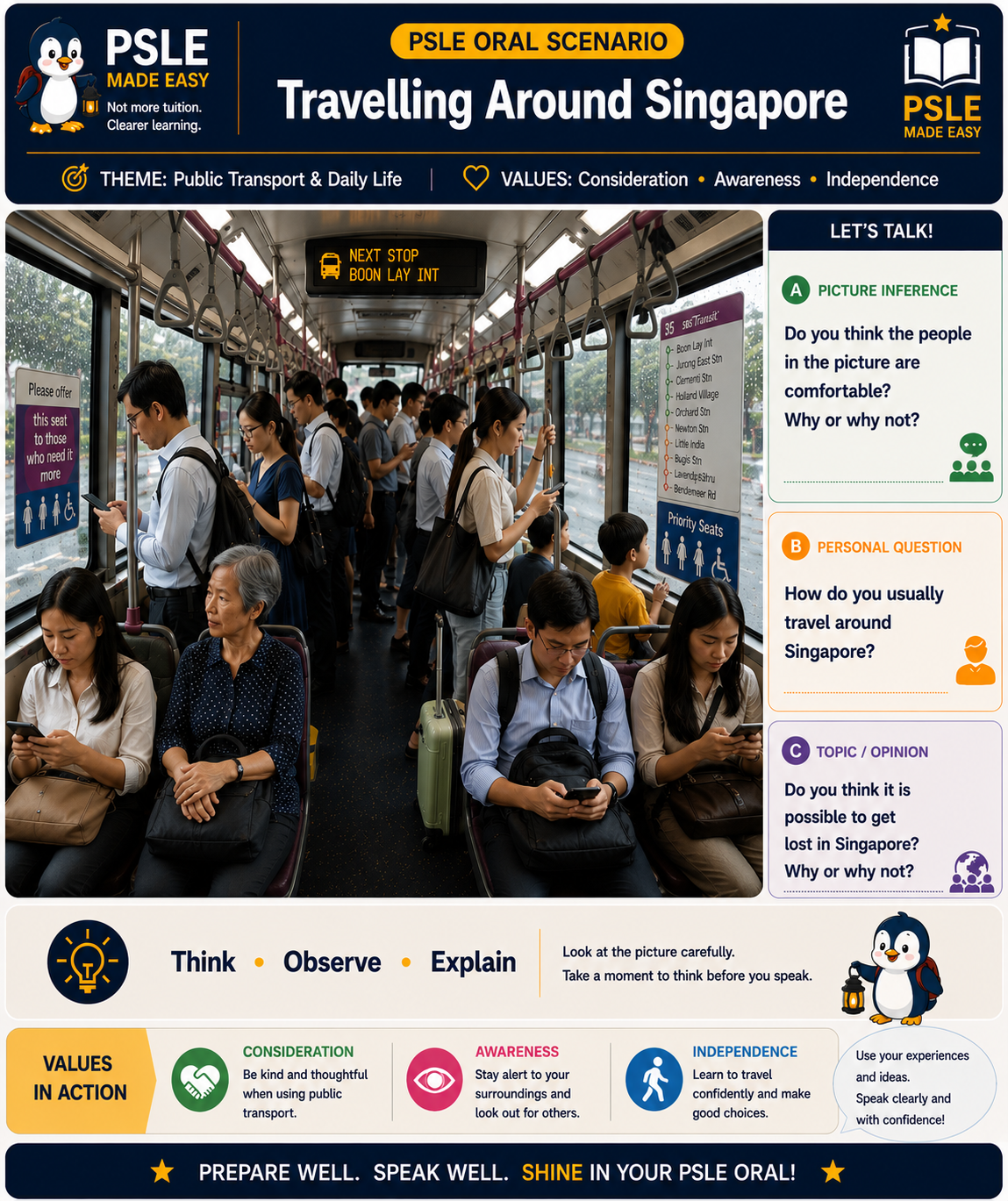
Before answering, scan the whole bus. Look at the seated passengers, the standing commuters, the signs, the weather outside and the way people are using the space.
What you can see
The bus is crowded. Several office workers are standing close together in the aisle while others are seated. Many passengers are looking at their phones, perhaps checking messages, reading or following their route.
An older passenger is seated near the front, while priority-seat signs and reminders to offer seats are visible. One commuter is travelling with luggage, and a child is looking out of the window instead of using a phone.
Rain can be seen outside the bus. The next-stop display and route information show how public transport gives passengers information to help them find their way.
What to notice for Q(a): This is a Feelings-type Q(a) — it asks you to infer how people feel from what you can see, not just describe the scene. Use picture evidence first, then infer comfort. Different passengers may feel differently, so your answer does not have to treat everyone the same.
② Q(a) — Feelings Type ▼
The Question
“Do you think the people in the picture are comfortable? Why or why not?”
You can give a balanced answer. Some seated passengers may be comfortable, while people standing in a crowded aisle may feel tired or cramped. The important part is to support your inference with what you can see.
Picture evidence you can use
- The aisle is crowded — standing passengers have little personal space and may have to balance while the bus is moving.
- Some passengers have seats — they may be more physically comfortable than those standing.
- Several commuters are carrying bags — holding bags while standing can make the journey more tiring.
- Many passengers are focused on their phones — this may help them pass the time even if the ride itself is crowded.
- The rainy weather outside — despite the crowd, being inside the bus may still feel more comfortable than walking in the rain.
What a weak answer sounds like
“No, they are not comfortable because the bus is crowded.”
The answer gives a clear opinion, but it uses only one general observation and treats every passenger as if they are having the same experience.
What a stronger answer sounds like
“I think some of the people are comfortable, but others probably are not. The passengers who have seats can rest and use their phones, so their journey may be quite comfortable. However, many office workers are standing close together in the aisle while carrying bags. They have less personal space and also need to hold on while the bus is moving, so they may feel tired or cramped. At the same time, it is raining outside, so even a crowded bus may still feel better than having to walk in the rain. This shows that comfort can depend on the passenger and the situation.”
Why this works: It uses several visible details, recognises different perspectives and explains why comfort is not the same for every passenger.
Going Beyond — add this
“I also think passengers can make a crowded journey more comfortable for one another by moving in, keeping bags out of the way and offering seats to people who need them more.”
③ Q(b) — Personal Question ▼
The Question
“How do you usually travel around Singapore?”
Describe your real routine. Say how you usually travel, where you commonly go and why that method works for you. A personal answer becomes stronger when it includes a real example rather than a list of transport types.
Experiences you could draw on
- Taking a public bus to school, tuition or a nearby shopping centre.
- Using the MRT for longer journeys.
- Walking or cycling for short neighbourhood trips.
- Travelling with family by car or taxi.
- Changing between bus and MRT when travelling somewhere unfamiliar.
What a weak answer sounds like
“I usually take the bus or MRT because they are convenient.”
The answer is relevant, but it gives no real routine or experience.
What a stronger answer sounds like
“I usually travel by bus because there is a bus stop near my home and it takes me directly to many places I go regularly. For longer journeys, I normally take a bus to the MRT station and continue by train. When I first started travelling without my parents, I used to keep checking the map because I was worried about missing my stop. Now I am much more confident because I recognise the routes I use often. Learning to travel by myself has made me more independent because I do not always need an adult to bring me somewhere.”
Why this works: It describes a genuine travel routine, includes a personal learning experience and connects travelling to greater independence.
Going Beyond — add this
“Travelling on my own also made me pay more attention to my surroundings because I cannot simply follow an adult and assume they know where to go.”
④ Q(c) — Broader Opinion ▼
The Question
“Do you think it is possible to get lost in Singapore? Why or why not?”
Avoid giving a simple “no, because Singapore is small”. Think about both sides. Singapore has clear signs, maps and navigation tools, but people can still become confused in unfamiliar places.
What a weak answer sounds like
“No, I do not think it is possible because Singapore is small and there are many signs.”
This gives one side only and does not consider situations where someone could still become confused.
What a stronger answer sounds like
“Yes, I think it is still possible to get lost in Singapore, even though our transport system is well organised. Someone may take the wrong bus, miss a stop or get confused in a large interchange or an unfamiliar neighbourhood. Navigation apps and signs make it much easier to recover, but we cannot depend on technology completely because a phone battery can run out or the signal may not work properly. I think the important skill is not never getting lost. It is staying calm, checking the information around you and knowing how to ask for help when you need it.”
Why this works: It considers both Singapore’s strong transport system and realistic situations where someone can still lose their way, then reframes the issue as one of problem-solving and independence.
Going Beyond — add this
“A visitor to Singapore may also find the same journey much harder than a local person, because knowing a place well is an advantage that we sometimes forget we have.”
⑤ Going Beyond Yourself — for This Topic ▼
Travelling is not only about getting from one place to another. It can teach awareness, independence, consideration and problem-solving.
After answering, ask yourself: What has travelling taught me beyond knowing a route?
How my thinking has changed
Ask: “What did I used to think about travelling on my own?”
“I used to think travelling independently was mainly about remembering which bus or train to take. Now I realise it is also about noticing signs, planning ahead and knowing what to do when something unexpected happens.”
Thinking about other passengers
Ask: “Who may find a crowded journey harder than I do?”
“A crowded bus may only be inconvenient for me, but it can be much more difficult for an elderly person, someone carrying a baby or a passenger with a disability. That makes small acts of consideration more important.”
What this makes me want to become
Ask: “What kind of traveller do I want to be?”
“I want to be confident enough to travel independently, but also aware enough to notice when someone around me needs help.”
⑥ Values to Anchor Your Answers To ▼
Consideration, Awareness and Independence each give your answer a different direction beyond simply saying that Singapore has convenient public transport.
🤝 Consideration
Consideration means remembering that a shared public space becomes more comfortable when passengers think about the needs of other people.
Anchor line: “A comfortable journey depends partly on the transport system and partly on how passengers treat one another.”
👀 Awareness
Awareness means paying attention to stops, signs, announcements and the people around you instead of depending completely on someone else or on your phone.
Anchor line: “Knowing where you are begins with noticing what is around you.”
🚶 Independence
Independence means being able to plan a journey, make decisions and respond calmly when something does not go according to plan.
Anchor line: “Being independent does not mean never needing help. It means knowing how to move forward when you are unsure.”
“Do not just describe the bus or say Singapore is easy to travel around. Use what you can see, connect it to your own experience, and show what travelling teaches us about awareness, consideration and independence.”