Crack Grammar Without Guessing
A student-friendly guide to identifying grammar types, spotting clues and choosing answers with reason.

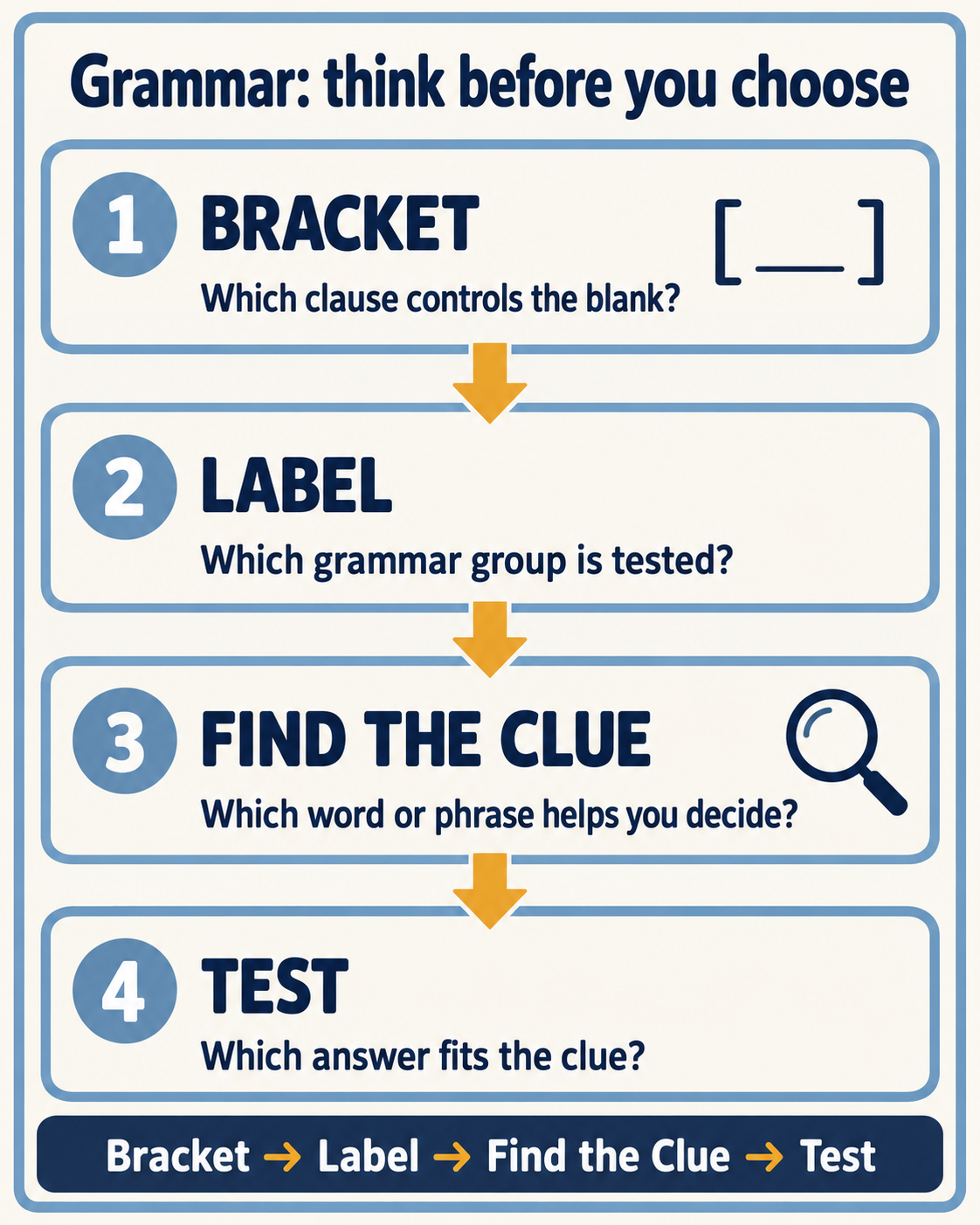
② The 4-Step Method
Apply this to every Grammar MCQ question:
- Bracket the working clause [ ] — identify which part of the sentence the blank belongs to.
- Label the grammar group — which of the 7 groups does this question test?
- Circle the clue phrase ( ) — find the word or phrase in the sentence that tells you the answer.
- Test and eliminate options — check each option against the clue and eliminate wrong answers.
“Never choose an answer before finding the clue. The clue is always there.”
Worked example — an earlier past action
① Remote Past — Past Perfect Tense
Formula: had + past participle
When: Action completed BEFORE another past action
Example: She had eaten before he arrived.
Grammar is not about memorising random rules blindly. It is about learning how to notice clues in the sentence.
Every Grammar MCQ question belongs to one of 7 grammar groups. Identify the group first, find the clue, then choose the answer with reason — not guesswork.
① The 7 Grammar Groups
Every Grammar MCQ question belongs to one of these 7 groups. Label the group before doing anything else.
- Verb phrases and tenses — what tense does the timeline require?
- Subject-verb agreement — who is the true subject? Is it singular or plural?
- Pronouns — who or what is being referred to?
- Determiners — what article or quantity word fits?
- Prepositions — what relationship between the noun and the action?
- Connectors — what is the relationship between the two ideas?
- Question tags and modal suggestions — positive or negative? Which modal?
“Name the group first. The clue becomes easier to find once you know what you are looking for.”
③ Verb Tense Chronology
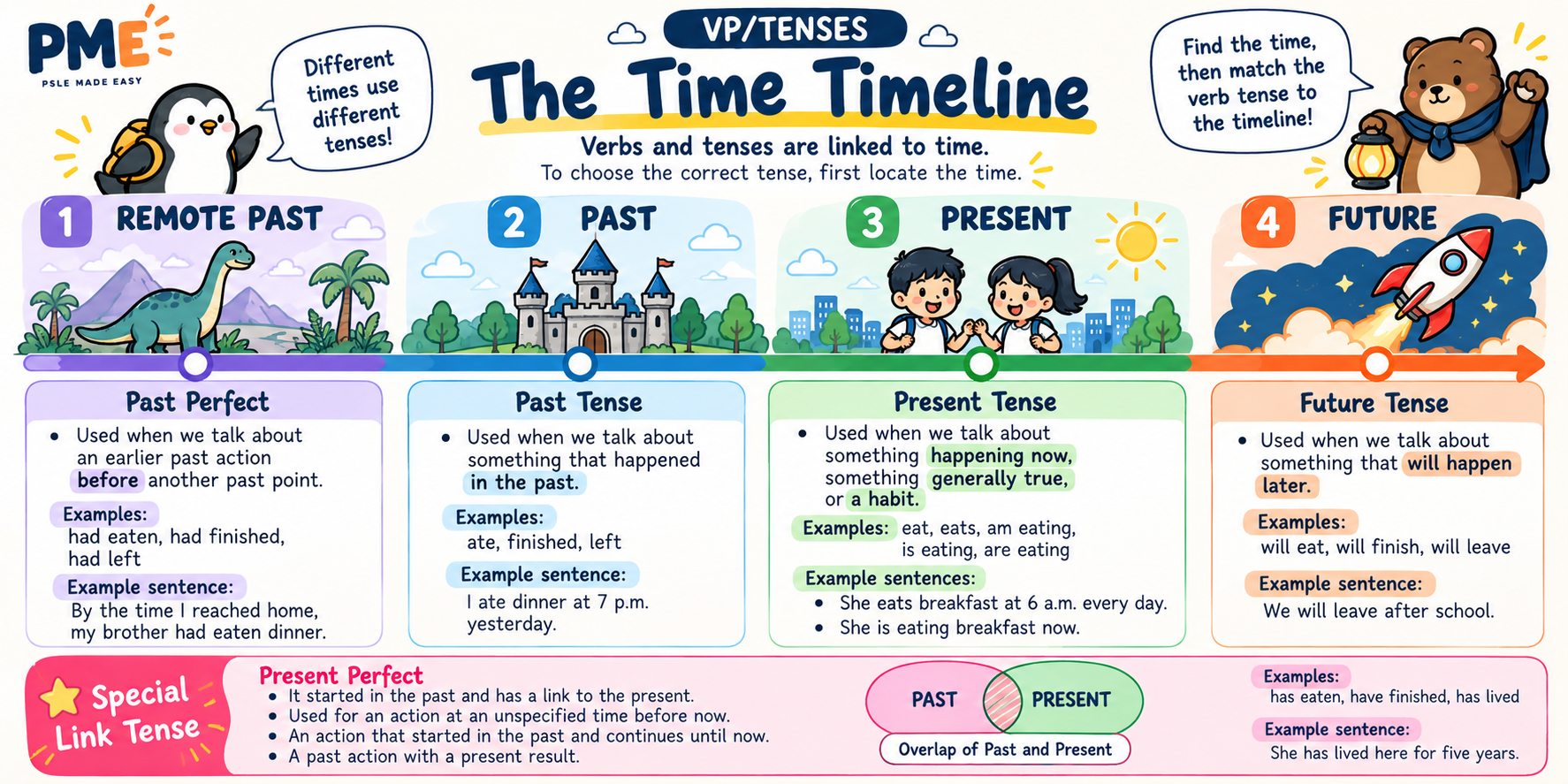
The timeline defines when actions happen. Understand the relationship between these key tenses.
② Past — Past Tense
Formula: verb (past form)
When: Completed action at a specific time in the past
Example: She ate breakfast yesterday.
③ Present — Present Tense
Formula: base verb / verb + s
When: General facts, habits or current actions
Example: She reads every day.
④ Future — Future Tense
Formula: will + base verb
When: Action that will happen later
Example: She will read tomorrow.
⑤ Blue Bridge — Present Perfect Tense
Formula: has / have + past participle
When: Connects the past to NOW — action started in the past, still relevant now
Example: She has prepared breakfast.
“The timeline defines when. Remote Past = had. Blue Bridge = has/have. They are not the same.”
④ Grammar Cloze Tips
Grammar Cloze uses the same 7 groups. The difference is that each word can only be used once.
- Each word can only be used once — plan before committing.
- Start with the easiest blanks to use up obvious answers first.
- Look before and after the blank for clues.
- Read the full sentence after filling to check it sounds right.
“In Grammar Cloze, elimination matters. The more blanks you fill correctly, the fewer choices remain.”
⑤ Practice
Use this Wayground practice link to practise Grammar questions: Open Grammar Practice.