How to Build an AL1 Learner
Strong results need more than more work. They need precision, awareness, maturity and growing independence.
What changes when a strong pupil wants to move further?
The journey is not simply “do more”
Methods and practice matter. But eventually the quality of the learner becomes increasingly important.
1 The score reality
A pupil can already be performing strongly and still remain some distance from AL1. Consider this example:
If Writing, Listening and Oral remained at 45, 20 and 37, Paper 2 would need to rise from 70 to at least 78 / 90 for the total to reach 180 / 200.
2 Why 70/90 can become a breakthrough gateway
From a PME teaching perspective, around 70 / 90 can feel like a common gateway for stronger Paper 2 pupils.
/90 Gateway
Reaching this range often means that many basic methods are already working. The pupil may recognise common question types, use familiar strategies and complete practice competently.
Moving beyond it may require improvement in areas such as:
- careful reading
- grammar stability
- vocabulary sense in context
- deeper inference
- answer precision
- recognising repeated mistakes
- independent checking
3 The PME Six-Pillar Framework
AL1 is a score band. The six areas below are a PSLE Made Easy teaching framework for thinking about the habits and abilities that can support strong English performance.
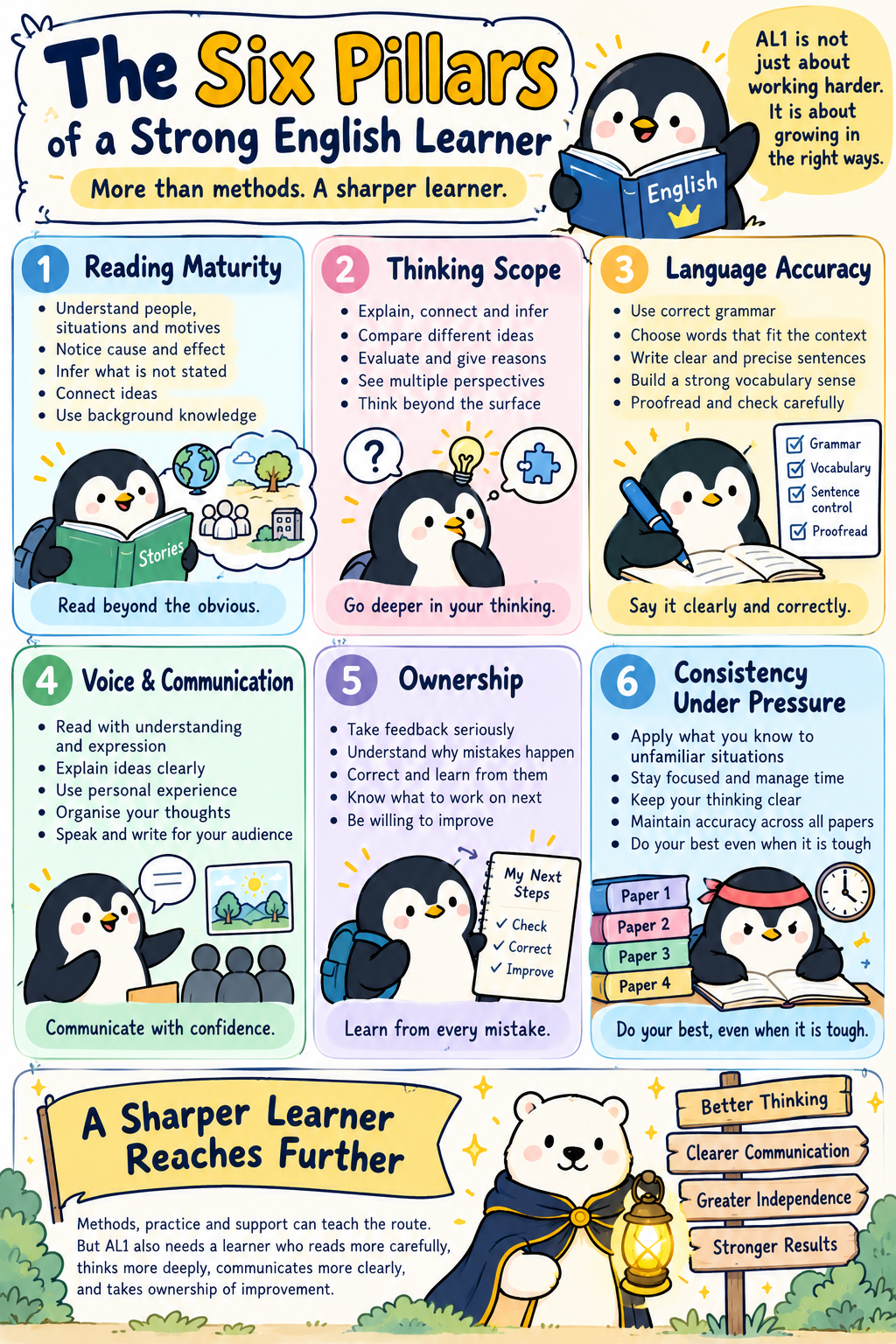
4 What does this look like across the four papers?
Paper 1 — Writing
Structure and useful phrases help. But stronger writing also requires purpose, audience awareness, story sense, character motivation, pacing and language that fits the situation.
Paper 2 — Language Use & Comprehension
Grammar must become stable, vocabulary must fit the context, and comprehension requires pupils to track information, infer meaning and answer precisely.
Paper 3 — Listening
Strong listening requires sustained attention, immediate processing, memory for detail and the discipline to keep following the message without controlling the pace.
Paper 4 — Oral Communication
Reading Aloud is about communicating meaning, not merely pronouncing words. Conversation requires pupils to develop ideas, explain experiences and communicate naturally.
5 What changes from strong AL2 towards AL1?
A strong pupil may already be doing many things correctly. The next step is often not simply doing more work. It is improving the quality of the thinking behind the work.
| Strong learner | Growing towards greater consistency |
|---|---|
| Completes practice | Studies the pattern behind mistakes |
| Knows a method | Understands when and why to use it |
| Answers the question | Answers precisely and relevantly |
| Uses good vocabulary | Chooses language that fits the context |
| Reads the passage | Tracks motives, causes, consequences and implications |
| Accepts correction | Uses correction to become more independent |
6 The independence test
One useful sign of progress is what happens after the pupil makes a mistake.
7 What can change now?
The next step does not always have to be another worksheet.
For Parents
- Ask what keeps causing marks to be lost.
- Encourage reading beyond assigned schoolwork.
- Discuss real situations, choices and consequences.
- Ask the child to explain corrections.
- Choose support that develops independence.
For Pupils
- After a mistake, ask: Why did I make it?
- After reading, ask: What is really happening?
- After Oral, ask: Did I explain or merely answer?
- After Writing, ask: Did my language fit the story?
- Identify the weakness that keeps returning.
Go deeper
The main idea is already above. Open these sections if you want to think more deeply about particular components.
Why methodology alone may reach a limit
Method matters. Pupils need strategies for comprehension, synthesis, editing, cloze, visual text, writing, oral and listening.
But knowing a method does not guarantee that the pupil will read accurately, interpret an unfamiliar situation, choose precise vocabulary or recognise a subtle inference.
Method provides a route. The learner still has to develop the judgement needed to travel it well.
Why Oral needs more than a memorised structure
A strong Oral response is not merely longer. It develops an idea clearly and naturally.
Pupils may need personal experience, social awareness, empathy, examples and the confidence to explain what they really think.
Reading Aloud similarly requires more than correct pronunciation. The pupil should understand and communicate the meaning of the text.
Why Writing needs story sense
Useful phrases can strengthen expression, but they cannot replace the story itself.
Strong Continuous Writing also depends on character motivation, believable reactions, meaningful development, pacing and emotional control.
Good language should serve the story, not draw attention away from it.
Build the learner, not just the score
Academic support can teach methods, provide feedback and reveal weaknesses. The pupil must gradually learn to use that support to become more aware, precise and independent.