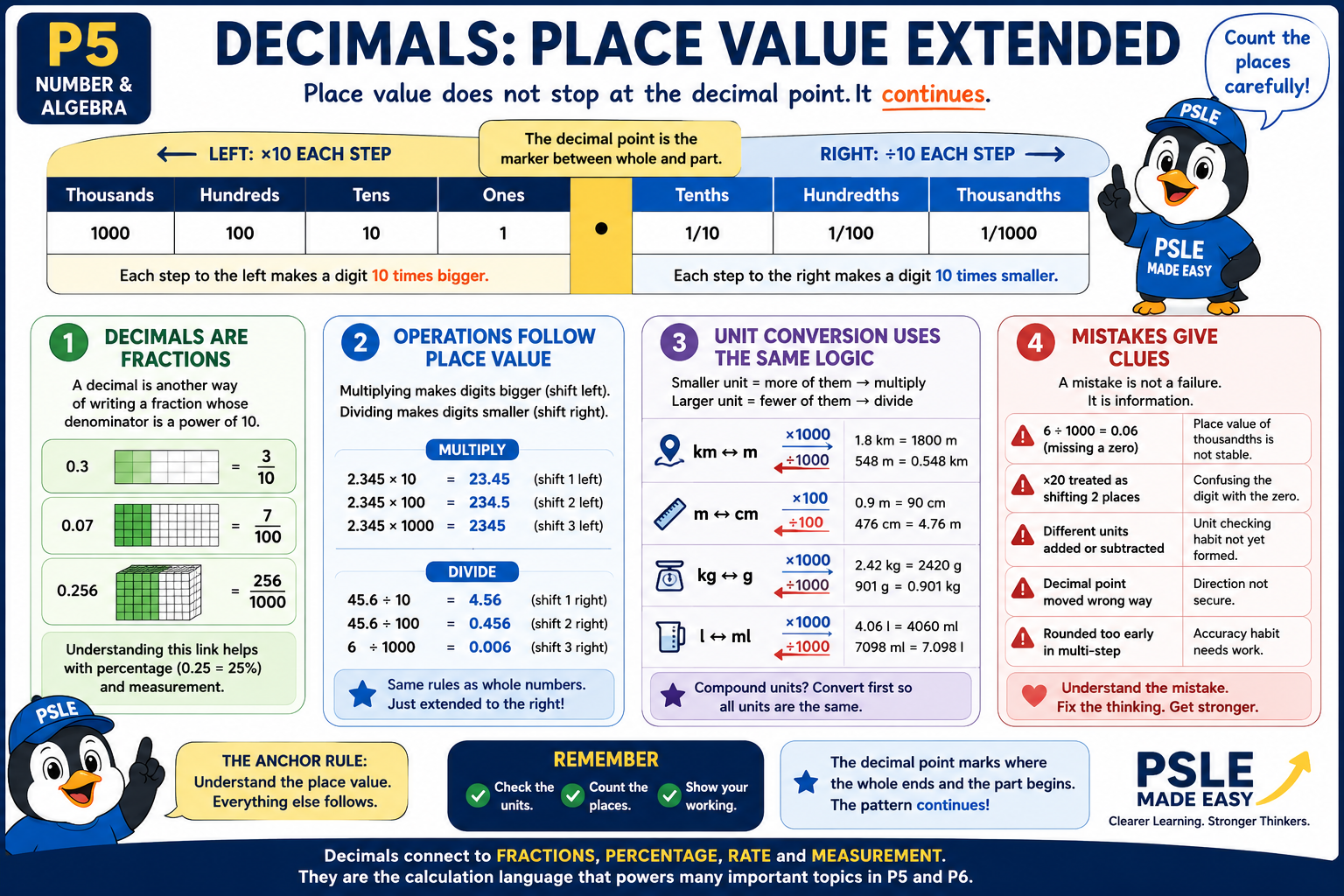
Decimals
You already understand this. You just haven’t seen it this way yet.
Decimals are not a new topic.
They are place value extended to the right of the ones column.
Just as we count thousands, hundreds, tens and ones going left — we count tenths, hundredths and thousandths going right. The pattern does not stop at the decimal point. It continues.
And those tenths, hundredths and thousandths are fractions — 1/10, 1/100, 1/1000. So 0.3 is simply 3/10. 0.07 is simply 7/100. A decimal is another way of writing a fraction whose denominator is a power of 10.
This means the four operations on decimals work exactly the same way as whole numbers. Same methods. Same logic. Just extended.
“A decimal is not a strange new number. It is a part of a whole — written differently.”
Parent Note
Many children struggle with P5 decimals not because the topic is hard, but because they see it as something entirely new to memorise.
It is not new. Your child learned place value in P3 and P4. Decimals are the same idea extended — the pattern simply continues past the ones column into tenths, hundredths and thousandths.
When your child hesitates on a decimal question, the most useful question you can ask is not “what is the method?” It is: “what does this digit represent?” If they can name the place value, the calculation usually follows.
The bigger picture: decimals connect directly to fractions (0.5 = 1/2), to percentage (0.35 = 35%) and to measurement (1.8 km = 1800 m). A child who understands decimals as a part-whole relationship — not just a calculation rule — will find these later topics much easier to handle.
Student Note
“You already know place value. Decimals are the same pattern going the other way.”
“0.3 is not a mystery. It is three-tenths. A fraction. Part of a whole.”
“When you understand what each digit means, the question becomes clearer.”
⓪ Before We Begin: What Decimals Actually Are
Look at this place value chart:
| Thousands | Hundreds | Tens | Ones | · | Tenths | Hundredths | Thousandths |
| 1000 | 100 | 10 | 1 | . | 1/10 | 1/100 | 1/1000 |
| ×10 each step left | ÷10 each step right |
Each step to the left makes a digit 10 times bigger. Each step to the right makes a digit 10 times smaller. The decimal point is simply the marker between whole and part.
So when we write 3.047:
- 3 is in the ones place → 3 whole units
- 0 is in the tenths place → 0 tenths
- 4 is in the hundredths place → 4/100
- 7 is in the thousandths place → 7/1000
The four operations work exactly the same way as whole numbers. P5 simply extends what your child already knows.
“The decimal point does not change the rules. It marks where the whole ends and the part begins.”
① Multiplying by 10, 100 and 1000
When we multiply a number by 10, every digit becomes 10 times its value. This means each digit shifts one place to the left on the place value chart.
Multiply by 100 → shift two places left. Multiply by 1000 → shift three places left.
Primary Method — Place Value Shift
2.345 × 10 = 23.45 → digits shift 1 place left
2.345 × 100 = 234.5 → digits shift 2 places left
2.345 × 1000 = 2345 → digits shift 3 places left
Why does this work? Because multiplying by 10 makes every digit 10 times bigger — which is exactly what moving one place to the left means on a place value chart.
Another Way to See This — Decimal Point Movement
Some students prefer to think of the decimal point moving instead of the digits shifting. The result is the same.
2.345 × 10 → decimal point moves 1 place right → 23.45
2.345 × 100 → decimal point moves 2 places right → 234.5
2.345 × 1000 → decimal point moves 3 places right → 2345.
Both methods give the same answer. The place value shift is the more accurate way to think about it — but use whichever feels clearer to you.
“Multiply by 10 → each digit becomes 10 times bigger → shifts one place left. The rule is always the same.”
② Multiplying by Tens, Hundreds and Thousands
What about multiplying by 20, 300 or 5000? Break the multiplier into two parts — the digit and the power of 10 — then handle them separately.
Primary Method — Two-Step Split
1.4 × 20
Step 1: 1.4 × 2 = 2.8 (multiply by the digit)
Step 2: 2.8 × 10 = 28 (multiply by the power of 10)
8.25 × 5000
Step 1: 8.25 × 5 = 41.25
Step 2: 41.25 × 1000 = 41 250
Another Way to See This — Count the Zeros
Count the zeros in the multiplier — that tells you how many places to shift after multiplying by the digit.
×20 → 1 zero → multiply by 2, then shift 1 place left
×300 → 2 zeros → multiply by 3, then shift 2 places left
×5000 → 3 zeros → multiply by 5, then shift 3 places left
This works because 20 = 2 × 10, 300 = 3 × 100, and so on.
Watch out:
×20 shifts 1 place, not 2. The 2 is the digit — you multiply by it. The 0 tells you the shift. Do not confuse the two.
“Split the multiplier. Handle the digit first, then apply the place value shift.”
③ Dividing by 10, 100 and 1000
Division is the reverse. Dividing by 10 makes every digit 10 times smaller — each digit shifts one place to the right on the place value chart.
Primary Method — Place Value Shift
45.6 ÷ 10 = 4.56 → digits shift 1 place right
45.6 ÷ 100 = 0.456 → digits shift 2 places right
6 ÷ 1000 = 0.006 → digits shift 3 places right
Notice 6 ÷ 1000 = 0.006. The digit 6 moves three places to the right. Two placeholder zeros must be written. This is where many students lose marks — they drop one zero and write 0.06 instead.
Another Way to See This — Fraction Thinking
Because decimals are fractions, dividing by 1000 is the same as writing the number over 1000.
6 ÷ 1000 = 6/1000 = 0.006
4.5 ÷ 100 = 4.5/100 = 45/1000 = 0.045
This approach reminds students that decimals and fractions are the same idea — and helps them check whether their answer is reasonable.
Watch out:
6 ÷ 1000 = 0.006 — not 0.06. Count the places carefully. Write placeholder zeros. Every zero matters.
“Divide by 10 → each digit becomes 10 times smaller → shifts one place right. Do not drop the zeros.”
④ Dividing by Tens, Hundreds and Thousands
Same logic as multiplying by multiples — split the divisor into the digit and the power of 10, then handle them in two steps.
Primary Method — Two-Step Split
8.4 ÷ 40
Step 1: 8.4 ÷ 4 = 2.1 (divide by the digit)
Step 2: 2.1 ÷ 10 = 0.21 (divide by the power of 10)
100.4 ÷ 400
Step 1: 100.4 ÷ 4 = 25.1
Step 2: 25.1 ÷ 100 = 0.251
Another Way to See This — Count the Zeros
Count the zeros in the divisor — that tells you how many places to shift after dividing by the digit.
÷40 → 1 zero → divide by 4, then shift 1 place right
÷400 → 2 zeros → divide by 4, then shift 2 places right
÷8000 → 3 zeros → divide by 8, then shift 3 places right
“Split the divisor. Divide by the digit first, then apply the place value shift.”
⑤ Converting Measurements
Unit conversion is place value shift applied to measurement. The rule is simple and always the same:
| Conversion | Larger → Smaller | Smaller → Larger | Example ↓ | Example ↑ |
| km ↔ m | × 1000 | ÷ 1000 | 1.8 km = 1800 m | 548 m = 0.548 km |
| m ↔ cm | × 100 | ÷ 100 | 0.9 m = 90 cm | 476 cm = 4.76 m |
| kg ↔ g | × 1000 | ÷ 1000 | 2.42 kg = 2420 g | 901 g = 0.901 kg |
| l ↔ ml | × 1000 | ÷ 1000 | 4.06 l = 4060 ml | 7098 ml = 7.098 l |
The anchor rule: converting to a smaller unit means more of them — so multiply. Converting to a larger unit means fewer of them — so divide.
Compound Units
3 km 45 m → 3 km + 45 m → 3 km + 0.045 km → 3.045 km
7.308 kg → 7 kg + 0.308 kg → 7 kg + 308 g → 7 kg 308 g
Another Way to See This — Use Place Value Directly
Think of the unit as the ones column. Everything smaller is a decimal of that unit.
If km is the ones column: 1 m = 0.001 km (one thousandth of a km).
So 45 m = 45 × 0.001 km = 0.045 km.
This connects directly back to place value — no new rule needed.
“Smaller unit = multiply. Larger unit = divide. Same rule every time.”
⑥ Word Problems
Word problems test whether students can identify the correct operation and manage units. The Maths is rarely the hard part — reading the question carefully is.
Before Every Word Problem — Three Questions
- What are the units? Are they the same?
- What is the question actually asking me to find?
- How many steps does this need?
Worked Example:
A roll of wire is 3.5 m long. John cuts 85 cm from it. How much wire is left? Give your answer in metres.
Step 1: Convert units — 85 cm = 0.85 m
Step 2: 3.5 − 0.85 = 2.65 m
Watch out:
Never add or subtract quantities with different units. Convert first — always.
“Check the units before you calculate. A wrong unit gives a wrong answer even when the Maths is correct.”
⑦ What Your Mistakes Are Telling You
A mistake is not a failure. It is information. Here is what the most common decimal errors are actually telling you — and what to do about them.
| The Mistake | What It Is Telling You | What to Do |
| 6 ÷ 1000 = 0.06 instead of 0.006 | Place value of thousandths is not stable | Draw the place value chart. Count each shift deliberately. |
| ×20 treated as shifting 2 places | Confusing the digit with the zero | Remind yourself: the zero shows the shift; the 2 is the multiplier. Two separate steps. |
| Adding 2.5 kg + 820 g without converting | Unit checking habit not yet formed | Make it a habit: underline the units before every calculation. |
| Decimal point moved the wrong way | Multiply vs divide direction not secure | Estimate first. 2.3 × 10 must be bigger than 2.3. If your answer is smaller, the direction is wrong. |
| Rounding intermediate steps too early | Accuracy not yet a habit in multi-step problems | Keep full precision until the last step. Round only the final answer. |
“A mistake that you understand is progress. A mistake you ignore will come back.”
⑧ Where Decimals Fit on the Number Spine
Decimals are not on the Number Spine as a standalone step. They are the calculation language that powers it.
The Connection
Decimals ↔ Fractions: 0.25 = 1/4. Same relationship, different notation. This connection must be solid before percentage work begins.
Decimals → Rate: Almost every rate problem involves decimals in measurement — litres per minute, km per hour, cost per unit. Decimal fluency is non-negotiable for Rate.
Decimals → Percentage: Percentage conversions move through decimals. 35% = 0.35. Students who are weak on decimals will stumble at every percentage conversion.
Decimals → P6 and beyond: Algebra, ratio, proportion — all require students to handle decimal values confidently in multi-step problems.
“The topic tells you where the question comes from. The relationship tells you how to solve it.”
Already have Koobits through school?
Use it intentionally for decimal practice — not random questions, but targeted by place value and operation. Find out how.
Using Koobits Well →Sources and Further Reading
- PSLE Mathematics 2026 syllabus: SEAB PSLE Mathematics 0008
- Primary Mathematics syllabus: MOE Primary Mathematics Syllabus
- Star Publishing Primary Mathematics 5B (2025 edition) — Chapters 7
“Do not just chase marks. Build the kind of learner who can earn them.”