
PME MATHS · FREE TEACHING GUIDE
How PME Sees Maths
See the Whole. Understand the Parts.
A question can look new while using a relationship you already know. Start by finding what each quantity means.
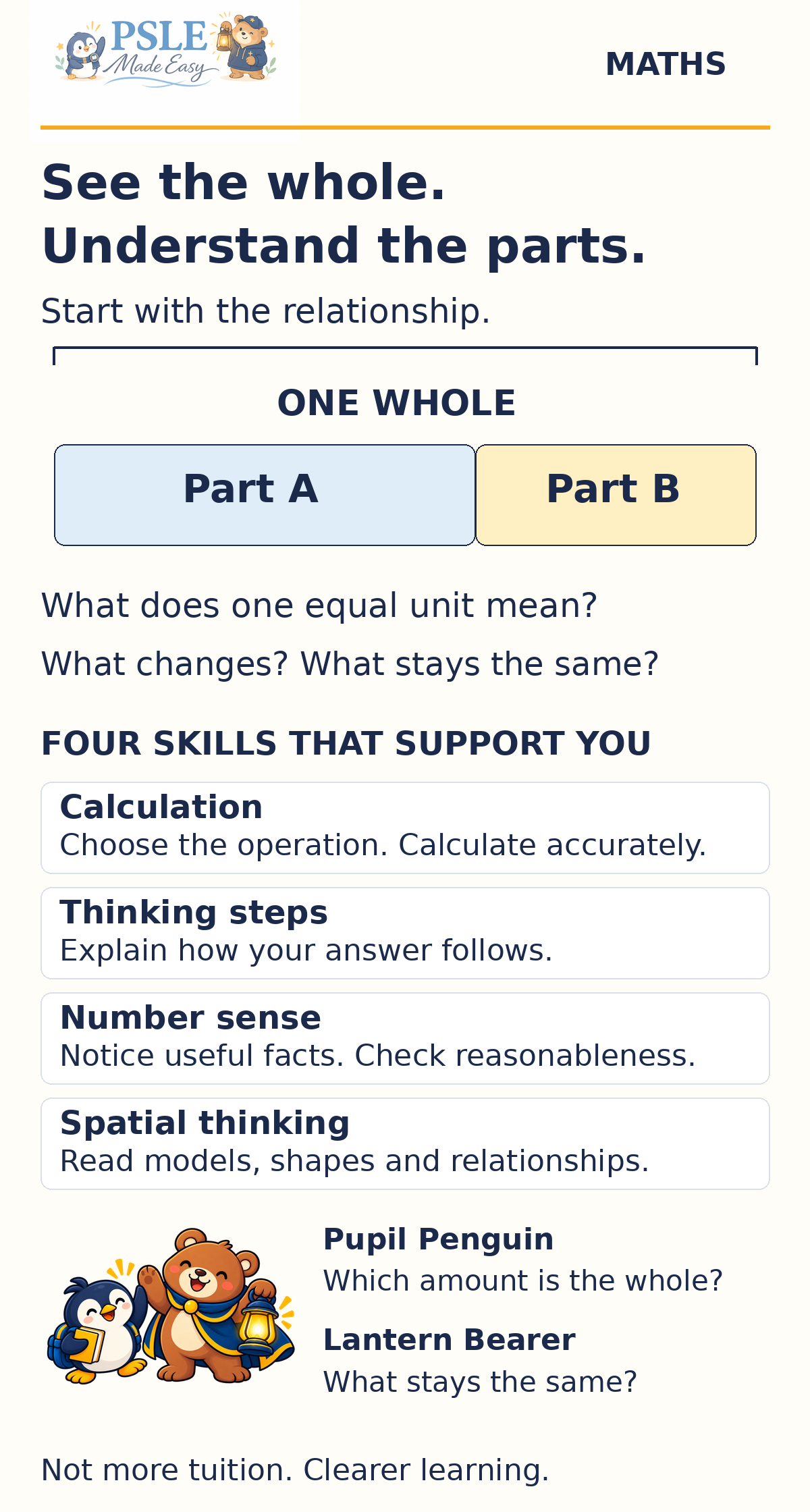
Find the relationship before calculating
Whole → parts → units → comparison or change. First identify the reference whole: the amount you are treating as one complete set. Name the parts, then decide what one equal unit means.
Ask whether you are comparing one part with another, a part with the whole, or an amount before and after a change. This helps you choose an operation that fits the situation.
A ratio of 3:2 compares two parts. If those parts make up the entire set, the whole is 5 units. If other groups exist, check what is included before calling 5 units the whole.
Fractions, decimals, percentages, model units and pie-chart angles can describe the same part of the same whole. Always ask: “A fraction or percentage of which amount?”
1. The parts change. The total stays.
Ada and Ben have $50 altogether, in the ratio 3:2. Ada gives Ben $5.
Before: 5 equal units represent the whole $50. One unit is $50 ÷ 5 = $10.
After: Ada has $30 − $5 = $25. Ben has $20 + $5 = $25.
New ratio = 25:25 = 1:1 · Total = $50
The transfer changes their individual amounts, but no money enters or leaves the pair. The total stays $50. In the new ratio, 1 unit is $25; the old ratio unit was $10. A unit belongs to the comparison you are using.
2. A fraction of a new whole
Mira spends of her money, then of the remainder. What fraction of her original money is left?
First spending: Split the original whole into 4 equal parts. Spend 1; keep 3.
Second spending: The remainder is now the reference whole. Divide that remainder into 3 equal parts and spend 2 of them.
Second spending = × = of the original money.
Left = × = of the original money.
The denominator 3 divides the remainder into equal parts. It does not divide the original amount into thirds. Here, each of those parts is of the original money.
Four skills support this thinking
Calculate accurately
Knowing which operation to use and carrying it out are different skills. Locate the specific error: a number fact, place value, regrouping or an operation. Use a purposeful check.
Account for the thinking
Mental working is still working. Fewer written lines can contain sound reasoning. Explain why the answer follows and record enough to check it: a step not written is not necessarily missing; a step not considered is missing.
Build number sense
Notice factors, multiples, squares, equivalents, place value and complements to 10, 100 or 1000. Estimate and check whether an answer is reasonable.
See spatial relationships
Read models, shapes, angles, nets, area and volume carefully. Geometry needs its own properties and reasoning; the whole-and-parts lens does not solve every Maths question.
Does an area of 64 always mean sides of 8?
For a square with area 64 square units, 8 × 8 tells us each side is 8 units. A rectangle with area 64 could instead be 4 by 16. Use the conditions in the question alongside the number fact.
What should I check when my answer goes wrong?
Ask: Did I choose the right whole? Did I confuse part:part with part:whole? Did a unit change meaning? Then check the operation and arithmetic. Fix the misunderstanding you find rather than repeating unrelated questions.