PSLE Science · Adaptations in action
How Do River Animals Survive?
River Wonders lets us explore how animals live in different freshwater habitats. Flowing water, flooded forests, riverbanks and muddy pools create different challenges.
Instead of memorising animal facts, learn to connect the challenge, the adaptation and the survival advantage.
For Pupils — Focus on These
- Notice the challenges of different river habitats.
- Identify adaptations that help animals survive.
- Explain how each adaptation provides an advantage.
The Big Idea: See the Connection
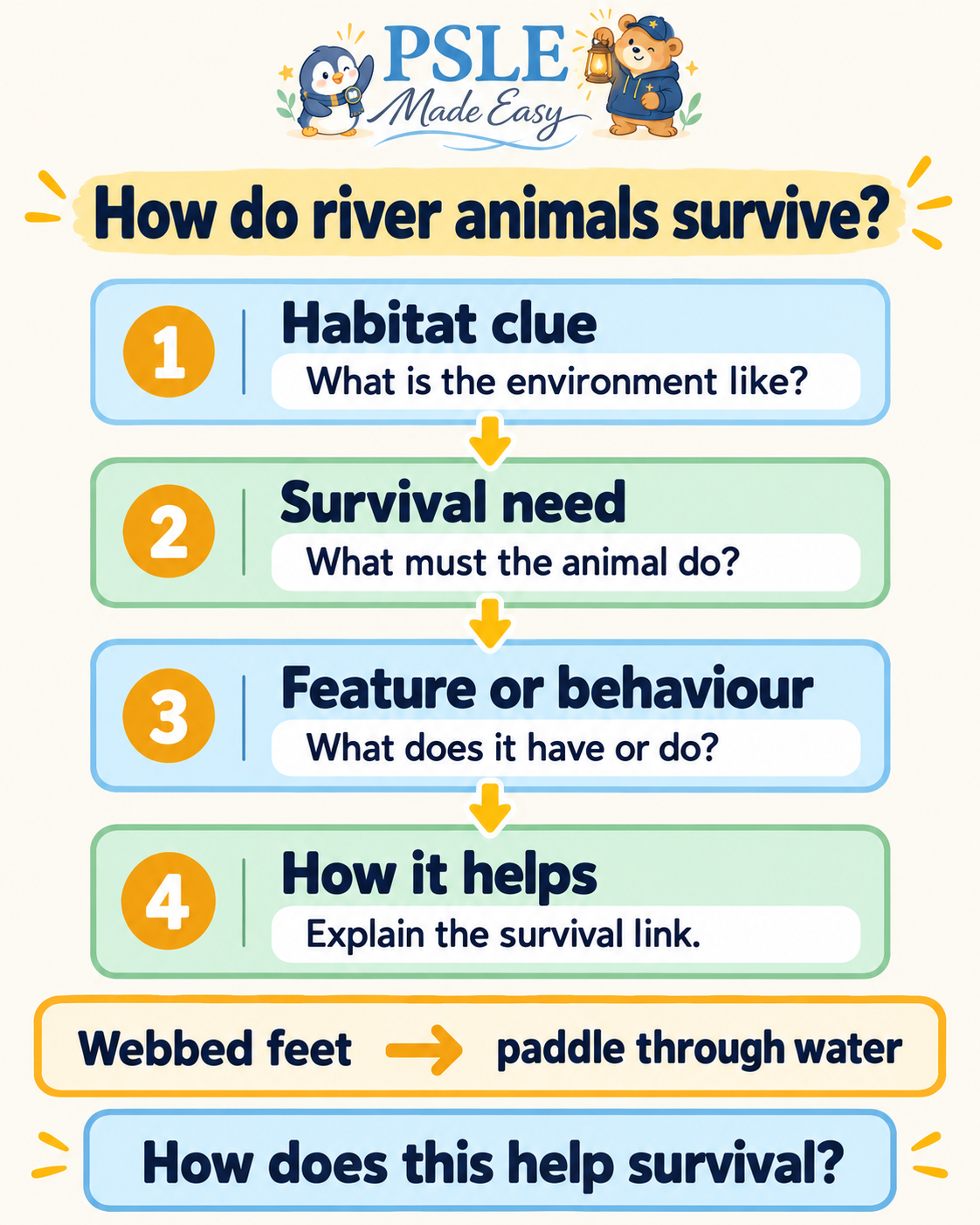
A habitat presents a problem for an organism. Its features or behaviours may help it respond to that problem.
Example: Murky water can make prey difficult to detect → an electric eel produces weak electrical signals → it can sense its surroundings → it has a better chance of finding food.
Explore River Habitats
Look at the surroundings before choosing an adaptation. Different parts of a river can present different challenges.
🌊 Water movement
Fast currents can push animals away. Calmer water may provide places to rest, feed or hide. Look for body shape, fins, gripping features and swimming behaviour.
🌧️ Changing water levels
Wet seasons can flood forests and connect pools; dry seasons expose new areas. Look for feeding, sheltering and movement as conditions change.
🌿 Riverbanks and roots
Vegetation, roots and rocks can offer places to shelter or search for food. Look for hiding, gripping, climbing and hunting behaviours.
💧 Freshwater conditions
Animals still need oxygen and food, and must avoid predators. Some water is deep, muddy or low in oxygen. Look for breathing and sensing features.
Look closer: six habitat clues from the original lesson
| Habitat clue | Challenge | What to investigate |
|---|---|---|
| Fast current | Being carried away or finding it hard to swim | Streamlined shape, strong fins, staying near sheltered areas |
| Deep water | Moving, feeding and obtaining oxygen underwater | Fins, gills, breath-holding or surfacing to breathe |
| Flooded forest | Water surrounds trees and changes where food is found | Swimming among plants and moving into newly flooded areas |
| Murky water | Difficulty seeing prey, shelter or danger | Touch, smell, water vibrations or electrical sensing |
| Riverbank vegetation | Need to hide or find food near the edge | Camouflage, shelters, burrows and quiet hunting |
| Open water | Greater exposure to predators | Schooling, rapid movement and alert behaviour |
These are clues to investigate, not a claim that every river animal has every feature.
River Wonders: Four Case Studies
For each example, identify what the habitat demands, then explain how a feature or behaviour may help. Mandai's current animal and zone pages support these links; the animals on display can change.
Amazon Flooded Forest
Giant River Otter
Electric Eel
Mekong Giant Catfish
Structural or Behavioural?
Structural = what it HAS
A body part or physical feature. For example, a giant river otter's webbed feet help it paddle through water; a streamlined fish body reduces water resistance.
Behavioural = what it DOES
An action or pattern of behaviour. For example, otters hunt together, or an animal hides among riverbank plants to avoid being noticed.
Think Like a Scientist
Use Concept → Evidence → Relate (CER) to make your explanation clear.
- Identify the concept: Is the question about an adaptation and survival?
- Examine the evidence: What habitat clue and animal feature or behaviour are given?
- Explain the connection: How does the feature or action work?
- Answer the question: State its survival advantage in that habitat.
Reusable answer frame: “The animal has / does [adaptation]. This helps it [function], so it can [survival advantage] in [habitat].” Adapt the wording to the evidence rather than copying it blindly.
Common PSLE Trap: Stopping at the Habitat
Simply describing the place does not explain the adaptation.
Not enough
“The animal lives in water with strong currents.”
This describes the habitat but says nothing about the animal's adaptation.
More complete
“A streamlined body reduces water resistance. This helps a fish swim more easily in moving water to find food or escape predators.”
It identifies a feature → function → advantage.
One more worked comparison
Weak: “The animal hides near plants.”
Improved: “Hiding among riverbank plants makes the animal harder for predators to spot. This helps it avoid danger.”
Here, the behaviour is hiding; the benefit is reduced detection by predators.
Remember
First see the habitat challenge. Then explain what the animal has or does, how it works, and how it helps survival. The same thinking works even when the animal changes.
For Parents — How You Can Help
Ask your child to describe one river habitat challenge before naming an adaptation. Then ask, “How does that feature or behaviour help the animal here?” Listen for the link between the animal's action or body feature and its survival advantage, rather than a list of memorised facts.
Examples are based on Mandai Wildlife Reserve — River Wonders, with animal facts verified against Mandai and scientific references. Check official exhibit information before visiting; animals on display may change.