A Visit to the Park
A Visit to the Park
Theme: Wildlife & Environment · Values: Respect, Responsibility, Caring
Parent Note
Wild animals in Singapore's parks — otters especially — are a topic children recognise instantly but rarely think through. "Don't disturb the animals" is true and also exactly what every other student will say.
What earns marks is a child who can point to the actual signage in the picture and reason about why those specific rules exist, plus a real memory of encountering an animal — even a small one like a squirrel or a stray cat — rather than a hypothetical.
Student Note
“The examiner has heard 'we should not disturb wild animals' a hundred times today. What they have not heard is you noticing what the sign actually says — and a real moment when you saw an animal and had to decide what to do.”
① Read the Picture First ▼
Before answering any question, spend ten seconds reading the picture properly. Not just "someone at a park." Look at exactly what the sign says and what that tells you about what's happening.
What you can see
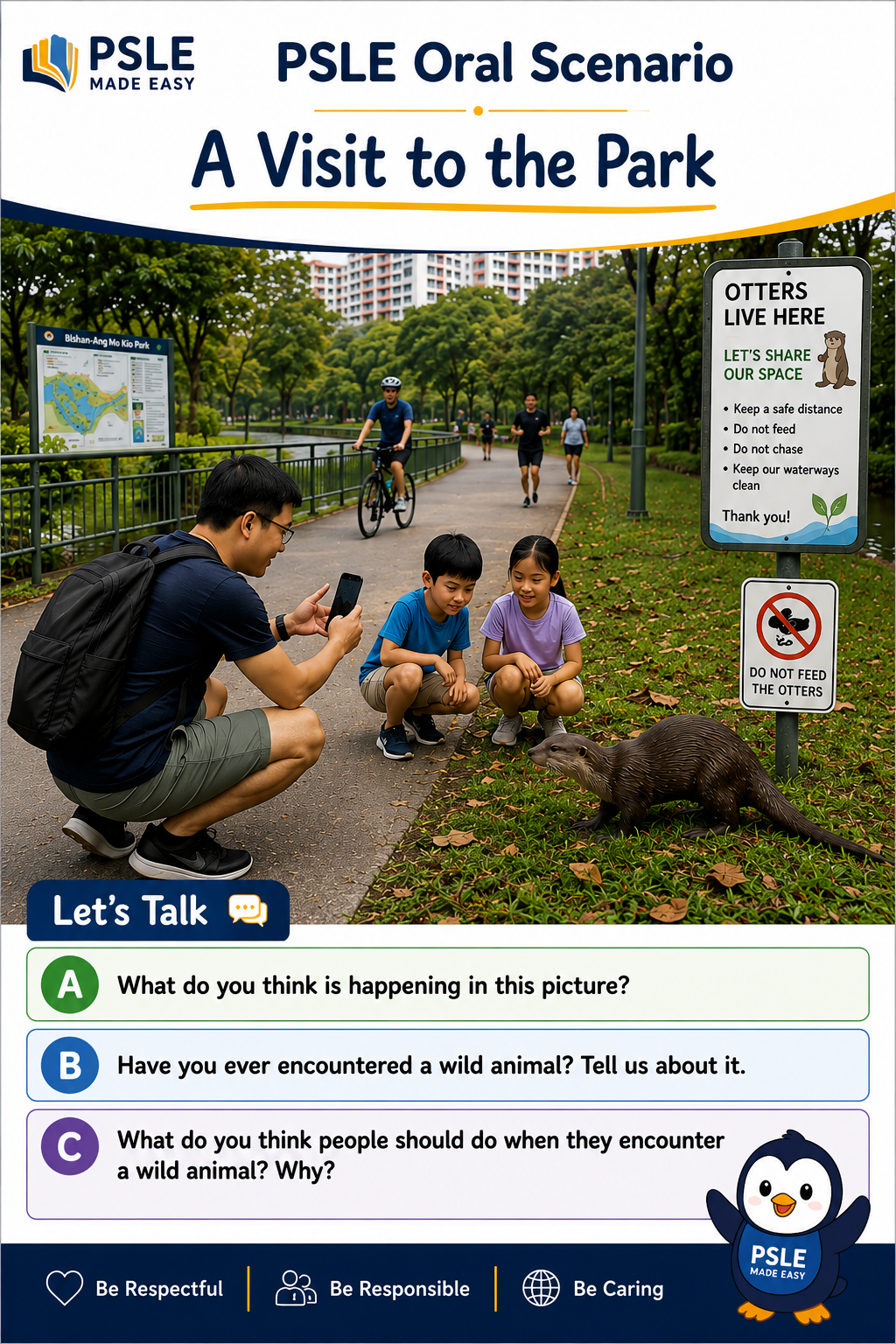
The scene is set at Bishan–Ang Mo Kio Park. A prominent sign reads "OTTERS LIVE HERE — LET'S SHARE OUR SPACE," with specific instructions: Keep a safe distance, Do not feed, Do not chase, Keep our waterways clean. A second, more direct sign says "DO NOT FEED THE OTTERS."
This isn't a generic "be kind to animals" scene — it's a specific park with a specific animal (otters) and specific, actionable rules, which gives you far more to work with than a vague nature scene would.
What to notice for Q(a): This Q(a) asks what is happening in the picture — a broad invitation to interpret the scene, not just list objects. Use the specific signage to explain what's going on, not a generic description of "a park."
② Q(a) — Action Type ▼
The Question
“What do you think is happening in this picture?”
This is a wide-open Action question, which is actually a trap — it invites a lazy, one-line answer. A strong response still narrows in on specific details rather than staying general.
Picture evidence you can use in your answer
- The "OTTERS LIVE HERE" sign — this tells you the park is a shared habitat, not just a recreation space.
- "LET'S SHARE OUR SPACE" — frames the relationship between people and wildlife as one of coexistence, not ownership.
- The specific rules listed: Keep a safe distance, Do not feed, Do not chase, Keep our waterways clean — each rule implies a specific way people have been getting this wrong.
- "DO NOT FEED THE OTTERS" repeated as its own standalone sign — suggests feeding wildlife is a common enough problem that it needed a second, more direct warning.
What a weak answer sounds like
“I think someone is walking in the park and seeing some animals.”
Technically true, but it ignores every sign in the picture. This answer could describe almost any park scene.
What a stronger answer sounds like
“I think someone is walking through Bishan–Ang Mo Kio Park and has come across the otter family that lives there. You can tell from the signs that this isn't a rare event — there's a whole set of rules posted, like keeping a safe distance and not feeding them, which means enough people must have gotten too close or fed the otters that the park needed to put up a clear warning. It looks like a moment where the person has to decide how to behave responsibly around wildlife that shares the same space as them.”
Why this works: Names the specific location and animal, and uses the existence of the rules themselves as evidence for what's actually happening — not just describing the scene at face value.
Going Beyond — add this
“I also think the phrase 'Let's share our space' is interesting — it suggests the park doesn't see this as humans tolerating animals, but as both having equal claim to the same environment.”
③ Q(b) — Personal Question ▼
The Question
“Have you ever encountered a wild animal? Tell us about it.”
Q(b) doesn't require an exotic story — a squirrel, a stray cat, a monitor lizard, or a wild boar sighting near a park connector all count. What matters is the specific moment and how you actually reacted, not how you think you should have reacted.
What a weak answer sounds like
“Yes, I have seen a wild animal before. I was careful and kept my distance.”
No animal named, no location, no real moment — just a summary that could apply to anyone.
What a stronger answer sounds like
“Once, while cycling along Bishan Park with my father, we suddenly saw a monitor lizard crossing the path right in front of us. I got a real shock and almost fell off my bike, but my father told me to just stop and wait calmly instead of screaming or trying to cycle around it quickly. We waited about a minute until it slowly moved into the grass. Afterwards my father explained that sudden movements could startle it and make it defensive, which was something I hadn't thought about before.”
Why this works: Specific location, specific animal, a real reaction (shock, almost falling), and a genuine lesson learned from someone else in the moment — not a rehearsed response.
Going Beyond — add this
“That moment changed how I react now. I used to think the safest thing to do was move away quickly. Now I know that staying calm and still is often safer than trying to escape.”
④ Q(c) — Broader Opinion ▼
The Question
“What do you think people should do when they encounter a wild animal? Why?”
Q(c) is asking for a general principle, not just "leave it alone." A stronger answer explains the reasoning behind the principle and acknowledges that the right response can depend on the animal and the situation.
What a weak answer sounds like
“People should not disturb wild animals and should leave them alone.”
A rule with no reasoning. It doesn't explain why, or acknowledge any nuance in different situations.
What a stronger answer sounds like
“I think people should stay calm, keep a safe distance, and never feed the animal, but exactly what 'safe distance' means depends on the animal — you'd give a wild boar much more space than a squirrel. The reason feeding is so harmful is that it teaches the animal to associate people with food, which can eventually make it more aggressive towards other people, or dependent on humans in a way that hurts its ability to survive naturally. So it's not just about our safety in that one moment — it actually affects the animal's whole future behaviour.”
Why this works: Gives a clear principle, acknowledges that the response should scale with the animal, and explains the actual reasoning behind the "do not feed" rule instead of just repeating it.
Going Beyond — add this
“I also think it matters who is watching. Children often copy what adults do around animals, so an adult who feeds an otter for a nice photo is teaching every child watching that it's acceptable, even if they never say a word.”
⑤ Going Beyond Yourself — for This Topic ▼
Wildlife encounters are a topic every Singaporean child has some experience with, thanks to how much nature sits inside our parks and estates. The way to stand out is to describe your own reaction honestly, not the "correct" reaction you know you're supposed to give.
Ask yourself: after sharing your personal encounter, can you take one more step?
How my thinking has changed
Ask: “What did I used to believe about wild animals that I no longer believe?”
“I used to think wild animals in a park were basically harmless and almost like pets. Now I understand they're still wild, and treating them casually — even just for a photo — can be dangerous for both of us.”
Realising others must feel this too
Ask: “Who else has to manage this same kind of encounter regularly?”
“It made me think about park rangers and NParks staff, who deal with this every single day, not just once. They must need a lot more patience than I do, explaining the same rules to visitors again and again.”
What this makes me want to become
Ask: “Did this change what I want to do or who I want to be?”
“It made me want to be someone who follows rules like these even when no one is watching — not because I'm afraid of getting in trouble, but because I actually understand why the rule exists.”
⑥ Values to Anchor Your Answers To ▼
The values on the infographic — Respect, Responsibility, Caring — are not just park rules. Each one gives your answer a different angle beyond "don't disturb the animals."
🙏 Respect
What it means in oral: respecting wildlife means recognising they have their own space and behaviour, not treating them as entertainment for a photo or video.
Anchor line: “Respecting an animal means letting it stay wild, not making it perform for us.”
📋 Responsibility
What it means in oral: responsibility means following the posted rules even when it's inconvenient — like keeping distance when you really want a closer photo.
Anchor line: “Being responsible around wildlife means my curiosity doesn't get to override a rule that protects both of us.”
💛 Caring
What it means in oral: caring about wildlife means thinking about their long-term wellbeing, not just the short-term joy of seeing them up close.
Anchor line: “Real care for an animal sometimes looks like keeping your distance, not getting closer.”
“Every student knows to say 'don't disturb wild animals.' The ones who score at Band 5 are the ones who can explain why the rule exists and describe a real moment they had to follow it.”