HOW PME SEES SCIENCE
How PME Sees Science
Science begins with understanding the world.
Observe. Inquire. Understand. Then show what you know in the examination.
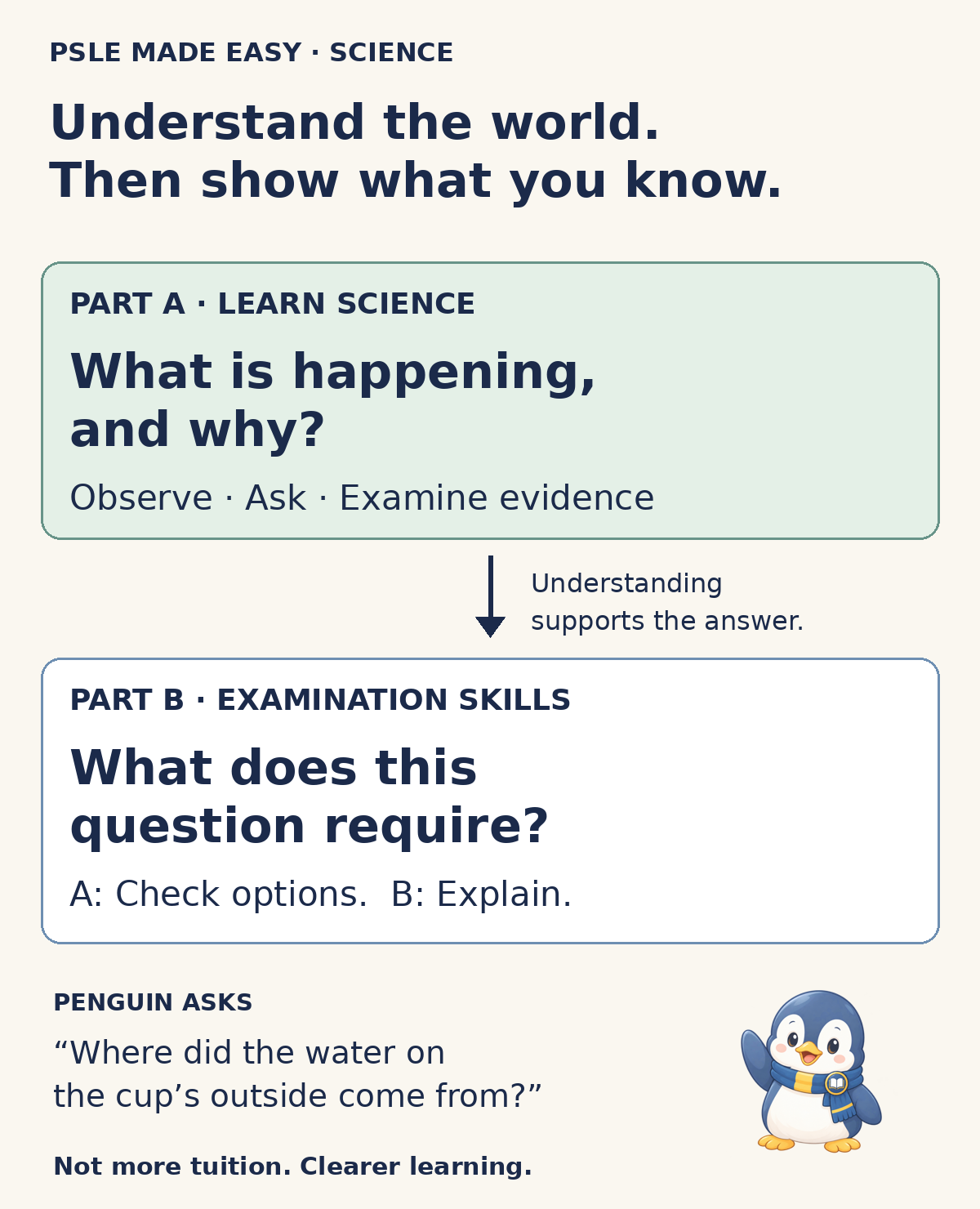
PART A · LEARN SCIENCE
Start with something you notice
Science helps us explain the world. Observe carefully, ask a useful question, and decide what evidence could help. Use accurate concepts to make an explanation, then check whether it fits the evidence.
You may move back and forth: a new observation can change your question or explanation. Inquiry is a flexible way of thinking, not a compulsory order of steps. It can involve an investigation, a diagram, a comparison or existing data.
Knowledge matters. Learn what scientific terms and processes mean, how they work, and the conditions in which they apply. Inquiry and concept knowledge support each other.
This approach reflects MOE’s 2023 Primary Science syllabus, including its emphasis on pupils as inquirers.
A cold cup. A useful question.
You notice tiny droplets on the outside of a cold cup. Where did the liquid water come from?
Observation
“I can see droplets on the outside.”
This reports something you can see. Record what actually happens.
Inference or explanation
“Water vapour condensed on the cold surface.”
This uses evidence and scientific knowledge to explain the observation.
What evidence would help?
Check for leaks or spills before deciding on a cause. With an adult, you could compare an intact, lidded plastic cup containing cold water with a similar cup containing room-temperature water. Start with dry outer surfaces, keep the surroundings and observation time the same, and record what you see.
This is a proposed comparison, not a report of measured results. Ask whether your observations support condensation, leakage or another explanation.
Connect the observation to the concept
Water vapour in the surrounding air can cool at the cold outer surface and condense into liquid water. The droplets need not have come through the cup wall. Whether droplets form depends on conditions, including the moisture in the air and how cold the surface is.
Science reference: USGS — Condensation and the Water Cycle.
PART B · EXAMINATION SKILLS
Show what you understand
An examination gives you a particular task. Your scientific understanding helps you decide what matters and explain it precisely. Examination routines help you show that understanding; they do not replace learning Science.
ORIGINAL PME TEACHING EXAMPLE · NOT A SEAB QUESTION
One situation, two different tasks
An intact plastic cup containing ice water has a sealed lid. Its outside is wiped dry and it is placed in warm, moist air. No water is spilled. Later, droplets appear on the outside.
Booklet A — check every option
Read the stem and its conditions. Identify the concept, then check all four options. Reject an option if it is scientifically wrong, only partly right, irrelevant or inconsistent with the situation. A familiar keyword is not enough.
Which explanation best fits the droplets?
Check the answer and all four options
B fits. The cold surface allows water vapour from the surrounding air to condense into liquid droplets.
- A: The stem describes an intact cup, not a leaking wall.
- B: It names the source, the cooling and the change to liquid water.
- C: Water vapour condenses; the air as a whole does not become liquid water.
- D: The visible droplets are liquid. Water vapour is the gaseous state.
Booklet B — unpack the task, then explain
First inspect the common stem: apparatus, variables, diagrams, observations and data can suggest relevant concepts. Anticipate possible concepts; do not decide the answer before reading each sub-question.
Read the exact demand, select relevant evidence, explain the Science and relate it back to what was asked. Check that you have not added an unsupported claim.
Explain why liquid water forms on the outside of the cup.
- Concept
- Condensation: water vapour changes into liquid water when sufficiently cooled.
- Evidence
- The cup has a cold outer surface and is in moist air. The cup is intact and sealed; no water was spilled.
- Relate
- Explain how water vapour from the surrounding air forms liquid droplets on that cold outside surface.
Water vapour in the surrounding air cools at the cold outer surface and condenses into liquid water, forming droplets on the outside of the cup.
Concept → Evidence → Relate is PME’s thinking reminder. It is not a requirement to write three labelled sentences. If a different sub-question asks you to compare, predict or suggest a fair test, answer that task.
Is CER new in 2026?
Two reminders, with different meanings
In published Science education, CER means Claim → Evidence → Reasoning: state an answer or conclusion, support it with evidence, and explain scientifically why that evidence supports it.
PME’s Concept → Evidence → Relate reminder foregrounds the scientific concept and the exact question. It is a different mnemonic. Neither should be presented here as an official requirement to write every PSLE answer in three labelled sentences.
What changed, and what did not?
The PSLE Science examination format was revised for 2026 and assesses the MOE 2023 syllabus. For 2026 Standard Science (0009), Booklet A has 30 MCQs worth 60 marks; Booklet B has 10–11 structured questions worth 40 marks. The paper lasts 1 hour 45 minutes. See SEAB’s format for examination from 2026 and its 2026 formats listing.
Scientific inquiry and evidence-based explanations are older ideas. MOE’s 2014 Primary Science syllabus already emphasised inquiry and evidence. McNeill, Lizotte, Krajcik and Marx’s 2006 study of scientific explanations explicitly discussed claim, evidence and reasoning.
Frameworks can organise thinking. They do not replace scientific understanding.
Exam reference checked 22 November 2026. This is a dated 2026 reference, not an independently confirmed 2027 format. Check the relevant year with SEAB.